


Why Stock Broker Registration Protects Your Money
Stock broker registration is the legal process that ensures anyone selling securities or managing trades on your behalf is qualified, licensed, and accountable to regulators.
Here’s a quick overview of what you need to know:
| What You Want to Do | Where to Go |
|---|---|
| Verify a broker’s license (U.S.) | FINRA BrokerCheck |
| Check an investment adviser | SEC IAPD |
| Find barred brokers | FINRA Barred Individuals List |
| Contact your state regulator | NASAA State Regulator Directory |
| Look up SEC enforcement actions | SEC Action Lookup |
The stakes are real. The Central Registration Depository (CRD) holds records on more than 650,000 stockbrokers, and the Investment Adviser Registration Depository (IARD) covers more than 260,000 investment advisers — yet not every person calling themselves a broker is actually registered.
As NASAA puts it plainly: while the vast majority of stockbrokers are honest, there are those who are not.
That’s exactly why knowing how to check a broker’s registration status before handing over your money is one of the smartest moves you can make.
I’m Faisal S. Chughtai, founder of ActiveX, with hands-on experience navigating digital platforms, regulatory tools, and financial technology — including the systems used for stock broker registration verification. In the sections below, I’ll walk you through everything you need to know, step by step.
Glossary for stock broker registration:
Understanding the Basics of Stock Broker Registration
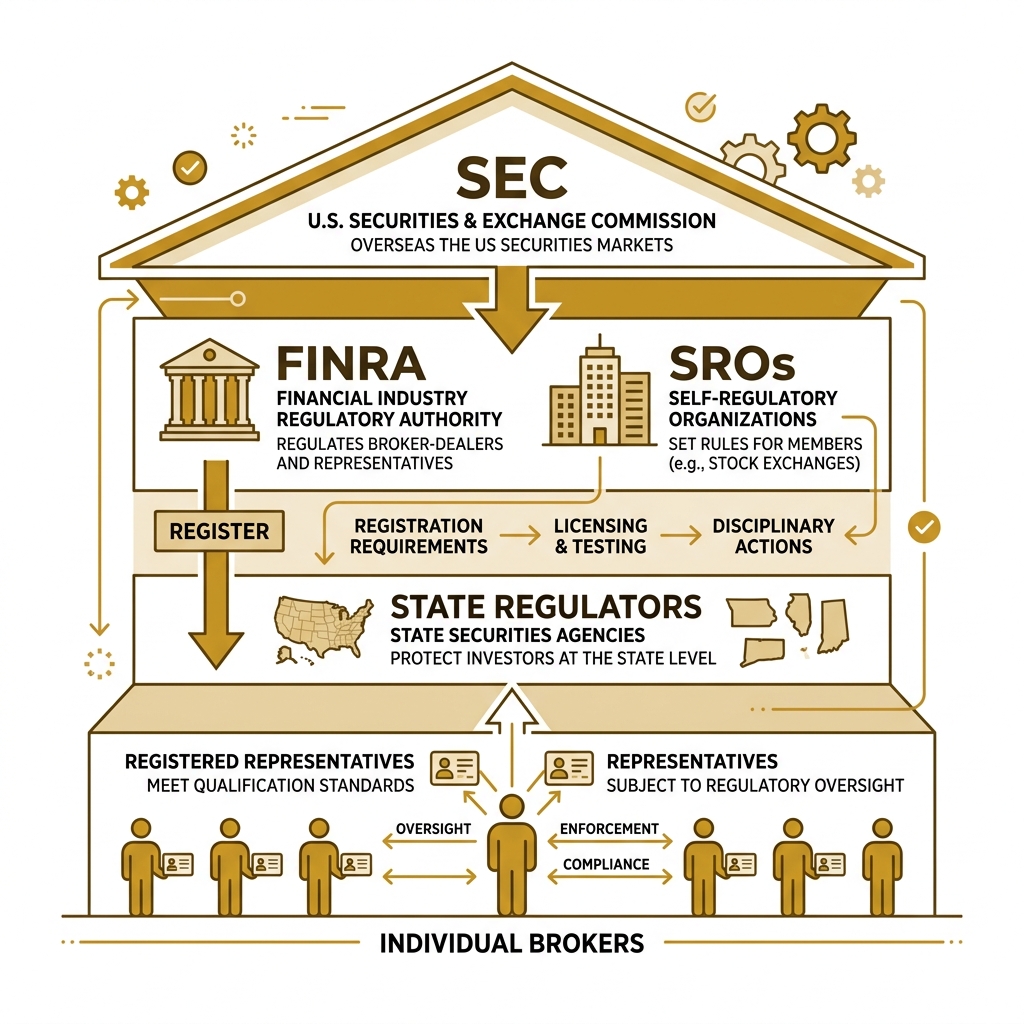
When we talk about stock broker registration, we are diving into the heart of the Securities Exchange Act of 1934. This landmark legislation governs the way securities markets and their participants operate in the United States. At its core, the law requires that most people or firms acting as “brokers” or “dealers” register with the Securities and Exchange Commission (SEC).

But the SEC doesn’t work alone. They are joined by Self-Regulatory Organizations (SROs), primarily the Financial Industry Regulatory Authority (FINRA). Think of the SEC as the high-level architect and FINRA as the boots-on-the-ground inspector ensuring every firm follows the blueprint. For a deeper dive into these rules, the SEC’s Guide to Broker-Dealer Registration serves as the primary manual for the industry.
Who is Required to Register?
If you are in the business of “effecting transactions in securities for the account of others,” you are likely a broker. This sounds technical, but it basically means if you are helping people buy or sell stocks, bonds, or mutual funds and getting paid for it, you need to be registered.
This requirement isn’t just for the massive firms you see on TV; it applies to anyone who handles customer funds or securities. Whether you are a retail salesperson, a branch manager, or even an investment banker, the law is clear: you must be registered before you can conduct securities business with the public. If you’re just starting out as an investor, checking this registration is the first step in The Ultimate Guide to Picking Your First Stock Market Broker.
Exemptions from Stock Broker Registration
Now, the law does provide a few “hall passes” or exemptions, though they are quite narrow.
- Intrastate Business: If a broker-dealer only conducts business within a single state and doesn’t use any “interstate commerce” (like a national exchange), they might be exempt from SEC registration. However, they still have to follow state laws. Pro tip: These firms often use website disclaimers to ensure they don’t accidentally attract out-of-state clients.
- Bank Exceptions: Under the Gramm-Leach-Bliley Act, banks have specific exceptions for certain activities. However, if they step outside those bounds, their subsidiaries must register.
- Issuer Exclusion: Generally, a company selling its own stock (the “issuer”) isn’t considered a broker. Their employees can sometimes help sell these shares without registering, provided they meet strict criteria under SEC Rule 3a4-1 details, such as not being paid a commission for the sales.
- Foreign Brokers: Foreign firms that limit their activities with U.S. investors can sometimes rely on Rule 15a-6 to avoid full U.S. registration.
Key Differences Between Brokers and Dealers
In the industry, we often use the term “broker-dealer” as if it’s one word. However, “broker” and “dealer” actually refer to two different hats a firm can wear.
| Feature | Broker (Acting as Agent) | Dealer (Acting as Principal) |
|---|---|---|
| Primary Role | Executes trades for others | Trades for its own account |
| Compensation | Commissions | Markups or Markdowns |
| Inventory | Does not hold the security | Holds an inventory of securities |
| Risk | Low (matching buyers/sellers) | High (market price fluctuations) |
When a firm acts as a broker, they are your agent. They go out into the market, find the stock you want, and charge you a commission for the service. When they act as a dealer, they are the principal. They are selling you a stock they already own (or buying one from you to keep). Instead of a commission, they make money on the “spread”—the difference between what they paid and what they sell it to you for.
How to Verify a Stock Broker Registration Using Public Databases
We live in an era where you can verify a professional’s credentials in seconds. You wouldn’t hire a surgeon without checking their board certification, and you shouldn’t hire a trader without checking the stock broker registration records.
The primary tool for this is BrokerCheck, maintained by FINRA. It draws data from the Central Registration Depository (CRD), a massive database containing the “permanent record” of every registered broker in the U.S. If you are looking for an investment adviser (someone who gets paid for advice rather than just executing trades), you should use the Investment Adviser Public Disclosure (IAPD) website. These tools are essential when Finding the Best Stock Broker Platform for Your Portfolio.
Checking Disciplinary History and Barred Individuals
A registration “active” status is good, but it’s not the whole story. You want to look for “red flags.” BrokerCheck and the IAPD will show you:
- Regulatory Actions: Has the SEC or FINRA fined or suspended them?
- Customer Complaints: Are there formal grievances or arbitrations on file?
- Employment History: Have they hopped between ten different firms in five years?
For the most serious offenders, you can browse the list of brokers barred by FINRA. These are individuals who have been banned from the industry. Additionally, the SEC Action Lookup tool allows you to see if the federal government has taken formal legal action against a person or firm.
Verifying International and State-Level Stock Broker Registration
Don’t forget the local level! Every state has its own securities regulator. These offices often have information that might not show up on national databases, such as local civil litigation or specific state-level disciplinary actions. You can find your local contact through the state securities regulators directory provided by NASAA.
For our neighbors to the north, Canada uses the National Registration Search. The OSC Registrant List for Ontario is often maintained separately, so be sure to check both if you are dealing with a Canadian firm.
The Registration Process and Required Qualifications
Becoming a registered broker-dealer is no walk in the park. It requires a firm to pass a rigorous “Standards of Admission” review.
- Form BD: This is the uniform application for broker-dealer registration. It’s filed through the CRD and shared with the SEC, SROs, and states.
- SRO Membership: A firm must join an SRO, usually FINRA. This involves a New Member Application (NMA) process that can take up to 180 days.
- SIPC Insurance: Almost all registered broker-dealers must join the Securities Investor Protection Corporation (SIPC). This provides a safety net for customers if the firm fails, covering up to $500,000 per customer (including a $100,000 limit for cash).
If you’re wondering which firms have survived this gauntlet, check out our analysis on Which Massive Brokerage Should You Actually Use?.
Essential Exams for Stock Broker Registration
Individual brokers (associated persons) have their own hurdles. They must pass qualification exams to prove they actually know what they are talking about.
- SIE Exam: The Securities Industry Essentials exam is the “intro” test. You don’t even need a firm to sponsor you to take it!
- Series 7: This is the “General Securities Representative” exam. It’s the big one that allows you to sell almost any type of security. It does require firm sponsorship via a Form U4.
- Series 63: Known as the Uniform Securities Agent State Law Examination, the NASAA Series 63 is required by most states. If you aren’t sponsored yet, you can use Form U10 to apply for this specific exam.
Financial Responsibility and Customer Protection
Regulators want to make sure a broker doesn’t just disappear with your money. To prevent this, firms must follow strict financial responsibility rules:
- Net Capital Rule (Rule 15c3-1): Firms must maintain a minimum amount of liquid assets. If their “net capital” drops too low, they have to stop doing business.
- Customer Protection Rule (Rule 15c3-3): This requires brokers to keep customer funds and securities separate from the firm’s own money. This prevents them from using your cash to pay their own rent.
- AML Programs: Under the Bank Secrecy Act, firms must have Anti-Money Laundering (AML) programs to spot and report suspicious activity.
Even in The Zero Commission Dream: A Guide to Free Stock Trading, these underlying safety rules still apply.
Conduct Standards and Ongoing Obligations
Once a firm completes its stock broker registration, the work has just begun. They are subject to a high standard of conduct:
- Suitability: A broker can’t just sell you any old stock. They must have a “reasonable basis” to believe a recommendation is suitable for your specific financial situation and goals.
- Best Execution: They are legally required to seek the most favorable terms reasonably available for your trades.
- Antifraud Rules: Sections 10(b) and 15(c) of the Exchange Act prohibit manipulative or deceptive acts.
Ongoing obligations include meticulous recordkeeping under Rule 17a-3 and 17a-4. Every trade, every piece of correspondence, and every customer complaint must be archived. This transparency is why keeping an eye on market leaders matters; for example, understanding Why the Apple Stock Price Today Matters for Your Future is easier when you know your broker is providing honest, regulated data.
Frequently Asked Questions about Stock Broker Registration
How do I know if a broker is legitimate?
The gold standard is checking FINRA BrokerCheck. If they aren’t listed there, or if their status is “not regulated,” you should be extremely cautious. Always cross-reference this with your state securities regulator to be 100% sure.
What is the difference between a broker and an investment adviser?
A broker generally executes trades and is paid through commissions (the “suitability” standard). An investment adviser provides ongoing financial advice and is usually paid a flat fee or a percentage of assets under management. Advisers are held to a “fiduciary” standard, meaning they must put your interests above their own at all times.
How can a broker terminate their registration?
When a broker leaves the industry or a firm closes, they must file a Form U5 (Uniform Termination Notice). This officially ends their registration with that specific firm. If they don’t join a new firm within two years, their licenses may expire, requiring them to retake the exams.
Conclusion
At Apex Observer News, we believe that an informed investor is a safe investor. Navigating stock broker registration might seem like wading through a sea of alphabet soup—SEC, FINRA, CRD, SIPC—but these organizations are the walls and gates that protect your financial future.
Before you make your next trade, take five minutes to run your broker’s name through the databases we’ve discussed. Regulatory transparency is your greatest ally in the quest for wealth building. For more insights and the latest updates on the financial world, check out More info about stock market news. Happy (and safe) trading!
