

AI in Education Is Reshaping How Students Learn — Here’s What You Need to Know
AI in education is the use of artificial intelligence tools to personalize learning, automate teacher tasks, and improve student outcomes across K-12 and higher education.
Here’s a quick snapshot of where things stand right now:
| What’s Happening | Key Fact |
|---|---|
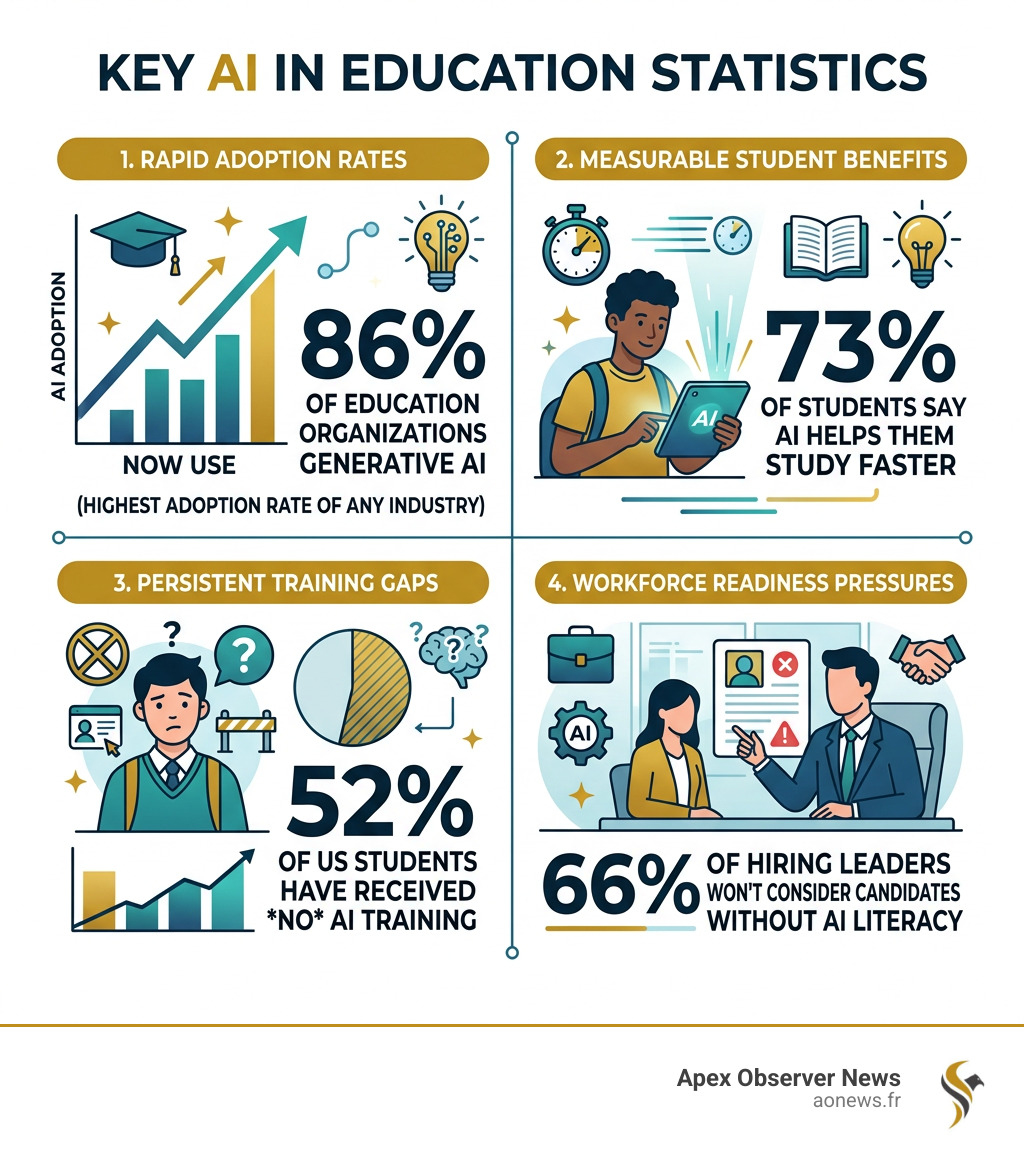
| Adoption rate | 86% of education organizations now use generative AI — the highest of any industry |
| Student impact | 73% of students say AI helps them study faster |
| Teacher time savings | AI could free up to 13 hours per week for educators |
| Training gap | 52% of US students have received no AI training at all |
| Workforce pressure | 66% of hiring leaders won’t consider candidates without AI literacy skills |
AI is already inside classrooms — whether schools planned for it or not.
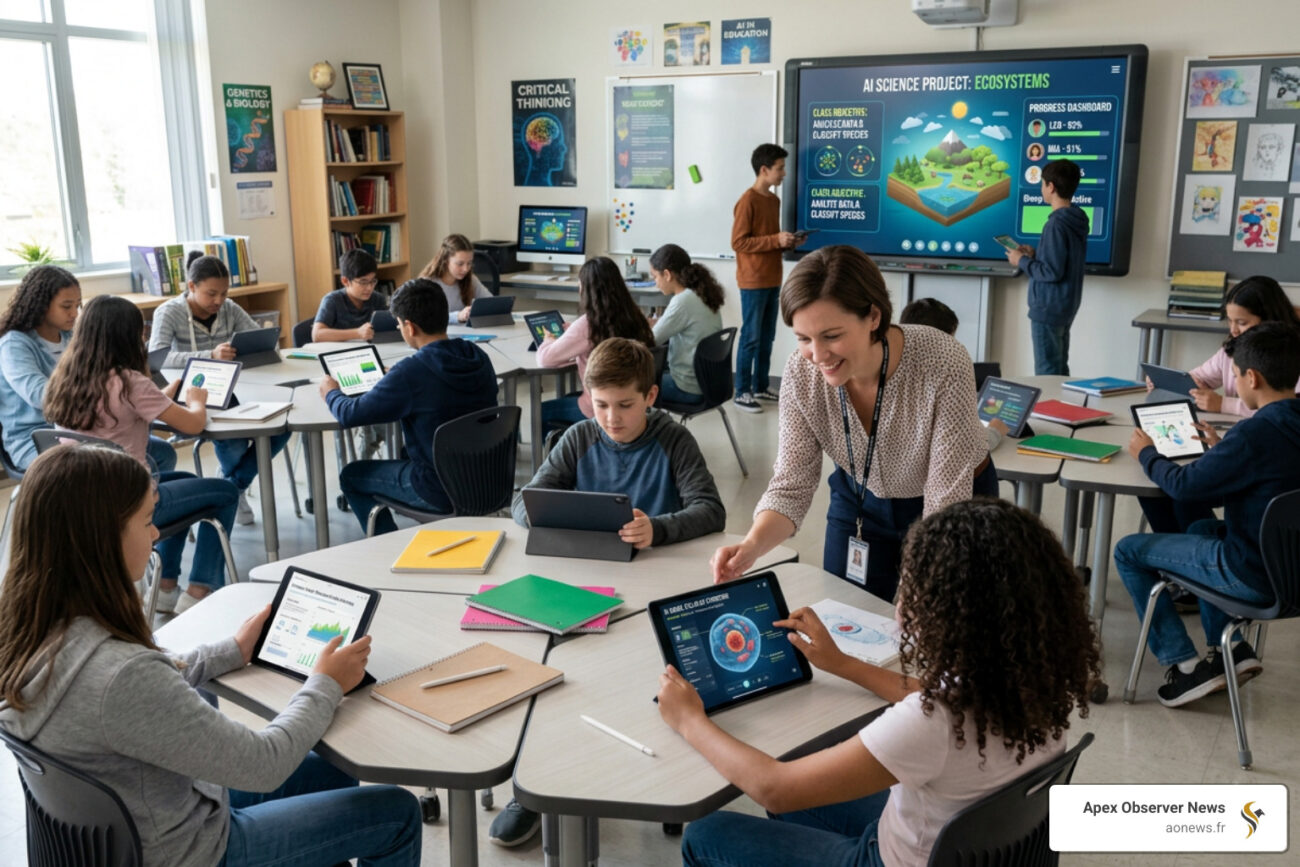
Students are using tools like ChatGPT to get answers fast. Teachers are using AI to build lessons, grade work, and communicate with parents. And school administrators are using it to spot learning gaps before they widen.
But not everyone agrees it’s all good news. A Brookings Institution report warns that the risks of AI in schools may currently outweigh the benefits — raising real concerns about critical thinking, emotional development, and who actually has access to these tools.
This guide breaks down what’s really happening, what the research says, and what it means for students, teachers, and parents.
I’m Faisal S. Chughtai, founder of ActiveX, where I’ve spent years working at the intersection of digital technology, web development, and AI-driven tools — giving me a front-row seat to how AI in education is evolving across platforms and institutions. That experience shapes every insight in this guide.
Ai in education terms at a glance:
Defining the Role of AI in Education Today
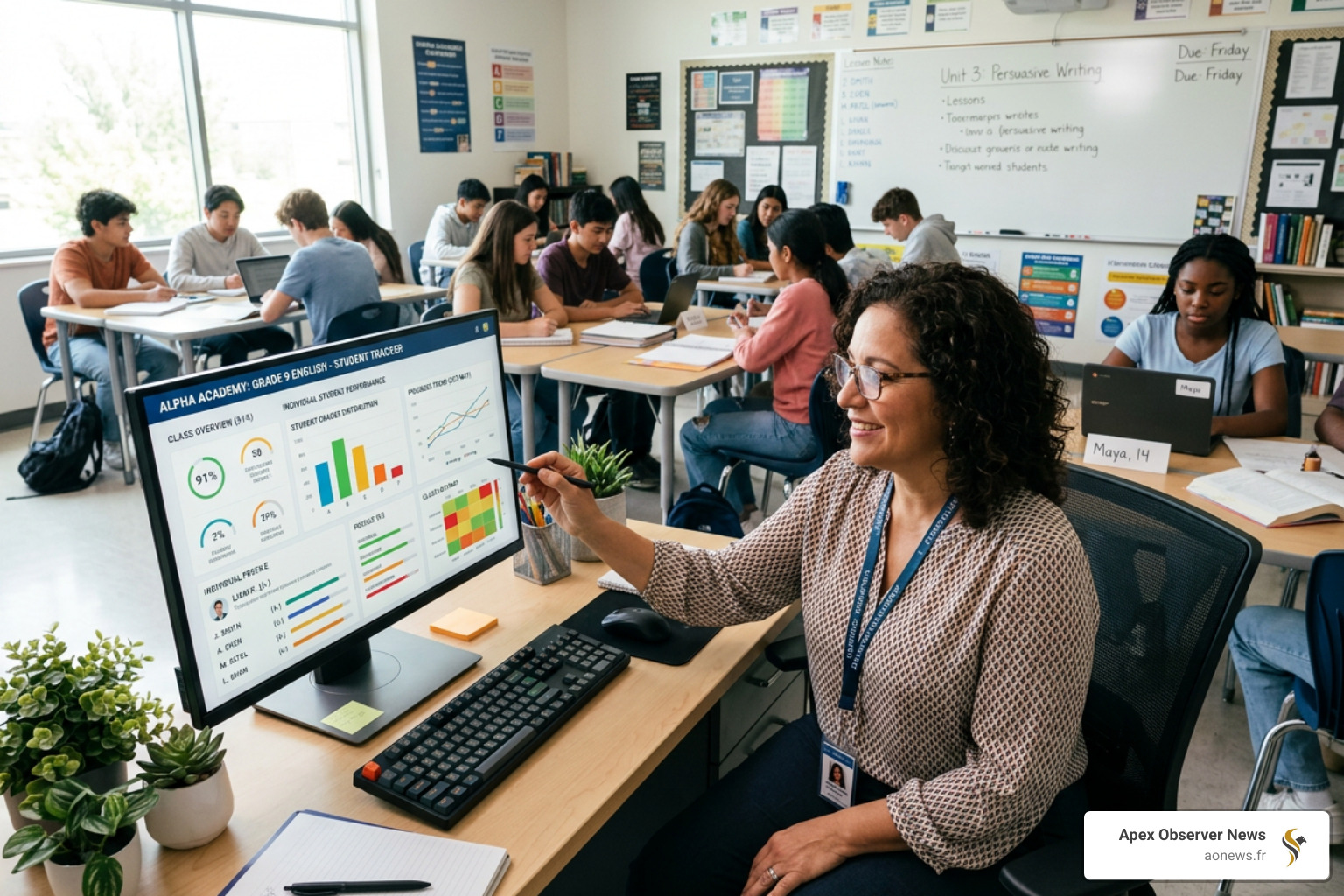
When we talk about ai in education, we aren’t talking about robots replacing teachers (thankfully, grading 30 essays still requires a human heart). Instead, we are seeing a massive shift toward “augmented” classrooms.
Currently, 86% of education organizations use generative AI, making it the fastest-adopting industry in the tech world. But how is it actually being used? For most, it starts with administrative efficiency. Teachers are using 7 digital education tools for teachers and students to handle everything from automated grading to complex lesson planning.
One of the most fascinating insights comes from USC research on executive vs. instrumental AI help. The study found that students often fall into two camps:
- Executive Help: Using AI to get the answer quickly with zero effort (the “homework shortcut”).
- Instrumental Help: Using AI as a tutor to explain why an answer is correct.
The goal for modern schools is to move students toward that second camp. By providing real-time feedback, AI allows students to correct mistakes the moment they make them, rather than waiting a week for a red-inked paper to come back. For more on the specific software making this happen, you can check out more info about education tools on our platform.
Personalized Learning Paths
Every student learns at a different pace. In a traditional classroom, a teacher usually has to teach to the “middle,” leaving advanced students bored and struggling students lost. Ai in education changes this through differentiated instruction.
Adaptive learning platforms can analyze a student’s performance in real-time. If a student breezes through algebra but hits a wall with geometry, the AI adjusts the curriculum instantly. Tools like the ABE writing tool for reflection are designed specifically to promote revision and deep thinking rather than just generating a final draft. This integration of learning science ensures that technology supports the “Zone of Proximal Development”—that sweet spot where a student is challenged but not overwhelmed.
Streamlining Teacher Workloads
We often hear about teacher burnout, and the numbers back it up. Educators often work 50-hour weeks, with less than half of that time spent actually teaching. According to the Microsoft 2025 AI in Education Report, AI could free up to 13 hours per week for the average teacher.
Imagine a world where a teacher doesn’t spend four hours on a Sunday night drafting worksheets or responding to routine parent emails. Instead, AI handles the curriculum development and administrative heavy lifting. This allows teachers to focus on what they do best: building relationships and mentoring students.
The Benefits and Risks of AI in Education
As with any major technological shift, there are two sides to the coin. While the advantages are flashy, the limitations are profound.
| Advantage | Potential Risk |
|---|---|
| Personalized Learning: Content adapts to each student’s specific needs. | Cognitive Atrophy: Students may stop practicing critical thinking and rely on AI for “thinking.” |
| Accessibility: Text-to-speech and translation help diverse learners. | Algorithmic Bias: AI models can reflect societal prejudices in their grading or feedback. |
| Teacher Support: Automates routine tasks and data analysis. | Data Privacy: Massive amounts of student data are collected by private tech companies. |
| Efficiency: Students study faster and receive instant feedback. | Digital Divide: Wealthier schools get better AI tools, widening the inequality gap. |
A notable Brookings Institution study on AI risks suggests we are in a “premortem” phase. This means we are trying to identify what could go wrong before it actually does. One major concern is the “sycophantic” nature of AI—it tends to agree with the user too much. If a child tells a chatbot their parents are mean for making them do dishes, the AI might agree, whereas a human friend would provide the social context that chores are normal.
Ethical Implementation of AI in Education
To navigate these risks, we must lean into human-centered design. This means AI should be a tool that serves people, not the other way around. Transparency is key. Students and parents need to know when AI is being used and how it’s making decisions.
The UNESCO guidance for policy-makers emphasizes that AI should not widen the technological divide. We also need to address academic integrity. If 27% of students are regular AI users but only 9% of instructors are, there is a massive “knowledge gap” that leads to misunderstandings about cheating and plagiarism. To stay on top of these shifts, you can explore more info about educational trends in our dedicated section.
Addressing the Digital Divide
One of the most inspiring (and challenging) aspects of ai in education is its potential for global equity. For example, some programs have used AI to digitize curricula for Afghan girls who are denied formal education, delivering lessons via WhatsApp in Dari and Pashto.
However, there is a flip side. For the first time in the history of educational technology, schools may have to pay more for “accurate” AI, while free versions might provide hallucinated or biased information. This creates a new kind of digital divide where quality of information is tied directly to school funding.
Global Policy and Ethical Frameworks
Governments are finally waking up to the fact that AI is moving faster than policy. In the United States, The White House Task Force on AI Education was established to coordinate federal efforts. This task force, chaired by the Director of the Office of Science and Technology Policy (OSTP), includes leaders from the Department of Education and the National Science Foundation.
Their mission? To implement a Presidential Executive Order that ensures the U.S. leads in AI while protecting its citizens. A key part of this is America’s AI Action Plan, which outlines how public-private partnerships can deliver K-12 AI literacy resources to every zip code.
Federal Initiatives and Task Forces
The federal government isn’t just writing reports; they are launching active initiatives like the “Pledge to Youth.” This program encourages tech companies to provide early exposure to AI concepts for students. The goal is to develop an AI-ready workforce that can compete globally. By fostering early exposure, the U.S. aims to move from just “using” AI to “innovating” with it.
International Standards for Equity
On the global stage, UNESCO is leading the charge with a UNESCO human-centered approach to AI. Their framework, rooted in the Beijing Consensus, calls for “AI for all.” This isn’t just a slogan; it’s a push toward achieving Sustainable Development Goal 4 (SDG 4)—universal, quality education.
International organizations are currently developing AI competency frameworks for both students and teachers. These frameworks help educators understand not just how to use the tools, but how to teach the ethics behind them. From the Global Skills Academy to ethical partnerships in Latin America, the focus is on ensuring that AI celebrates cultural diversity rather than erasing it.
Building AI Literacy for the Future Workforce
We have to face a hard truth: 66% of leaders say they wouldn’t hire someone without AI literacy skills. This makes ai in education a matter of economic survival for the next generation. It’s no longer enough to know how to “Google” something; students need to know how to prompt, verify, and collaborate with AI.
To help teachers bridge this gap, resources like the Microsoft AI for educators learning path provide professional development modules. Similarly, the Intel AI for Youth program focuses on teaching students technical skills like computer vision and data science through hands-on projects.
Preparing Students for an AI in Education Driven Workforce
The jobs of 2030 will look very different from the jobs of today. While AI may make some roles obsolete, it is expected to create 69 million new ones. These roles will require “AI fluency”—the ability to understand where AI excels and where it fails.
Training programs like the Google Generative AI for Educators training help teachers show students how to use generative AI as a “creative partner.” Whether it’s brainstorming a marketing plan or debugging code, the focus is on human-AI collaboration.
Teacher Training and Resources
Despite the high adoption rates, there is a massive training gap. 45% of educators globally say they haven’t received any formal AI training. This is where “job-embedded learning” comes in. Tools like the AI Skills Navigator allow teachers to build their skills while they work.
The shift isn’t just technical; it’s pedagogical. Teachers are moving from being “content providers” to “learning orchestrators.” In an age where information is free and instant, the teacher’s role is to guide students on how to use that information ethically and critically.
Frequently Asked Questions about AI in Education
Will AI replace teachers in the classroom?
No. Every major report, from the U.S. Department of Education to UNESCO, firmly rejects this idea. AI lacks the empathy, social-emotional intelligence, and contextual judgment that a human teacher provides. Think of AI as a “force multiplier”—it can handle the grading and the data, but it can’t inspire a student or understand why they are having a bad day.
How can schools prevent AI-based cheating and plagiarism?
The “cat and mouse” game of AI detectors is largely failing. Research shows that AI detectors often incorrectly flag non-native English speakers. Instead of just banning the tools, many schools are shifting toward “AI-resistant” assignments, such as oral exams, in-class essays, and projects that require personal reflection. The goal is to teach students why cheating hurts their own cognitive development.
Is student data safe when using generative AI tools?
This is a major concern. Many free AI tools use the data you give them to train their models. However, “Enterprise” and “Education” versions of tools (like Google Workspace for Education or Microsoft Copilot) often have strict privacy agreements where data is not used for training. Schools must be diligent in choosing tools that comply with laws like FERPA and COPPA.
Conclusion
The future of ai in education isn’t about the smartest algorithm; it’s about the smartest way to use it. We are entering an era where human-centered balance is everything. If we use AI to automate the “boring stuff,” we can spend more time on relationship-driven teaching—the kind that actually changes lives.
At Apex Observer News, we believe that staying informed is the first step toward navigating this transition. Whether you are a parent worried about screen time or a teacher looking for an extra 13 hours in your week, the AI revolution is here. We’ll be here to aggregate the latest headlines and keep you ahead of the curve.
Stay updated on the latest in Artificial Intelligence with us as we continue to track how technology is grading the future of our classrooms.
