


Why Your Freelancing Portfolio Can Make or Break Your Career
A freelancing portfolio is a curated collection of your best work that shows potential clients exactly what you can do — before they ever speak to you.
Quick answer: What is a freelancing portfolio and why does it matter?
- It is a showcase of your skills, past projects, and results
- It acts as your first impression and primary sales tool
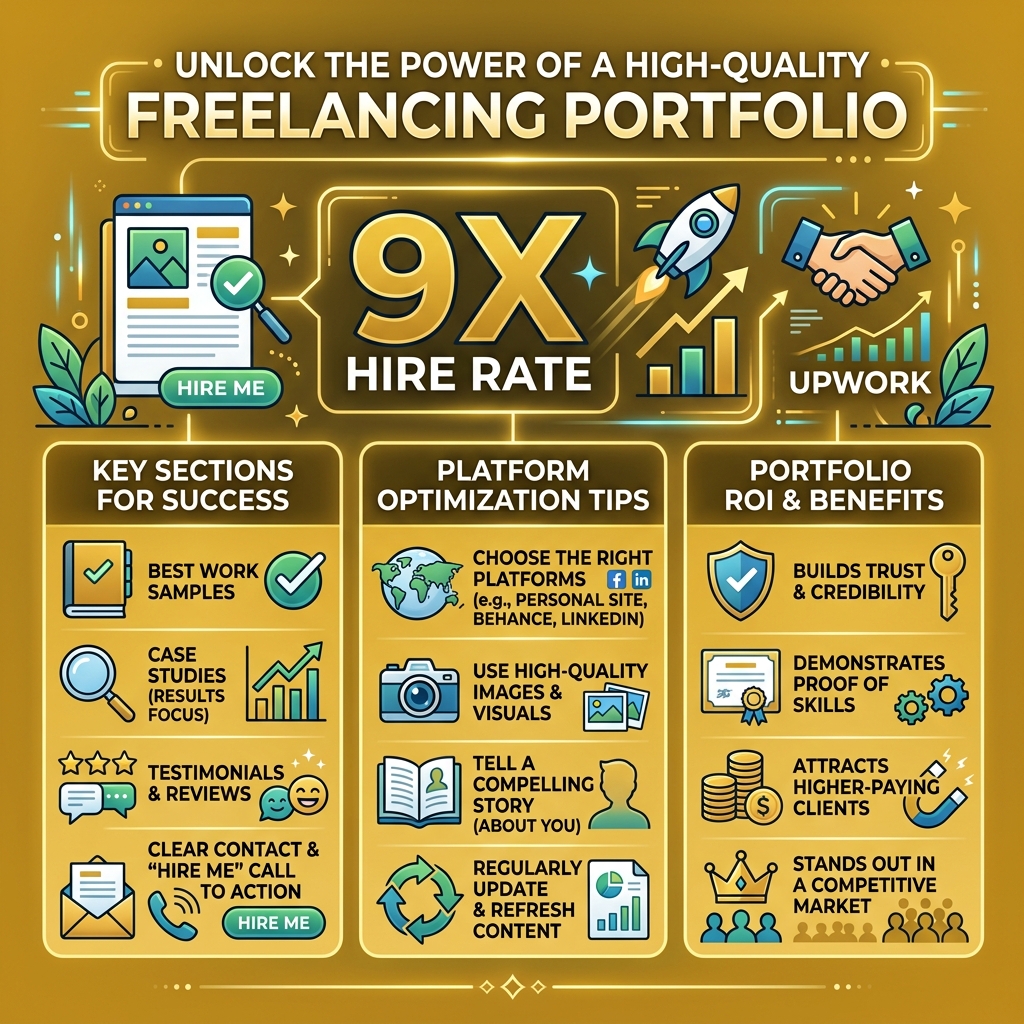
- Freelancers with a published portfolio are hired 9 times more often than those without (Upwork)
- It works across platforms — personal websites, Upwork, Behance, and more
- It replaces a traditional resume by showing proof of your abilities, not just claims
Think of it as your career highlight reel. A strong portfolio does the selling for you — even while you sleep.
Whether you are a web designer, copywriter, developer, or UX writer, your portfolio is often the only thing standing between you and your next client. With over 10,000 freelancer portfolios on Behance alone, the competition is real. Standing out is not optional.
I’m Faisal S. Chughtai, founder of ActiveX, with hands-on experience in branding, web and app development, SEO, and digital marketing — all areas where a strong freelancing portfolio is the difference between landing premium clients and being overlooked. In this guide, I’ll walk you through everything you need to build one that actually works.
Freelancing portfolio word roundup:
Why a Freelancing Portfolio is Your Most Powerful Sales Tool
We often tell new freelancers that their portfolio is not just a gallery; it is a silent salesperson working 24/7. The data backs this up. According to Upwork, freelancers who take the time to publish a portfolio are hired nine times more frequently than those who skip this step. This is because a freelancing portfolio provides immediate social proof. When anyone can claim to be an expert, your work samples are the “receipts” that prove your value.
A well-crafted portfolio builds credibility by moving the conversation from “What can you do?” to “How can you do this for me?” It allows you to showcase not just the final product, but the strategic thinking behind it. This is particularly important for Pakistani freelancers as catalysts for change, who are increasingly competing on a global stage and need to demonstrate world-class standards to overcome regional biases.
One of the most effective ways to boost this credibility is by requesting client testimonials and integrating them directly into your project displays. When a potential client sees a beautiful design paired with a quote about how that design solved a business problem, the “trust gap” closes instantly.
Comparing Freelancer vs. Agency Portfolios
Clients often weigh the pros and cons of hiring a solo freelancer versus a full-scale agency. Your portfolio should highlight the unique benefits of the “freelancer experience.”
| Feature | Freelancer Portfolio | Agency Portfolio |
|---|---|---|
| Cost to Client | Typically $3,500 – $15,000 | Often $20,000 – $250,000+ |
| Communication | Direct access to the creator | Often filtered through PMs |
| Project Focus | High personal investment | High volume, multi-team |
| Speed | Agile and quick pivots | Structured, often slower |
| Vibe | Personal brand and “vibe check” | Corporate and standardized |
Structuring Your Freelancing Portfolio for Maximum Impact
We recommend a structure that prioritizes user experience (UX). If a client can’t find what they need in three clicks, you’ve likely lost them. A high-impact freelancing portfolio usually follows this flow:
- The Hook (Hero Section): A clear statement of who you are and the specific problem you solve.
- The Work (Portfolio Grid): High-quality visuals of your best projects.
- The Proof (Case Studies & Testimonials): The “how” and “why” behind the “what.”
- The Person (About Me): A touch of personality to show you’re a human being, not a bot.
- The Action (Contact Us): A simple, frictionless way to start a conversation.
For those seeking visual inspiration, looking at curated Freelance Portfolios on Awwwards can be a game-changer. These award-winning sites often use minimal color schemes (like cyan and dark UI), parallax scrolling, and 3D interactions to create a memorable experience. However, functionality should never be sacrificed for “flashiness.” A great portfolio allows the work to speak for itself.
Essential Elements of a High-Converting Portfolio Website

A high-converting freelancing portfolio isn’t just a collection of pretty pictures; it’s a data-driven document. To truly stand out, we need to move beyond “I designed this” and toward “I achieved this.”
Case Studies and Quantifiable Metrics
The most successful freelancers use their portfolios to tell stories of transformation. Instead of just showing a screenshot of a blog post, a content strategist might highlight an 1800% traffic uplift for a SaaS client. A developer might show how a site redesign led to a 70% increase in monthly leads via gated content.
When writing your case studies, follow this simple framework:
- The Challenge: What was the client’s problem? (e.g., “The client had a high bounce rate and low conversions.”)
- The Solution: What did you do? (e.g., “I implemented a mobile-responsive design and optimized the CTA flow.”)
- The Result: Use hard numbers. (e.g., “Reduced bounce rate by 25% and increased signups by 438%.”)
Visual Trust Signals
Including recognizable client logos is a shortcut to trust. If you’ve worked with a “household name,” put that logo front and center. If you’re just starting out, don’t worry—there are 10 quick and easy ways to freelance that can help you land those first few logo-worthy projects.
Clear Calls to Action (CTA)
Every page of your portfolio should lead the visitor toward a specific action. Whether it’s “Book a Discovery Call,” “Download My PDF Portfolio,” or “Let’s Talk on Slack,” make it impossible to miss. We’ve seen portfolios where the work was brilliant, but the contact form was hidden at the bottom of a long “About” page—don’t let that be you!
How to Build a Portfolio with No Prior Client Work
The “Catch-22” of freelancing is real: you need a portfolio to get work, but you need work to build a portfolio. If you are a new freelancer, we suggest these four strategies to bridge the gap:
- Mock Projects: Create a “concept” project for a brand you admire. If you’re a designer, redesign a popular app. If you’re a writer, write a series of high-quality blog posts on a trending topic. Label these clearly as “Concept Work” or “Self-Initiated Projects.”
- Volunteer Work: Offer your services to a local non-profit or a friend’s startup. This gives you a real-world use case and a genuine testimonial.
- Personal Branding: Your own website is your first project. If you are a developer, the code behind your portfolio is a work sample. If you are a designer, the UI of your site is your first impression.
- Skill Demonstrations: Use snippets or “mini-projects.” A developer might share a clean GitHub repository, while a marketer might share a breakdown of a successful personal social media campaign.
For those in specific regions, look for government-backed support. For instance, learning how to become a freelancer under Pakistan’s national initiatives can provide resources and platforms to showcase your emerging talent.
Tools for Quick Creation
You don’t need to spend months coding a site from scratch.
- Canva: With over 20,000 templates, Canva is perfect for creating PDF portfolios or simple landing pages.
- Adobe Portfolio: This is a fantastic tool for creatives because it allows you to sync your Behance projects to a custom site instantly.
- Upwork Portfolio: Don’t ignore the built-in tools on platforms. An optimized Upwork portfolio is often the first thing a client sees after your proposal.
Best Practices for Showcasing Design and Development Skills
Showcasing a dual skill set—like being both a designer and a developer—requires a delicate balance. We find that the best hybrid portfolios act as a “vibe check” first and a technical deep dive second.
The “Complete Package” Narrative
Market yourself as a “full-stack” solution. For a designer-developer, this means showing Figma mockups alongside the final live site. This demonstrates that you understand both the aesthetic requirements and the technical constraints of a project. Expert freelancers like Kegan Quimby often highlight stats like “10+ years experience” and “1M+ lines of code” to immediately establish authority in both realms.
Technical Excellence and SEO
Your portfolio must practice what it preaches. If you claim to be an SEO expert, your portfolio site should rank for your target keywords. If you are a developer, your site must be lightning-fast.
- Mobile Responsiveness: With the majority of traffic being mobile, reducing bounce rates through mobile responsiveness is critical. A buggy mobile menu is an instant “no” from a potential client.
- CMS Expertise: Mention the specific tools you use, such as WordPress, Shopify, or Contentful. Clients often search for freelancers with specific platform experience.
- Code Snippets: For developers, including a “tech stack” section with clean icons or even small, interactive code snippets can prove your proficiency in languages like JavaScript, PHP, or frameworks like React and Vue.
Optimizing Your Freelancing Portfolio for Platforms and SEO
Visibility is just as important as quality. We recommend a multi-channel approach:
- Behance & Dribbble: These are high-traffic galleries. Use relevant tags like “UI/UX,” “Web Design,” and “Branding” to get discovered by recruiters.
- Upwork Integration: Link your portfolio items to your past Upwork contracts. This adds a layer of verified credibility that a standalone website can’t match.
- Keyword Research: Identify what your target clients are searching for. Are they looking for a “Freelance SaaS Copywriter” or a “B2B Content Strategist”? Use these terms in your page titles and headers.
- Image Optimization: High-resolution images are great, but they can slow down your site. Use compressed formats (like WebP) and include descriptive Alt-text for SEO.
Exploring different ways of online earning in Pakistan or globally often starts with these basic SEO foundations. If clients can’t find you, they can’t hire you.
Frequently Asked Questions about Freelancing Portfolios
How often should I update my portfolio?
We recommend a “one-in, one-out” rule. Every time you complete a project that is better than your current “worst” portfolio item, swap them. At a minimum, do a deep audit every six months to ensure your contact info, tech stack, and pricing (if included) are still accurate.
What are the best tools for quick portfolio creation?
For non-coders, Canva and Adobe Portfolio are the gold standards. If you want more control, WordPress with a builder like Elementor or Webflow are excellent choices. For a purely professional, platform-based approach, Behance and LinkedIn’s “Featured” section are essential.
Should I include my pricing in my portfolio?
This is a personal choice. Including a “starting at” price can help filter out low-budget clients who aren’t a good fit. However, many freelancers prefer to keep pricing private to allow for custom quotes based on the project’s complexity. If you do include pricing, ensure it reflects your experience level—for example, web design projects typically range from $3,500 to over $15,000 for experienced freelancers.
Conclusion
At Apex Observer News, we’ve seen how the digital landscape is constantly shifting, but one thing remains constant: quality wins. Your freelancing portfolio is the most important asset you own as a digital professional. It is the bridge between your skills and a client’s needs.
Building a standout portfolio takes time, but the return on investment is undeniable. By focusing on quantifiable results, maintaining a clean UX, and optimizing for search, you set yourself up for long-term success in the global gig economy. Your portfolio is a living document—keep it fresh, keep it honest, and let your work do the talking.
For more insights into digital work, you can explore more freelancing guides and news on our platform. Whether you’re just starting out or you’re a seasoned pro, staying informed is the first step toward staying ahead.
