

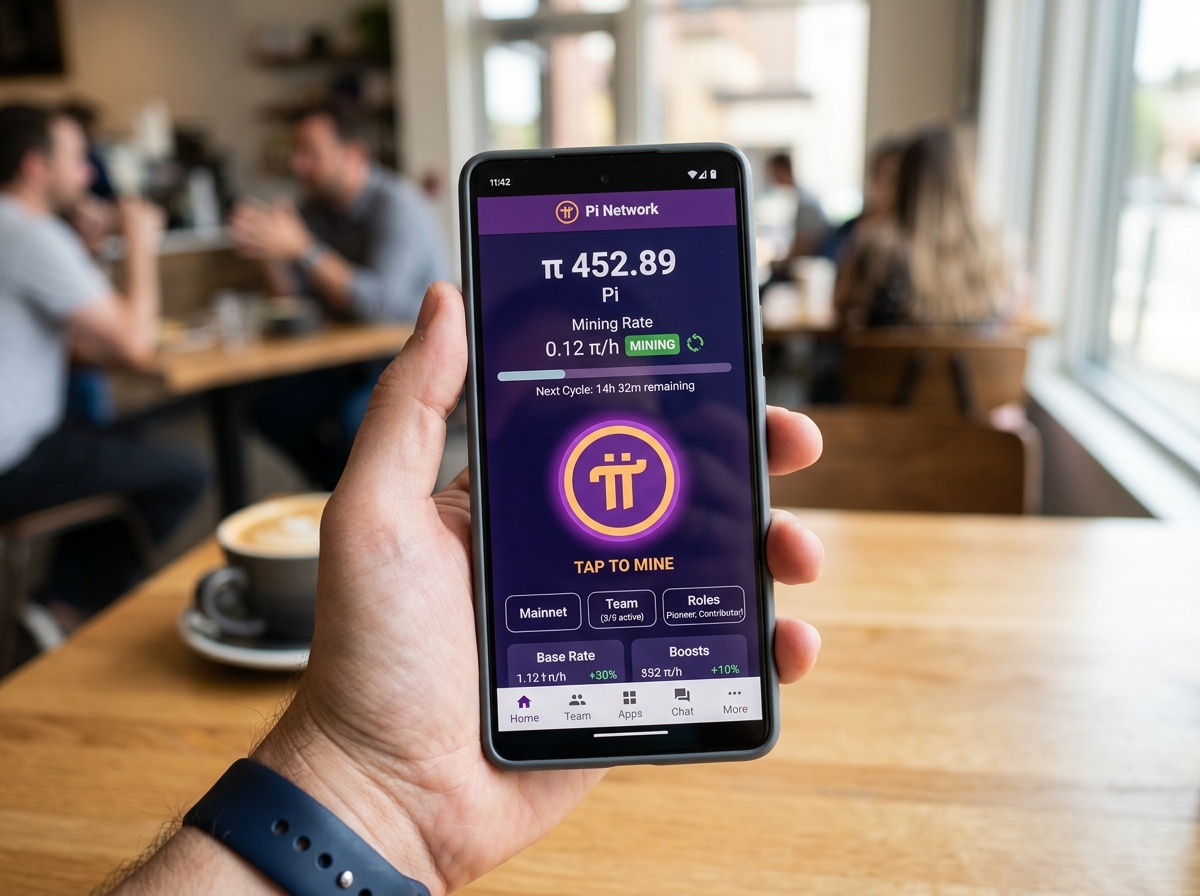
Is Pi Network Cryptocurrency Legitimate? Here’s What You Need to Know
Pi network cryptocurrency is a mobile-first digital coin that lets everyday people mine crypto directly from their smartphones — no expensive hardware, no massive electricity bills. But with its wild price swings and years-long road to full launch, many people are asking: is it real, or is it just hype?
Here’s a quick snapshot before we dive deeper:
| Question | Quick Answer |
|---|---|
| What is it? | A mobile-mineable cryptocurrency built on a Stellar-based consensus protocol |
| Who made it? | Dr. Nicolas Kokkalis and Dr. Chengdiao Fan, both Stanford PhDs |
| Current price | ~$0.1782 USD (down from ATH of $2.98) |
| Market cap | ~$1.73 billion (ranked #43) |
| Circulating supply | 9.72B PI out of 100B max |
| Is it launched? | Partially — currently in Enclosed Mainnet phase |
| Is it legitimate? | Backed by real founders, real tech, but real risks too |
| Members worldwide | 35+ million |
Pi is not a scam in the traditional sense — it has credible founders, a published whitepaper, and a functioning blockchain. But it’s also not without serious concerns, including KYC delays, price volatility, and an open mainnet that hasn’t fully arrived yet.
I’m Faisal S. Chughtai, founder of ActiveX, with hands-on experience in app ecosystems, blockchain-based platforms, and digital marketing — all directly relevant to evaluating a pi network cryptocurrency project like this one. Let’s break down exactly what you need to know to make an informed decision.
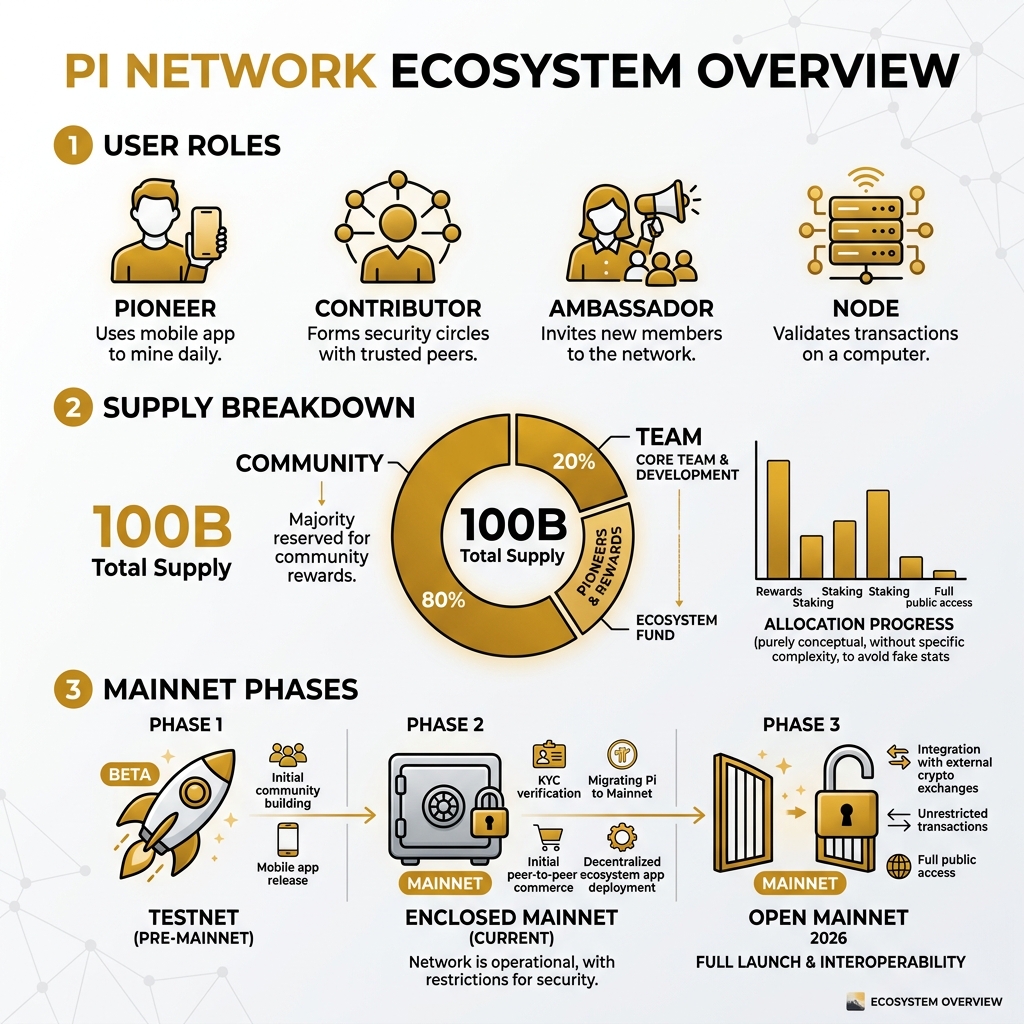
Handy pi network cryptocurrency terms:
Understanding the pi network cryptocurrency Ecosystem
When we first look at the pi network cryptocurrency, it is easy to see why it has captured the imagination of over 35 million members worldwide. Unlike traditional cryptocurrencies that require specialized “mining rigs” or massive server farms, Pi operates on a social cryptocurrency model. It is designed to be decentralized, secure, and interoperable, but most importantly, it is accessible to anyone with a smartphone.
At the heart of the network is the Stellar Consensus Protocol (SCP). While Bitcoin uses a “Proof of Work” system that requires computers to solve complex math problems (consuming massive amounts of energy), Pi uses a Federated Byzantine Agreement. Instead of burning electricity, the network secures its ledger through a “global trust graph.”
As users, we build this trust graph through Security Circles. By vouching for 3 to 5 people we trust, we help the network determine who is a legitimate actor and who isn’t. This energy-efficient approach is what allows us to “mine” on our phones without draining the battery or using excessive data.
User Roles in the Ecosystem
To keep the network running smoothly, we can take on several different roles as defined in the Pi Network Whitepaper:
- Pioneer: The basic role. We simply open the app once every 24 hours and tap a button to prove we aren’t a robot.
- Contributor: By forming a Security Circle with other Pioneers we trust, we earn a higher mining rate.
- Ambassador: We earn rewards for inviting new members to the community.
- Node: For the more tech-savvy among us, we can run the Pi Node software on our computers to help validate transactions and secure the blockchain.
| Feature | Bitcoin Mining | Pi Network Mining |
|---|---|---|
| Hardware | Expensive ASICs/GPUs | Standard Smartphone |
| Energy Use | Extremely High | Negligible (Battery-friendly) |
| Consensus | Proof of Work (PoW) | Stellar Consensus Protocol (SCP) |
| Accessibility | Limited to pros/wealthy | Open to everyone |
| Reward Basis | Computational Power | Social Trust & Contribution |
The Evolution of pi network cryptocurrency Technology
The technology behind the pi network cryptocurrency isn’t static; it has been evolving rapidly through several key technical upgrades. Most notably, the Core Team recently completed the migration to Protocol version 20.2. This was a “groundbreaking” move because it laid the foundational support for the gradual rollout of smart contracts.
We’ve seen a flurry of activity recently. On February 20, the network hit version 19.6, followed by v19.9 on March 4, and finally v20.2 on March 12. These updates are critical because they prepare the blockchain for “utility-based product innovation.” Essentially, the team is building a decentralized developer platform where apps can actually use PI as a currency.
You can actually track these developments yourself on the Pi Blockchain Explorer. This transparency is one of the reasons we view the project as more than just a simple app. It is a functioning Layer 1 blockchain that is currently facilitating the migration of millions of users from the Testnet to the Mainnet.
Current Price and Supply of pi network cryptocurrency
Let’s talk numbers, because the market for PI has been a bit of a roller coaster. As of our latest data, the price sits around $0.1782 USD, representing a significant drop from its all-time high of $2.98 reached in February 2025.
The Pi Coin Price Trends show that the market is highly volatile. For example, when Kraken announced a listing, the price skyrocketed to nearly $0.30, only to plummet by 30% shortly after. This is what traders call a “sell-the-news” event.
Here is the current breakdown of the supply:
- Max Supply: 100 Billion PI
- Circulating Supply: 9.72 Billion PI (roughly 9.73% of the max)
- Market Cap: Approximately $1.73 Billion
The distribution model is quite unique. 65% of the max supply is reserved for community mining rewards, while 20% goes to the Core Team (unlocked proportionally as the community mines), 10% for ecosystem growth, and 5% for liquidity. This model aims to prevent the centralization of wealth that we often see in older coins like Bitcoin, where a tiny percentage of users own the vast majority of the supply.
Founders and the Vision for Mobile Mining
The legitimacy of any crypto project often starts with the people behind it. The pi network cryptocurrency was founded by a team of Stanford graduates: Dr. Nicolas Kokkalis and Dr. Chengdiao Fan.
Dr. Kokkalis holds a PhD in Electrical Engineering and did his post-doc in Computer Science, focusing on distributed systems and Human-Computer Interaction (HCI). Dr. Fan holds a PhD in Anthropological Sciences, specializing in social computing and how technology can impact human behavior.
Their vision was to create an inclusive economy. They realized that traditional mining was becoming “out of reach” for the average person, centralized in the hands of massive mining farms. By creating a system that is planet-friendly and battery-friendly, they’ve made it possible for anyone to Download the Pi App and participate in the “cryptocurrency revolution.”
Legitimacy Review: Challenges, KYC, and Mainnet Status
Is it all sunshine and rainbows? Not quite. If you look at the reviews on the Google Play Store (where the app has over 100 million downloads), you’ll find a mix of excitement and frustration.
The biggest challenge facing the network right now is the KYC (Know Your Customer) verification process. Because Pi aims to have a “one-person-one-account” policy to ensure fair distribution, every user must be verified. However, many Pioneers have reported long delays, unavailable slots, and “unverified balances” that they can’t yet move to their wallets.
The Phases of Launch
Pi has gone through a structured roadmap:
- Phase 1 (Beta): Initial distribution and trust graph bootstrapping.
- Phase 2 (Testnet): Testing the node software and blockchain stability.
- Phase 3 (Mainnet): We are currently in the Enclosed Mainnet phase. This means the blockchain is live, but it is firewalled to prevent external connectivity. You can use your PI within the Pi ecosystem (like the Pi Browser and Wallet), but you can’t yet trade it for Bitcoin or USD on major external exchanges.
The transition to Open Mainnet is the most anticipated event in the Pi Network News. This transition depends on the ecosystem reaching a certain level of maturity and a significant portion of the community completing KYC.
Real-World Utility
To prove that PI isn’t just “monopoly money,” the team has been pushing for real-world adoption. PiFest 2024 was a massive success, featuring over 27,000 active sellers and 28,000 test merchants across 160 countries. From local brick-and-mortar shops to online marketplaces, people are actually bartering goods and services for PI.
One thing we must emphasize is wallet security. The Pi Wallet is non-custodial. This means you are the only one with the passphrase. If you lose it, the Core Team cannot recover it for you, and your funds will be lost forever. As the saying goes: not your keys, not your coins!
Frequently Asked Questions about Pi Network
Is Pi Network a scam or a legitimate project?
Based on our research and the development progress, Pi Network appears to be a legitimate project with a very long development cycle. It has a transparent team of Stanford PhDs, a functioning blockchain, and a massive global community. However, the heavy presence of ads in the app and the slow rollout of the Open Mainnet have led some to remain skeptical. It is not a “get rich quick” scheme; it is a long-term social experiment in digital currency.
When will the Pi Network Open Mainnet launch?
There is no fixed date yet, but the roadmap suggests it will happen once specific milestones are met: a critical mass of KYC-verified users, a robust set of utility-based apps, and a stable market environment. Recent updates like the v20.2 protocol migration suggest we are getting closer to the finish line.
How does Pi mining work without draining phone battery?
It doesn’t actually “mine” in the way Bitcoin does (using raw processing power). Instead, the app records your participation in the network. The actual heavy lifting of reaching consensus is done by the Nodes using the Stellar Consensus Protocol. Your phone simply acts as a gateway to vouch for your trust circle, which requires almost zero energy.
Conclusion
The pi network cryptocurrency represents a fascinating shift in digital finance. It has successfully democratized the idea of mining, bringing it to the pockets of millions who were previously left out of the crypto loop.
However, we must be clear: there are risks. The price is currently volatile, and the “Enclosed” nature of the network means your PI doesn’t have full liquidity yet. The recent “sell-the-news” event following the Kraken listing serves as a reminder that the market can be unforgiving.
As we look forward to the smart contract rollout and the eventual launch of the Open Mainnet, the project’s success will depend on whether it can turn its massive user base into a thriving, self-sustaining economy.
If you’re new to the space, we recommend checking out our Ultimate Guide to Crypto to get a better handle on the basics. Stay tuned to Apex Observer News (Aonews.fr) for the latest updates, and Explore Crypto News to stay ahead of the curve.
Mining Pi is “easy as Pi,” but as with all investments, we should only commit what we are prepared to see fluctuate. Whether it becomes the next global currency or remains a niche social experiment, the journey of Pi is certainly one of the most interesting stories in tech today.
