

Why the Emerging of Technology Is Reshaping Everything Right Now
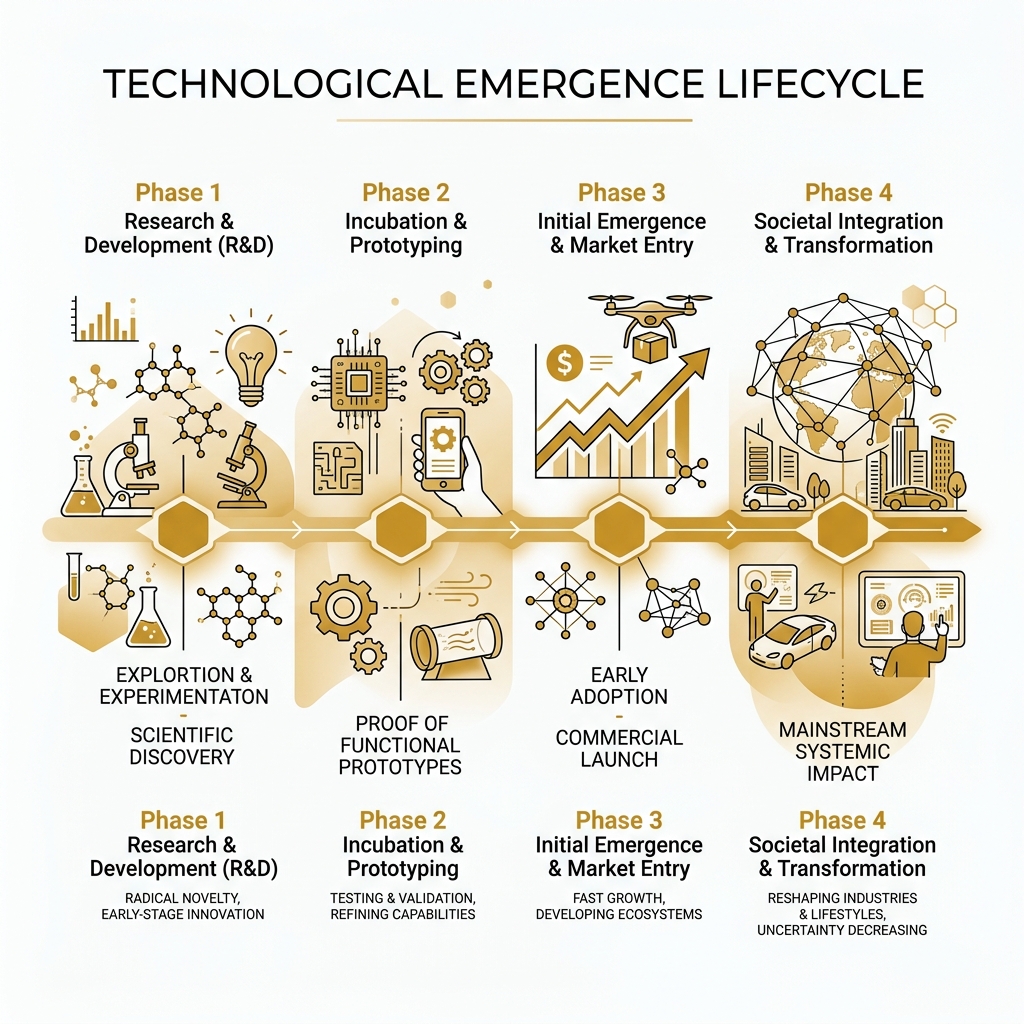
The emerging of technology describes the process by which new innovations move from research labs into everyday life — transforming industries, societies, and how we work and live.
Here is a quick snapshot of what you need to know:
| Key Point | Quick Answer |
|---|---|
| What it means | New technologies still largely unrealized in development or practical impact |
| Key traits | Radical novelty, fast growth, coherence, prominent impact, uncertainty |
| Top 2025 examples | AI, structural battery composites, osmotic power, engineered living therapeutics |
| Who tracks it | World Economic Forum, Forrester, US National Science and Technology Council |
| Biggest driver | AI — the most prolific emerging tech by patents, per WIPO |
| Main risk | Job displacement, inequality, ethical concerns, existential threats |
We are living through what many researchers call a technological renaissance. The speed of change is unlike anything before. Generative AI, for example, reached 100 million users in just two months — a milestone that took the telephone 50 years.
Every year, breakthroughs emerge from research labs that rewrite what is possible. Some are entirely new inventions. Others are older technologies finding powerful new applications. All of them share one thing: their full impact is still unfolding.
I’m Faisal S. Chughtai, founder of ActiveX — a digital branding, development, and marketing firm — and I have spent years tracking the emerging of technology across web, app, and AI ecosystems to help businesses stay ahead. In the sections below, I’ll break down everything you need to know — from definitions and 2025 breakthroughs to risks, ROI, and real-world impact.
Defining the Emerging of Technology: Key Characteristics
When we talk about the emerging of technology, we aren’t just talking about a new gadget hitting the shelves. True technological emergence is a specific phenomenon. According to researchers like Rotolo, Hicks, and Martin, an emerging technology is characterized by five defining traits:
- Radical Novelty: It introduces something fundamentally new or applies an existing technology in a way that creates a brand-new capability.
- Relatively Fast Growth: These technologies don’t just sit in labs; they experience an exponential rise in interest, patent filings, and scientific publications.
- Coherence: Over time, the technology moves from a vague concept to a clearly defined field with a community of experts and standardized practices.
- Prominent Impact: It has the potential to change the status quo, reshape economies, and redefine how we interact with the world.
- Uncertainty and Ambiguity: Because it is still “emerging,” we don’t yet know exactly how it will be regulated, who will win the market, or what the unintended consequences might be.

At its heart, the emerging of technology is a tipping point. It is the moment a scientific breakthrough transitions from a niche experiment into a transformative force. For those of us in the business world, understanding these traits is the first step toward building a Beginners Guide to AI in Business and other tech-forward strategies.
Top 10 Breakthroughs for 2025 and Beyond
Every year, the World Economic Forum (WEF), in collaboration with Frontiers, identifies the innovations most likely to impact the world over the next three to five years. For 2025, the list is a fascinating mix of sustainability, healthcare, and digital integrity.
- Structural Battery Composites: Imagine a car where the body of the vehicle is the battery. These materials store energy while providing structural integrity, potentially revolutionizing the weight and range of EVs.
- Engineered Living Therapeutics: This involves using synthetic biology to create “living medicines”—bacteria or cells engineered to sense and treat diseases inside the human body.
- Osmotic Power: By harnessing the energy created when salt water and fresh water meet, we can tap into a massive, constant source of renewable energy. This is a key pillar in The Green Tech Revolution.
- AI-Generated Content Watermarking: As deepfakes become more convincing, the ability to “tag” AI content at the source is becoming a critical tool for maintaining trust in digital information.
These technologies are evaluated across dimensions like scientific progress, ecosystem readiness, and strategic impact. They aren’t just cool ideas; they are the tools we will use to address global challenges like climate change and chronic disease.
The Rapid Emerging of Technology in AI and Automation
If 2024 was the year of “AI experimentation,” 2025 is the year of “AI impact.” According to Forrester’s latest research, we are seeing a major shake-up in the tech hierarchy. While Extended Reality (XR) has taken a step back in priority, AI is stepping up in a massive way.
The big trend for 2025 is Agentic AI. We are moving away from simple chatbots toward autonomous agents that can reason, plan, and execute complex workflows. This shift is creating what some call a “silicon-based workforce,” where AI doesn’t just assist humans but acts as a co-pilot capable of handling end-to-end business processes.
To navigate this, leaders need a solid The Strategic Guide to Using AI in Your Business Today. The “knowledge half-life” in AI has shrunk to months, meaning the time it takes to study a technology might exceed its window of relevance. Velocity is now more important than perfection.
Global Shifts and the Emerging of Technology in 2025
The emerging of technology isn’t happening at the same pace everywhere. Regional dynamics are playing a huge role in how these innovations are adopted:
- Europe: Geopolitical pressures and energy security concerns are accelerating investments in green tech and sovereign AI. Contrary to some myths, European firms are often at the forefront of ethical AI and sustainable manufacturing.
- APAC: This region is no longer just following global trends; it is setting them. From mobile-first entertainment to advanced robotics in manufacturing, APAC is a hub of bold innovation.
- North America: The US continues to lead in R&D spending and patent filings, particularly in AI and biotechnology, though it faces increasing competition from China.
To dive deeper into these regional shifts and see the full list of winners and losers, you can Join The Webinar: The Top 10 Emerging Technologies Of 2025 hosted by Forrester.
Strategic Impact: From Biotechnology to Space Exploration
The emerging of technology creates two types of change: incremental and disruptive. While incremental change improves what we already have (like a better smartphone camera), disruptive change makes the old way of doing things obsolete.
| Technology Type | Example | Impact |
|---|---|---|
| Disruptive | Multi-use Rockets | Slashes the cost of space access, enabling 10,000+ satellites to orbit today. |
| Disruptive | Gene Therapy | Moves from treating symptoms to curing genetic diseases at the source. |
| Incremental | 5G Connectivity | Speeds up existing mobile data, enabling better streaming and IoT. |
| Disruptive | Cultured Meat | Produces “no-kill” protein, potentially upending the global livestock industry. |
In agriculture, we are seeing a massive shift. The The Future of Food and Artificial Intelligence on the Farm is already here, with AI-enabled sensors monitoring soil health and autonomous tractors reducing herbicide use by up to 90%.
Biotechnology is another “bleeding edge” field. Between 1990 and 2014, over 2,000 gene therapy trials were conducted. Today, we are seeing the fruits of that labor with cancer vaccines like Provenge and CRISPR-based treatments that were once the stuff of science fiction.
National Security and the Emerging of Technology
Technology is now a primary tool of diplomacy and defense. The US Department of State and the National Science and Technology Council (NSTC) maintain a “Critical and Emerging Technologies List” to prioritize innovations vital to national security.
Key focus areas for 2024 and 2025 include:
- Pax Silica: The strategic importance of semiconductors and microelectronics in maintaining global stability.
- C-UAS Technology: Developing systems to counter unmanned aerial systems (drones), which have become a major factor in modern conflict.
- AI Partnerships: Establishing international norms and safety standards for AI to prevent its misuse by bad actors.
These initiatives show that the emerging of technology isn’t just a business concern—it’s a matter of global safety and democratic values.
Navigating Risks, Ethics, and Business ROI
With great power comes… well, a lot of homework for business leaders. The emerging of technology brings significant risks that we cannot ignore.
- Automation and Unemployment: While tech revolutions usually create more jobs than they destroy, the transition can be painful. Up to 60% of occupations have duties that could be automated to some degree.
- Existential Risks: Figures like Bill Joy and Nick Bostrom have warned about the long-term dangers of uncontrolled AI or nanotechnology.
- Distributive Justice: There is a real risk that emerging tech will widen the gap between the “digital haves” and “have-nots,” both within countries and between nations.
For businesses, the challenge is calculating ROI. Forrester suggests using “Benefit Horizons” to evaluate investments:
- Horizon 1 (Short-term): Technologies that deliver value within 1-2 years (e.g., Generative AI for productivity).
- Horizon 2 (Mid-term): Technologies that require 3-5 years to mature (e.g., Agentic AI, Advanced Robotics).
- Horizon 3 (Long-term): High-risk, high-reward bets that may take 5+ years (e.g., Quantum Computing).
Understanding How AI and Robotics Work Together to Change the World can help you build a business case that balances innovation with fiscal responsibility.
Frequently Asked Questions about Emerging Tech
What are the top emerging technologies for 2025?
The top technologies identified by the World Economic Forum and Forrester include Agentic AI, structural battery composites, engineered living therapeutics, osmotic power, and AI-generated content watermarking.
How do businesses calculate ROI for new technology?
Businesses should categorize technologies into three benefit horizons. Short-term ROI usually comes from efficiency gains (doing things faster), while long-term ROI comes from transformation (doing entirely new things). It’s crucial to lead with a business problem rather than the tech itself.
What are the main ethical risks of these innovations?
The primary concerns are job displacement due to automation, data privacy violations, the “black box” nature of AI decision-making, and the potential for increased economic inequality if access to technology is not inclusive.
Conclusion
At Apex Observer News, we believe that staying informed is the best way to navigate the emerging of technology. As a digital news aggregator, our mission is to provide you with real-time updates across tech, business, and global affairs, helping you spot the trends that matter before they become mainstream.
The technological renaissance we are witnessing offers unprecedented opportunities for sustainable growth and inclusive innovation. Whether it’s a breakthrough in clean energy or a new AI tool that empowers your workforce, the future is being written right now.
To stay updated on the latest breakthroughs and expert analysis, be sure to explore our dedicated section for emerging-technologies. The world is changing fast—don’t get left behind.
