

Electric Vehicle Battery Costs: What You Need to Know in 2026
Electric vehicle battery costs are one of the biggest financial questions facing EV buyers today. Here’s a fast answer before we dive deeper:
| Scenario | Typical Cost |
|---|---|
| Full battery replacement (out-of-pocket) | $5,000 – $20,000 |
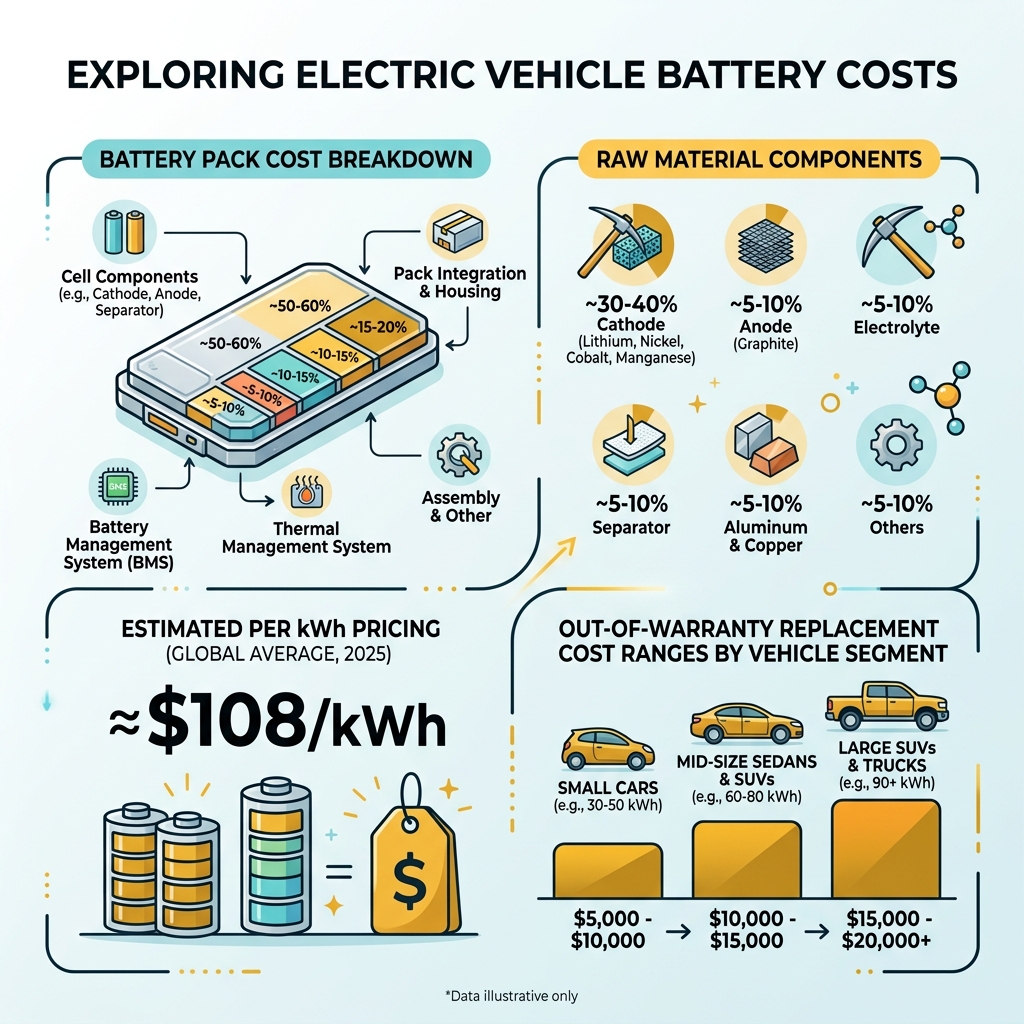
| Per kWh (global average, 2026) | ~$108/kWh |
| Per kWh (China LFP packs, 2026) | ~$81/kWh |
| Per kWh (North America, 2026) | ~44% above China pricing |
| Chance of needing replacement within warranty | Very low (~1.5% failure rate) |
| Standard warranty coverage | 8 years / 100,000 miles |
The good news? Most EV owners never pay a cent out of pocket for a battery replacement. Warranties cover the vast majority of failures, and modern batteries are built to last 10-20 years or 100,000-200,000 miles.
The bad news? If you do need one outside of warranty, the bill can sting hard.
Battery costs have fallen dramatically — down roughly 90% since 2008, from $1,355/kWh to around $108/kWh in 2026 according to BloombergNEF. Yet replacement quotes at dealerships still routinely land between $10,000 and $20,000 once you factor in labor, overhead, and parts markups.
That gap between falling manufacturing costs and real-world replacement bills is exactly what confuses most people — and what this guide is here to clear up.
I’m Faisal S. Chughtai, founder of ActiveX and a digital strategist with deep experience researching and communicating complex technology trends — including electric vehicle battery costs — in plain language for everyday consumers. In the sections below, we’ll walk through everything you need to make smart, confident decisions about EV ownership.
Glossary for electric vehicle battery costs:
Understanding Electric Vehicle Battery Costs in 2026
When we talk about electric vehicle battery costs, we have to look at two different numbers: the manufacturing cost (what it costs the factory to build the battery) and the replacement cost (what a dealership charges you to swap one out).
In 2026, the manufacturing floor has dropped significantly. According to the latest DOE estimates, battery pack costs for light-duty vehicles in 2023 were 90% lower than in 2008. This trend has continued into 2026, with global average pack prices hitting approximately $108 per kilowatt-hour (kWh).
However, if you walk into a dealership today for an out-of-warranty replacement, you aren’t paying $108/kWh. You are likely looking at a total bill between $5,000 and $20,000. Why the disconnect?
- Labor Expenses: High-voltage battery swaps require specialized technicians and safety equipment.
- Logistics: Shipping a 1,000-pound lithium-ion battery is incredibly expensive due to weight and hazardous material regulations.
- Retail Margins: Dealerships and manufacturers add significant markups to the base cell cost to cover overhead and profit.
The primary driver behind the falling prices is manufacturing overcapacity, particularly in China. With supply currently outpacing demand, competition is “cut-throat,” as industry analysts put it, forcing manufacturers to find every possible efficiency.
Why do electric vehicle battery costs vary by model?
Not all batteries are created equal. A battery for a compact city car is a completely different beast than the massive power plant found in a luxury SUV or a heavy-duty pickup.
The cost is primarily determined by three things:
- Pack Size (kWh): A Tesla Model 3 Long Range has a much larger “fuel tank” than a standard Nissan Leaf. More capacity equals more cells, which equals a higher bill.
- Energy Density & Chemistry: High-performance cars often use Nickel Manganese Cobalt (NMC) batteries, which are energy-dense but expensive. More affordable cars are shifting to Lithium Iron Phosphate (LFP), which is cheaper but heavier.
- Vehicle Architecture: Some modern cars use “Cell-to-Pack” (C2P) designs where cells are integrated directly into the chassis. This saves weight and cost but can make individual module repairs nearly impossible.
| Vehicle Model | Estimated Battery Size | Replacement Cost (Est. 2026) | Cost Per kWh (Retail) |
|---|---|---|---|
| Tesla Model 3 | 50 – 82 kWh | $10,000 – $16,000 | ~$170 – $200 |
| Nissan Leaf (40kWh) | 40 kWh | $8,000 – $12,500 | ~$200 – $310 |
| Chevy Bolt EV | 60 – 66 kWh | $14,000 – $16,500 | ~$230 – $250 |
| BMW i3 | 22 – 42 kWh | $16,000 – $33,000* | Variable |
| Hyundai Ioniq 5 | 58 – 77 kWh | $6,500 – $36,000** | Extreme Range |
- BMW i3 costs are notoriously high due to low production volumes and parts scarcity; some owners have reported quotes as high as $71,000 at dealerships, though third-party shops offer much cheaper module repairs. ** Hyundai Ioniq 5 costs vary wildly based on whether a full assembly or a specific module is replaced.
The Science of Battery Longevity and Replacement Rarity
If you’re worried that your EV battery will suddenly “die” like a smartphone after two years, we have some reassuring data for you. Research into over 15,000 plug-in EVs found that only 1.5% of batteries needed replacement due to failure (excluding manufacturer recalls).
Modern EV batteries are designed to outlast the car itself. Most manufacturers expect a lifespan of 10 to 20 years, or between 100,000 and 200,000 miles. By the time the battery has degraded to the point of being unusable (usually defined as losing 30% of its original capacity), the rest of the car’s components—like the suspension, interior, and body—might already be reaching the end of their lives.
What keeps these batteries alive so long? It’s the Battery Management System (BMS). This is a sophisticated computer that monitors every single cell in the pack. It manages:
- Thermal Management: Using liquid cooling or heating to keep the battery in its “happy” temperature range (usually 60°F to 95°F).
- Cycle Life: Preventing the battery from truly reaching 0% or 100% charge, which reduces chemical stress.
- Balancing: Ensuring all cells discharge and charge at the same rate to prevent “weak links” in the chain.
Managing out-of-pocket electric vehicle battery costs with warranties
The single best defense against high electric vehicle battery costs is the manufacturer’s warranty. In the United States, federal law requires that EV batteries be covered for at least 8 years or 100,000 miles. In states like California that follow stricter emissions rules, this can even extend to 10 years or 150,000 miles.
Most of these warranties aren’t just for total failure; they also cover capacity retention. Typically, if your battery’s health drops below 70% or 75% during the warranty period, the manufacturer must repair or replace it for free.
When buying a used EV, these warranties are almost always transferable to the new owner. This makes used EVs from 2020 or later a very safe bet, as they often have 4-5 years of factory protection remaining. Some companies even offer extended service contracts specifically for batteries, though you should read the fine print carefully to ensure they cover gradual degradation, not just “sudden death.”
Market Trends: LFP Adoption and the $100/kWh Tipping Point
We are currently witnessing a massive shift in how batteries are made. For years, the “Gold Standard” was Nickel Manganese Cobalt (NMC). It was powerful and light, but expensive and prone to price swings in the cobalt market.
Enter Lithium Iron Phosphate (LFP). This chemistry is taking over the world. In 2026, LFP accounts for roughly 65% of global cell production. Why?
- It’s significantly cheaper (averaging $81/kWh for packs in China).
- It doesn’t use expensive cobalt or nickel.
- It is much more durable, often lasting thousands more charge cycles than NMC.
- It is chemically more stable, meaning a lower risk of fire.
BloombergNEF’s recent industry price survey results show that while global prices are falling, where you live matters. China is the world leader in battery production, with pack prices averaging around $84/kWh. Meanwhile, North America and Europe face “regional premiums”—prices in the U.S. can be 44% higher than in China due to lower production volumes, higher labor costs, and import tariffs.
We are entering a “commodity-clearing” regime. This means that as manufacturing capacity continues to grow, batteries are becoming a standard commodity like steel or oil. This will eventually lead to price parity, where an electric car costs exactly the same (or less) to buy upfront as a gasoline car.
Alternatives to Full Battery Replacement
If you are out of warranty and hit with a $15,000 quote from a dealer, don’t panic. You have options that didn’t exist five years ago.
- Refurbished Packs: Companies like Greentec Auto specialize in taking old battery packs, testing the cells, and replacing only the failed ones. A refurbished Tesla or Leaf pack can often be had for 30% to 50% less than a brand-new one.
- Module-Level Repair: Most EV batteries are made of several “modules.” If only one module has failed, a skilled third-party technician can swap that specific section. This can turn a $12,000 replacement into a $2,500 repair.
- The Used Market: As more EVs are involved in accidents that don’t damage the battery, “salvage” batteries are becoming available. These are risky, but for an older car, they can be a budget-friendly way to stay on the road.
Before choosing any of these, you must get a State of Health (SoH) diagnostic. This isn’t just looking at the range on the dashboard; it’s a deep dive into the battery’s internal resistance and voltage balance.
What happens to the old batteries? They rarely go to a landfill. “Second-life” applications are booming. An EV battery that is too “weak” to power a car still has 70% of its capacity—perfect for home energy storage (storing solar power) or grid-scale backup systems.
Proactive Maintenance to Avoid High Costs
While you can’t control the market price of lithium, you can control how long your specific battery lasts. Think of your battery like a professional athlete: it performs best when it’s not pushed to its absolute limits every single day.
Here are our top tips to avoid ever having to pay for a replacement:
- The 20-80% Rule: Lithium batteries are most stressed when they are completely full or nearly empty. For daily driving, try to keep your charge between 20% and 80%. Only charge to 100% when you are heading out on a long road trip.
- Limit DC Fast Charging: Those “Superchargers” are amazing for road trips, but they generate significant heat. Frequent use of high-speed chargers can accelerate degradation. Stick to Level 2 (home/work) charging for 90% of your needs.
- Temperature Protection: Extreme heat is the #1 enemy of battery life. If it’s 100°F outside, park in the shade or a garage. If your car has a “preconditioning” feature, use it while the car is plugged in to bring the battery to the optimal temperature before you drive.
- Drive Steadily: Frequent “flooring it” creates massive power surges that heat up the battery cells. Smooth acceleration isn’t just safer; it’s better for your wallet.
- Software Updates: Always install the latest manufacturer updates. These often include improvements to the BMS that can extend the life of your pack.
Frequently Asked Questions about EV Batteries
How much does it cost to replace a Tesla battery in 2026?
For a Tesla Model 3, a full out-of-pocket battery replacement typically ranges from $10,000 to $16,000. This includes roughly $2,000 to $3,000 in labor. Tesla often offers “remanufactured” packs, which are batteries that have been repaired at the factory, as a lower-cost alternative to a “factory-new” pack. For the older Model S, costs can climb higher, with some owners reporting quotes of $20,000 to $22,000 for the larger 90kWh or 100kWh packs.
Will EV battery prices continue to fall through 2030?
Yes. Analysts forecast that prices will continue to drop, potentially reaching $69/kWh by 2030. This will be driven by even greater manufacturing efficiency and the emergence of new technologies. Solid-state batteries (which use a solid electrolyte instead of a liquid one) and sodium-ion batteries (which replace expensive lithium with cheap salt) are expected to enter the mass market later this decade, further driving down electric vehicle battery costs.
Does insurance cover EV battery replacement?
It depends on why the battery failed.
- Collision/Accidents: Yes. If you are in a wreck and the battery is damaged, your insurance (Collision coverage) will cover the replacement or “total” the car if the cost is too high.
- Mechanical Failure: No. Standard insurance does not cover a battery that simply stops working or wears out over time. That is what the manufacturer’s warranty is for.
- Specialized Policies: Some insurers now offer specific EV riders that provide better coverage for battery-related “total loss” scenarios, which can be helpful since even minor underside damage can sometimes lead to a full battery replacement recommendation for safety reasons.
Conclusion
At Apex Observer News, we’ve seen the narrative around EVs shift from “experimental” to “inevitable.” While electric vehicle battery costs remain the single largest component of an EV’s price tag, the trend is overwhelmingly positive. With costs down 90% over the last 15 years and failure rates remaining incredibly low, the “battery anxiety” of the past is quickly becoming a myth.
Whether you are looking for the latest business news on manufacturing trends or just trying to decide if a used EV is right for your family, the battery is a robust, highly engineered piece of technology. By understanding your warranty and following simple maintenance habits, you can enjoy the savings of electric driving without the fear of a surprise five-figure bill.
The electrification tipping point isn’t just coming—it’s already here.
