

What Is the Currency Ranking in the World Right Now?
Currency ranking in the world is a topic that surprises most people — because the US dollar, despite being the most powerful currency globally, is not the highest-valued one.
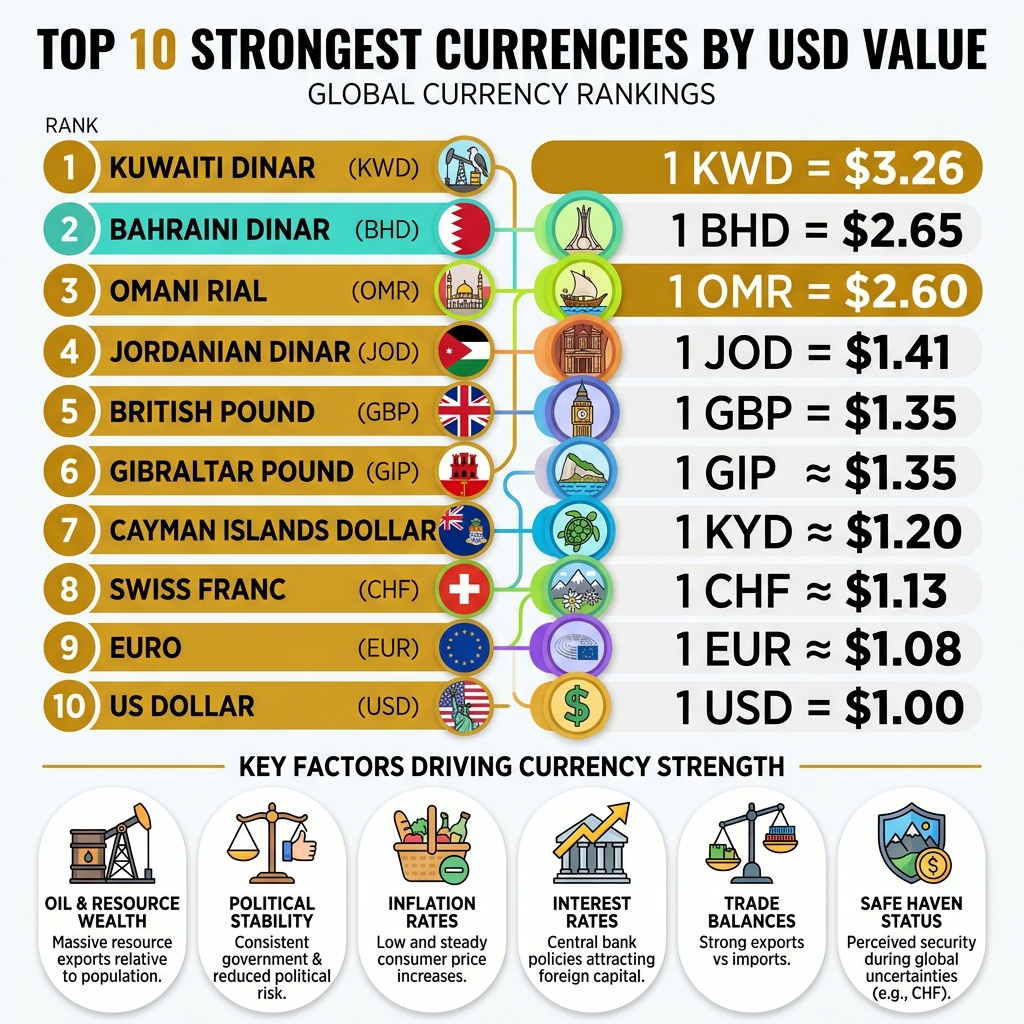
Here is a quick snapshot of the top 10 strongest currencies ranked by value against the US dollar:
| Rank | Currency | Code | Value vs. USD |
|---|---|---|---|
| 1 | Kuwaiti Dinar | KWD | 1 KWD = $3.26 |
| 2 | Bahraini Dinar | BHD | 1 BHD = $2.65 |
| 3 | Omani Rial | OMR | 1 OMR = $2.60 |
| 4 | Jordanian Dinar | JOD | 1 JOD = $1.41 |
| 5 | British Pound | GBP | 1 GBP = $1.35 |
| 6 | Gibraltar Pound | GIP | 1 GIP ≈ $1.35 |
| 7 | Cayman Islands Dollar | KYD | 1 KYD ≈ $1.20 |
| 8 | Swiss Franc | CHF | 1 CHF ≈ $1.13 |
| 9 | Euro | EUR | 1 EUR ≈ $1.08 |
| 10 | US Dollar | USD | 1 USD = $1.00 |
At the other end of the spectrum, the Iranian Rial (IRR) is the weakest currency in the world — 1 USD buys approximately 371,992 IRR.
Currency value is shaped by oil wealth, political stability, inflation, interest rates, and trade balances. Small, oil-rich nations like Kuwait, Bahrain, and Oman consistently top the rankings — not because of large economies, but because of massive resource wealth spread across small populations.
This guide breaks down every major factor, from the strongest to the weakest currencies, and explains what it all means for travelers, investors, and everyday consumers.
I’m Faisal S. Chughtai, founder of ActiveX, with years of experience in digital marketing, SEO, and business analytics — including tracking global economic trends like currency ranking in the world that directly impact financial decision-making. My work sits at the intersection of data, strategy, and clear communication, which is exactly what you’ll find in the detailed review ahead.
The Top 10 Strongest Currencies in the World
When we talk about the currency ranking in the world, we have to distinguish between “strength” (how much one unit buys) and “power” (how much it is used). If you are holding a Kuwaiti Dinar, you have the most “expensive” piece of paper in the world.
1. Kuwaiti Dinar (KWD)
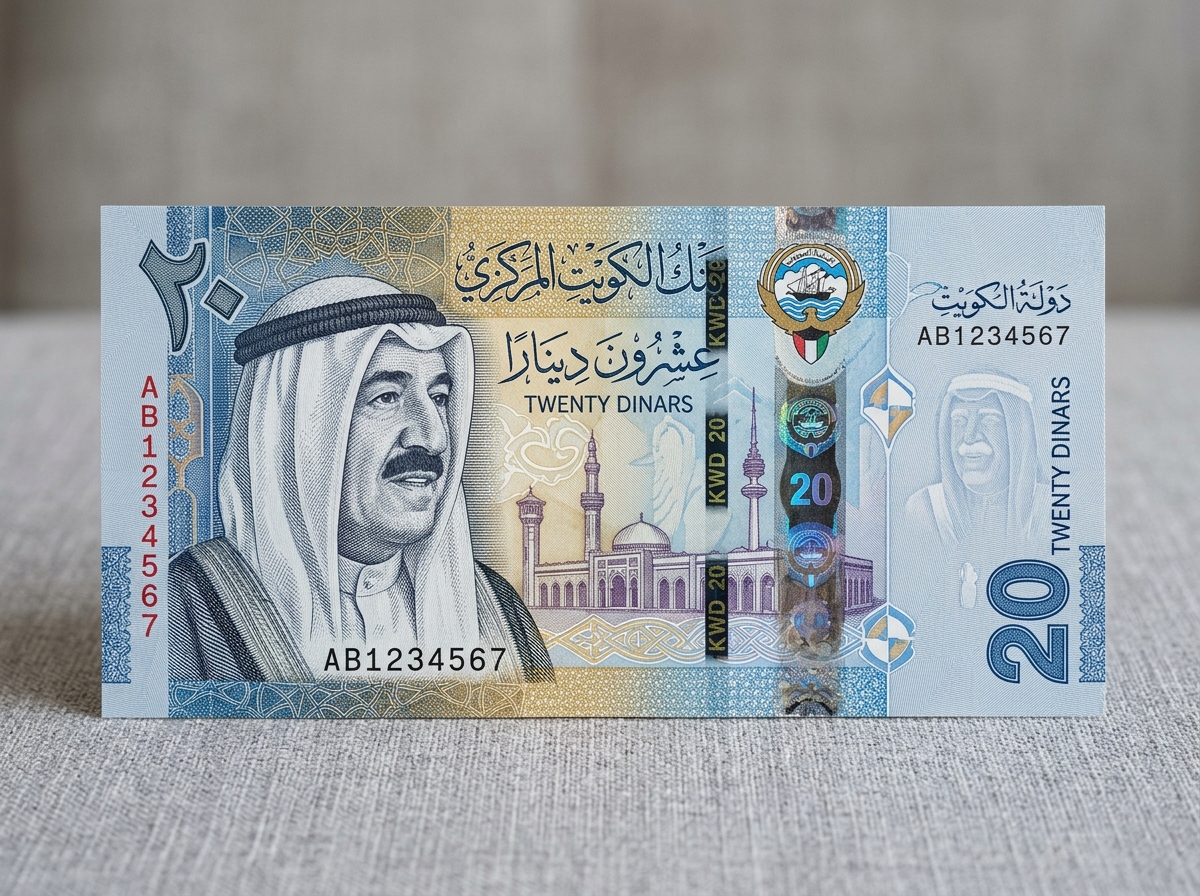
The undisputed heavyweight champion. Introduced in 1961, the KWD has held the top spot for decades. Why? Kuwait sits on roughly 7% of the world’s proven oil reserves. With a relatively small population of about 5.2 million, the “math of wealth” is simple: massive oil exports divided by few people equals a very high-value currency.
2. Bahraini Dinar (BHD)
Ranked second, the BHD is pegged to the US dollar but maintains a higher face value. Bahrain was the first Gulf state to discover oil, but it has since diversified into a major financial hub. This stability keeps its currency at a premium.
3. Omani Rial (OMR)
Oman follows a similar blueprint to its neighbors. The Rial is highly valued because of the country’s prudent monetary policy and significant oil exports. Since 1986, it has maintained a fixed exchange rate with the USD, ensuring that 1 OMR consistently buys over $2.60.
4. Jordanian Dinar (JOD)
Jordan is a fascinating outlier. Unlike the others above it, Jordan doesn’t have massive oil reserves. Instead, its strength comes from a rigid peg to the US dollar and significant support from international aid and remittances. The government maintains high interest rates to keep the JOD attractive to investors.
5. British Pound (GBP)
The oldest currency still in use, the Pound Sterling is a global heavyweight. While it lost its “world reserve” status to the dollar after WWII, it remains a symbol of stability and is the fourth most traded currency. According to the Triennial Central Bank Survey on Foreign Exchange, the GBP continues to play a massive role in global finance.
6. Gibraltar Pound (GIP)
Gibraltar is a British Overseas Territory, and its pound is pegged at par (1:1) with the British Pound Sterling. Its value is essentially a mirror of the UK’s currency.
7. Cayman Islands Dollar (KYD)
As a world-renowned offshore financial center and tax haven, the Cayman Islands attracts trillions of dollars in capital. This demand for the local currency for licensing and financial operations keeps the KYD valuation high.
8. Swiss Franc (CHF)
The ultimate “safe-haven” asset. Switzerland’s neutrality, low debt levels, and historically low inflation make the Franc the currency people run to when the world gets messy. In 2025, the CHF strengthened significantly against the dollar as global uncertainty rose.
9. Euro (EUR)
The Euro represents 20 member states of the European Union. It is the second most traded currency and the second largest reserve currency. While individual economies within the Eurozone vary, the collective strength of the bloc keeps the Euro consistently stronger than the US dollar.
10. US Dollar (USD)
The benchmark. Even though it is 10th on this list by unit value, it is the most important currency on the planet. It is the primary reserve currency and the “grease” that keeps global trade moving.
Defining the Strongest Currency Ranking in the World
“Strongest” in this context refers to nominal value—how many US dollars you get for one unit of the foreign currency. For the Gulf nations, this is achieved through fixed exchange rates backed by massive sovereign wealth funds. Kuwait’s fund, for example, manages over $900 billion, providing a “cushion” that ensures the Dinar never wavers, even when oil prices dip.
How the US Dollar Dominates the Currency Ranking in the World
It might seem odd that the dollar is #10, but its power isn’t in its price—it’s in its ubiquity. The dollar is currently at a dollar at 3-month high as traders pare near-term rate cut wagers, showing that when the economy gets tight, investors still want the greenback. It accounts for nearly 90% of all forex trades and makes up about 56% of global currency reserves.
Most Traded Currencies vs. Highest Value Currencies
There is a massive difference between a currency being “expensive” and being “useful.” You can’t easily walk into a shop in Tokyo and pay with Kuwaiti Dinars.
Trading Volume and the Global Currency Ranking in the World
The forex market is a monster, trading roughly $6.6 trillion every single day. While the KWD is the most valuable, it barely registers in terms of trading volume. The most traded currencies are:
- US Dollar (USD): Involved in almost 90% of trades.
- Euro (EUR): The second pillar of global finance.
- Japanese Yen (JPY): A favorite for “carry trades” due to low interest rates.
- British Pound (GBP): A staple of European trade.
When markets get volatile, we often see a bond and bitcoin selloff leaves stocks unsteady, leading traders to move their money into “safe-haven” currencies like the Swiss Franc or the Japanese Yen. According to IMF data on official foreign exchange reserves, the USD and EUR remain the dominant choices for central banks around the world.
Economic Drivers of Currency Strength and Volatility
Why does one currency soar while another crashes? It’s not magic; it’s math and politics.
The Role of Oil in Middle Eastern Currency Value
For Kuwait, Bahrain, and Oman, currency strength is literally pumped out of the ground. These nations operate on a “petrodollar” system where their exports generate massive USD inflows. By keeping their populations small and their reserves high, they can afford to keep their exchange rates high. The CIA World Factbook on economic geography highlights how these resource-rich nations use their geography to anchor their monetary value.
Impact of Inflation and Interest Rates
Inflation is the “silent killer” of currency value. If a country prints too much money, each unit becomes worth less. Central banks counter this by raising interest rates. When the Fed raises rates, as seen in our federal reserve interest rates current rates guide, the dollar usually gets stronger because it offers a better return for investors.
We saw this recently with the june cpi numbers and what they mean for your wallet; when inflation stays high, the central bank is forced to keep rates high, which keeps the currency “strong” but makes borrowing more expensive for us.
The World’s Weakest Currencies: Factors of Decline
On the flip side of the currency ranking in the world, we find nations struggling with hyperinflation and instability.
The Iranian Rial (IRR) is often cited as the weakest. Decades of economic sanctions, political unrest, and a lack of foreign investment have decimated its value. When a country is cut off from global trade, its currency becomes almost worthless outside its borders.
Similarly, the Lebanese Pound and the Vietnamese Dong face their own hurdles. In some cases, we even see the dollar edges down against dong on black market, where the “official” rate and the “street” rate are miles apart. Weak currencies are usually the result of:
- Hyperinflation: Prices rising so fast the currency loses value by the hour.
- Political Instability: Coups or wars that destroy investor trust.
- High Debt: Governments printing money to pay off loans they can’t afford.
Frequently Asked Questions about Currency Ranking in the World
What is the strongest currency in the world and why?
The Kuwaiti Dinar (KWD) is the strongest. Its value is driven by Kuwait’s massive oil exports, a small population, and a sophisticated sovereign wealth fund that maintains a managed exchange rate basket.
Why is the US Dollar not the highest-valued currency?
Currency value is relative. The US has a massive economy, but it also has a massive supply of dollars in circulation (over $2 trillion in physical cash alone). The US prioritizes the dollar being a “medium of exchange” for the whole world, which requires it to be widely available rather than artificially “expensive.”
How do exchange rate fluctuations affect international travel?
If you’re traveling from a “strong” currency country (like the US) to a “weak” currency country (like Vietnam or Turkey), your money goes much further. You’ll find that hotels, meals, and tours are significantly cheaper. Conversely, travelers from weak-currency nations find it very expensive to visit places like London, New York, or Geneva.
Conclusion
Understanding the currency ranking in the world is about more than just knowing which bill has the most zeros. It’s a window into global power, resource wealth, and the health of national economies. Whether it’s the oil-backed dominance of the Kuwaiti Dinar or the safe-haven reliability of the Swiss Franc, these rankings affect everything from the price of your morning coffee to the cost of your next vacation.
At Apex Observer News, we are dedicated to bringing you the most current and comprehensive market analysis. Stay ahead of the curve by checking out More business and crypto news for the latest updates on global finance.
