


Why Brokerage and Trading Is Your Gateway to Building Real Wealth
Brokerage and trading is how everyday people buy and sell investments like stocks, ETFs, bonds, and crypto — all through an account that works very differently from a regular bank account.
Here’s a quick snapshot of what you need to know:
| Topic | Key Fact |
|---|---|
| What it is | An account to buy/sell investments through a licensed firm |
| Cost to start | $0 minimum at most major brokers |
| Commissions | $0 for online US stocks and ETFs |
| SIPC protection | Up to $500,000 ($250,000 for cash) |
| Yield on idle cash | Up to ~3.32% via money market funds |
| Account types | Cash account or margin account |
| Top brokers | Fidelity, Schwab, E*TRADE, Interactive Brokers |
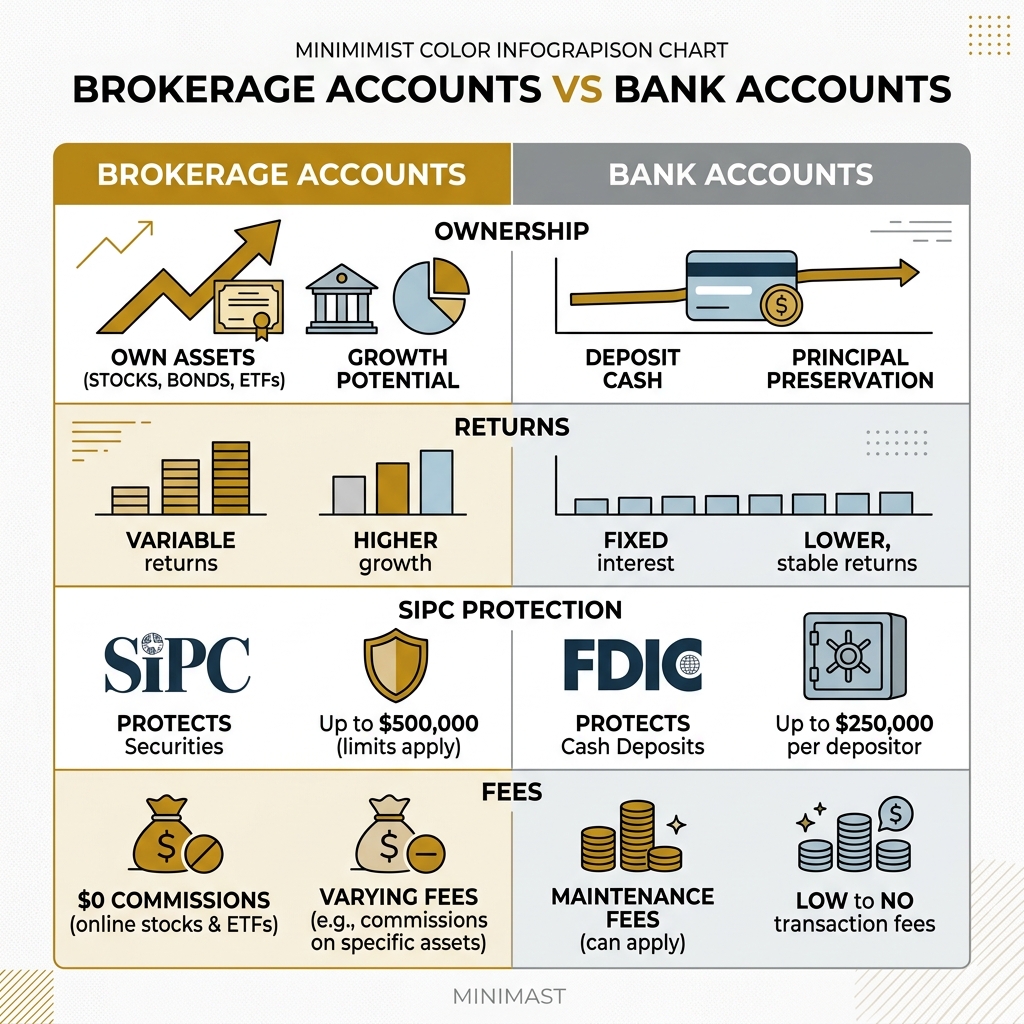
Unlike a bank account, a brokerage account lets you own assets — shares of companies, funds, bonds — that can grow in value over time. Your money isn’t just sitting there earning a tiny interest rate. It’s working in the market.
The tradeoff? Investments can go down in value, and there are rules, fees, and choices that can feel overwhelming at first. That’s exactly what this guide cuts through.
I’m Faisal S. Chughtai, founder of ActiveX, with hands-on experience in digital strategy, financial platforms, and helping people navigate complex ecosystems — including brokerage and trading. Let’s break it all down so you can make confident, informed decisions.
Basic brokerage and trading terms:
The Essentials of Brokerage and Trading
When we talk about a brokerage account, we are describing an arrangement between an individual and a licensed brokerage firm. Think of it as a specialized bucket for your financial assets. While a bank account is primarily for storing cash and facilitating transactions, a brokerage account is designed for growth and market participation.
Once you set up your account and deposit funds, you can place orders to buy or sell various securities. The most important distinction here is asset ownership. In a brokerage account, you aren’t just a “depositor”; you are an owner of the underlying stocks, bonds, or mutual funds you purchase.
Safety is always a top concern for us. It is vital to understand that brokerage accounts are insured differently than bank accounts. While the FDIC covers banks, brokerage firms are typically members of the Securities Investor Protection Corporation (SIPC). If a firm fails, SIPC protection covers up to $500,000 in lost or missing assets, which includes a $250,000 limit for cash. However, it is crucial to remember that SIPC does not protect you against market losses—if your favorite tech stock drops to zero, SIPC isn’t going to write you a check.
For a deeper dive into the technical side of these systems, check out our guide on Everything You Need to Know About Best Trading Platform.
Opening Your First Account for Brokerage and Trading
Getting started is surprisingly fast. Most modern platforms allow us to open an account online in about 10 minutes. However, because these firms are regulated by the SEC and FINRA, they are required to verify who you are under the USA PATRIOT Act.
When you sit down to apply, have the following information ready:
- Social Security Number (SSN) or Taxpayer Identification Number.
- Employment Information: The firm needs to know where you work and your annual income.
- Financial Profile: You’ll be asked about your net worth and investment experience.
- Identity Verification: You may need to upload a photo of a government-issued ID.
Once the account is approved, you need to fund it. Most of us use Electronic Funds Transfers (EFT) from a linked bank account, which is usually the fastest method. You can also use wire transfers, mail in a physical check, or transfer an existing account from another broker.
If you are feeling a bit lost on which firm to choose, we recommend reading The Ultimate Guide to Picking Your First Stock Market Broker.
Essential Strategies for Successful Brokerage and Trading
Before you place your first trade, we need to talk about strategy. Successful brokerage and trading isn’t about “getting lucky” on a meme stock; it’s about discipline and understanding your personal risk tolerance.
- Risk Tolerance: Are you okay with seeing your account value drop 20% in a month if it means potentially higher long-term gains? If that thought keeps you up at night, your strategy should lean more toward bonds and stable ETFs.
- Diversification: Don’t put all your eggs in one basket. By spreading investments across different sectors (tech, healthcare, energy) and asset classes (stocks, bonds, real estate), we can reduce the impact of any single investment’s poor performance.
- Automated Investing: Many brokers now allow you to set your investing on “repeat.” This helps manage market volatility through dollar-cost averaging—buying a set amount regardless of the current price.
- Tax-Loss Harvesting: This is a strategy where you sell an investment that is at a loss to offset capital gains tax liabilities. It’s a great way to keep more of your profits in your pocket.
For more tips on tailoring your account to your specific needs, see our article on Finding the Best Stock Broker Platform for Your Portfolio.
Comparing Account Types and Fee Structures
The landscape of brokerage and trading has changed dramatically over the last few years. The “Zero Commission Dream” is now a reality for most online US stock and ETF trades. However, while the headlines say “$0,” there are still nuances in the fee structures that we need to watch out for.
Broker Comparison Table (Current Market Rates)
| Broker | Stock/ETF Commission | Options Fee (per contract) | Margin Rate (Base) |
|---|---|---|---|
| Fidelity | $0 | $0.65 | 7.50% |
| Charles Schwab | $0 | $0.65 | 10.075% |
| E*TRADE | $0 | $0.65 ($0.50 for 30+ trades) | 10.45% |
| Interactive Brokers | $0 (Lite) / Tiered (Pro) | $0.15 – $0.65 | 6.33% – 7.33% |
| Vanguard | $0 | $1.00 | 10.00% |
As you can see, while trading stocks is free, options and margin rates vary significantly. If you plan on trading 50 options contracts a week, that $0.15 difference between brokers adds up fast! To avoid hidden costs, read our guide on How to Find the Best Low Commission Stock Broker Without Getting Fleeced.
Cash vs. Margin Account Requirements
When you open an account, you have two primary choices: a cash account or a margin account.
- Cash Accounts: You can only buy securities using the money you have actually deposited. If you have $1,000, you can buy $1,000 worth of stock. It is simpler and carries less risk.
- Margin Accounts: These allow you to borrow money from the broker to buy more securities. Under Regulation T, firms can generally lend you up to 50% of the purchase price.
The Risks of Margin: Borrowing money isn’t free. You’ll pay interest (margin rates), and if the value of your stocks drops too low, you’ll hit a margin call. This is when the broker requires you to deposit more cash or sell assets immediately. Under FINRA rules, the maintenance margin is typically 25%, but many brokers have stricter “house” requirements.
For the legal nitty-gritty, you can view the official Regulation T Requirements.
Maximizing Yield on Uninvested Cash
One of our favorite “hacks” in modern brokerage and trading is making sure your idle cash is actually earning something. If you sell a stock and don’t immediately reinvest the money, where does it go?
In the past, it sat there earning 0.01%. Today, top brokers offer “cash sweep” programs. For example, Fidelity offers a 7-day yield of 3.32% on uninvested cash in the SPAXX money market fund (as of February 26, 2026). Some brokers like Interactive Brokers or Robinhood (with Gold) offer even higher rates, sometimes exceeding 4% or 5%.
Always check your broker’s SPAXX Performance Data or equivalent money market fund yields to ensure your “sideline” cash is keeping up with inflation.
Evaluating Platform Features and Investment Options
Modern brokerage accounts aren’t just for stocks anymore. We now have access to a dizzying array of assets right from our smartphones.
- Fractional Shares: This is a game-changer. Fidelity, Schwab, and Robinhood allow you to buy “slices” of expensive stocks. Want to own a piece of a $3,000 stock but only have $10? You can. Fidelity offers fractional shares for as little as $1.
- ETFs and Mutual Funds: These allow us to buy a “basket” of stocks in one go.
- Bonds and CDs: For those looking for fixed income and more stability.
- Crypto: Many brokers now integrate Bitcoin and Ethereum trading directly into the app.
- International Markets: Some brokers (like Interactive Brokers) give us access to 170 markets in 40 countries.
To learn more about trading without fees, read The Zero Commission Dream: A Guide to Free Stock Trading.
Advanced Tools for Modern Brokerage and Trading
For those of us looking to move beyond basic buy-and-hold, brokers are rolling out high-tech tools:
- Prediction Markets: Platforms like Kalshi (integrated with Robinhood) allow us to trade “event contracts.” You can literally bet on whether the Fed will lower interest rates or who will win an election. In Q2 2025 alone, Robinhood users traded approximately $1 billion in these event contracts.
- AI Analysis: Platforms are beginning to integrate AI tools (like xAI’s Grok or Polymarket’s AI context) to provide instant market analysis and probability shifts.
- Technical Charting: Tools like Schwab’s thinkorswim or TradeStation’s TITAN X provide institutional-grade charting for advanced traders.
Before diving into complex instruments, make sure you understand the Characteristics and Risks of Standardized Options.
Research and Educational Resources for Beginners
You don’t need a finance degree to succeed in brokerage and trading. Most top-rated brokers provide a wealth of free resources:
- Paper Trading: Webull and Interactive Brokers offer “simulated” trading with fake money so you can practice without risk.
- Webinars: E*TRADE hosts weekly “getting started” webinars every Wednesday at 11 a.m. ET.
- Independent Research: Fidelity provides research from over 20 independent providers like Morningstar and Argus.
Check out our guide on Online Free Stock Trading: How to Keep Your Profits in Your Pocket for more educational tips.
Account Transfers and Security Protections
If you are unhappy with your current broker, you aren’t stuck. Moving your money is a standardized process called ACATS (Automated Customer Account Transfer Service).
- Timeline: A standard transfer usually takes 3 to 4 business days.
- In-Kind Transfers: You don’t have to sell your stocks to move them. You can move the actual shares (in-kind) so you don’t trigger a tax event.
- Fees: While the new broker usually won’t charge you to join, your old broker might charge a “close-out” fee (typically $50-$100). Many new brokers will reimburse this fee if you ask!
Security is Paramount: We always recommend enabling Multi-Factor Authentication (MFA). Most brokers also offer a “Trusted Contact” feature—someone the firm can call if they suspect you are being defrauded or if there is suspicious activity on your account.
Common Investor Questions
What is the difference between a brokerage and a bank account?
A bank account is for saving and spending cash with FDIC protection. A brokerage account is for buying assets (stocks, bonds) that have the potential to grow but also carry market risk. Brokerage accounts are protected by SIPC, which covers the firm’s failure, not your investment losses.
How long does it take to transfer assets between brokers?
Using the ACATS system, most transfers are completed within 3 to 7 business days. It is best to avoid trading during this window to prevent any delays in the settlement process.
Are my investments protected if a brokerage firm fails?
Yes, if the firm is a member of SIPC. You are covered for up to $500,000 in total value, which includes a $250,000 cap on cash. Again, this only protects against the firm going bust, not the stock market going down.
Conclusion
At Apex Observer News, we believe that understanding brokerage and trading is the first step toward true financial independence. Whether you are starting with $1 in fractional shares or rolling over a 401(k), the tools available today have made the markets more accessible than ever before.
By choosing the right platform, staying diversified, and keeping an eye on those pesky margin rates, you can build a portfolio that stands the test of time. Stay informed, stay disciplined, and keep your eyes on the long-term prize.
For the latest updates on market trends and financial literacy, visit our Latest Stock Market News and Analysis.

One thought on “Cheat Sheet to Brokerage and Trading”
Comments are closed.