

Who Was Cesar Chavez? The Labor Leader Who Changed American History
Cesar Chavez was an American labor leader and civil rights activist who spent his life fighting for the rights of farmworkers across the United States. Here is a quick snapshot:
| Key Fact | Detail |
|---|---|
| Born | March 31, 1927, Yuma, Arizona |
| Died | April 23, 1993, aged 66 |
| Known For | Co-founding the United Farm Workers (UFW) |
| Key Tactic | Nonviolent resistance — strikes, boycotts, hunger fasts |
| Biggest Win | California Agricultural Labor Relations Act (1975) |
| Famous Motto | “Sí, se puede” — Yes, we can |
Born into a family that lost everything in the Great Depression, Chavez became a migrant farmworker as a child. He later built one of the most powerful labor movements in U.S. history — and his story is one of both remarkable courage and real complexity.
His movement won better wages, safer conditions, and landmark legal protections for some of America’s most vulnerable workers. Yet recent years have brought serious new scrutiny to his personal conduct and leadership style.
Today, Chavez remains a deeply significant — and newly debated — figure in American history.
I’m Faisal S. Chughtai, founder of ActiveX, with extensive experience researching and writing about influential figures like Cesar Chavez whose legacies sit at the intersection of social justice, community organizing, and public debate. In the sections below, we’ll break down everything you need to know — from his early life to the controversies reshaping how the world sees him.
Essential cesar chavez terms:
The Early Life and Achievements of Cesar Chavez
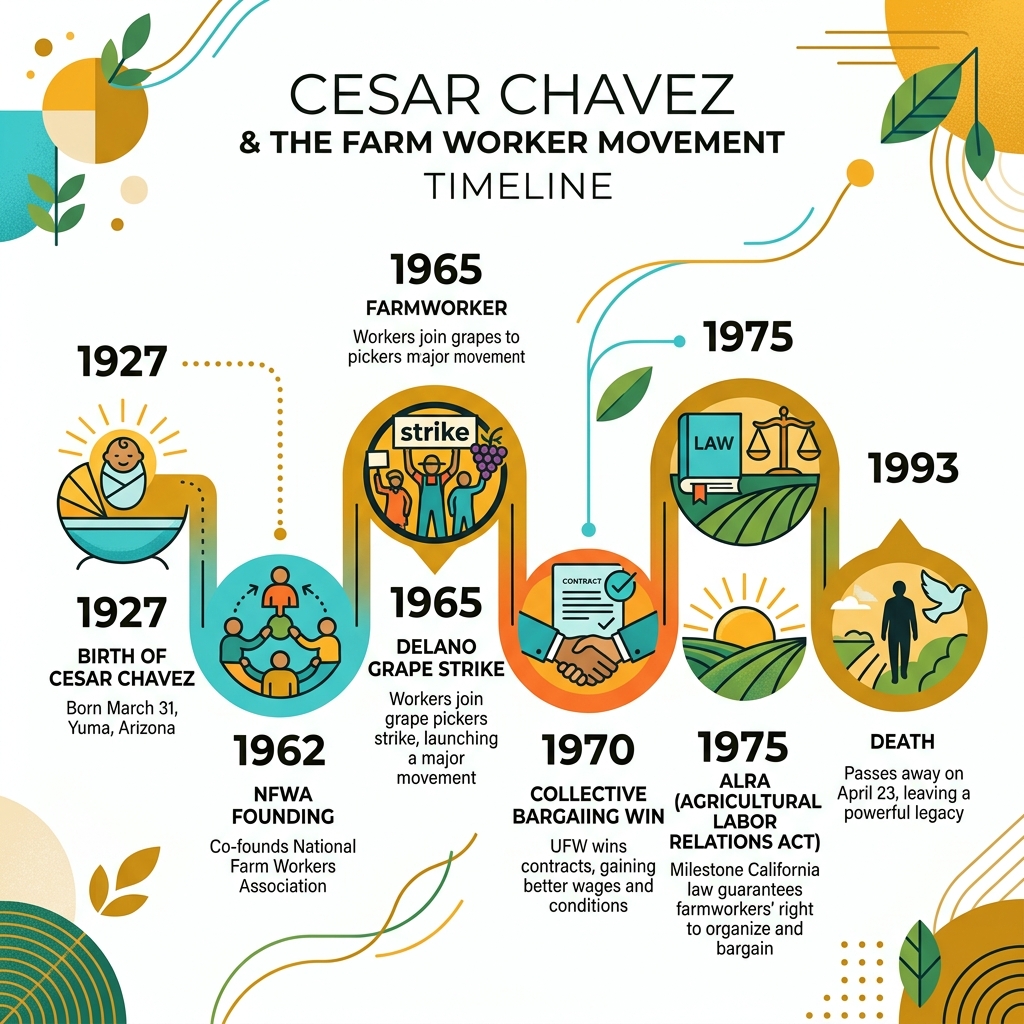
The journey of Cesar Chavez began in Yuma, Arizona, where he was born on March 31, 1927. His family owned a small farm and a grocery store, but the harsh winds of the Great Depression blew their stability away. In 1938, after the family lost their homestead to foreclosure, they joined the exodus of 300,000 “Dust Bowl” migrants heading west to California.
This transition from landowner to migrant laborer was a defining trauma for young Chavez. He spent his youth moving from one harvest to the next, following the crops across California. This transient lifestyle meant his education was constantly interrupted; it is estimated that he attended more than 36 schools before finally dropping out after the eighth grade to work in the fields full-time to support his family.
After serving two years in the U.S. Navy from 1946 to 1948, Chavez returned to California and married Helen Fabela, whom he had met in the Delano vineyards. His entry into formal activism came in 1952 when he joined the Community Service Organization (CSO), a Latino civil rights group. Under the mentorship of Fred Ross and influenced by the teachings of Saul Alinsky, Chavez learned the art of grassroots organizing, leading voter registration drives and fighting against racial discrimination.
It was during these years that he met Dolores Huerta, a fellow organizer who would become his most vital partner. In 1962, after the CSO refused to focus specifically on farmworkers, Chavez resigned. Using his life savings of $1,200, he moved to Delano to found the National Farm Workers Association (NFWA). While he organized door-to-door, Helen worked in the fields to keep the family afloat.

The Impact of the Delano Grape Strike on Cesar Chavez
The true test of Cesar Chavez and his fledgling union came in September 1965. Filipino-American farmworkers, led by Larry Itliong and the Agricultural Workers Organizing Committee (AWOC), walked off the job at grape vineyards in Delano, demanding wages equal to the federal minimum. Chavez’s NFWA joined the strike, a move that eventually led to the merger of the two groups into what we now know as the United Farm Workers (UFW).
The Delano Grape Strike lasted a grueling five years. Because farmworkers were not protected by the National Labor Relations Act, they had no legal right to unionize or bargain. Chavez realized that the workers couldn’t win on the picket lines alone because growers could simply hire strikebreakers. He shifted the battlefield to the American dinner table.
By launching a nationwide consumer boycott of California table grapes, the UFW applied massive economic pressure on the agricultural industry. UFW activists traveled to major cities across North America, convincing millions of Americans to stop buying grapes. By 1970, the pressure became unbearable for the industry. Major growers, including Schenley Industries and Giumarra Vineyards, finally signed contracts that provided workers with higher pay, health benefits, and protection against toxic pesticides.
This momentum eventually led to the passage of the California Agricultural Labor Relations Act of 1975, the first law in U.S. history to grant farmworkers the right to organize and hold secret-ballot union elections.
Nonviolent Tactics: Hunger Strikes and Boycotts
One of the most remarkable aspects of the movement led by Cesar Chavez was its unwavering commitment to nonviolence. Chavez was deeply inspired by the spiritual and political philosophy of Mahatma Gandhi and Dr. Martin Luther King Jr. He believed that the moral authority of a nonviolent movement would eventually overcome the physical and economic power of the growers.
To maintain discipline within the union and draw national attention to “La Causa,” Chavez turned to the “fast” as a form of spiritual and political penance. His most famous hunger strike occurred in 1968. For 25 days, Chavez consumed nothing but water to rededicate the movement to nonviolence. The fast ended in a massive public event where Senator Robert F. Kennedy joined Chavez to break bread, calling him “one of the heroic figures of our time.”
Chavez’s commitment to self-sacrifice continued throughout his life. In 1972, he fasted for 25 days to protest an Arizona law that banned farmworker organizing. Later, in 1988 at the age of 61, he undertook a 36-day “Fast for Life” to highlight the dangers of pesticides to both farmworkers and consumers. These fasts took a permanent toll on his health, but they successfully galvanized public support and kept the plight of the workers in the national headlines.
Another iconic tactic was the 340-mile march from Delano to Sacramento in 1966. What began with 50 marchers grew into a massive demonstration of 8,000 people by the time they reached the state capitol on Easter Sunday. These events weren’t just about labor; they were about the dignity of the Latino community.
Controversies and the 2026 Sexual Abuse Allegations
While Cesar Chavez has long been celebrated as a saint-like figure, historians and former colleagues have also pointed to a more complex and sometimes troubling reality. As the UFW grew, Chavez’s leadership style became increasingly autocratic. In the late 1970s, he became influenced by Synanon, a controversial drug rehabilitation cult. He began implementing “The Game,” a form of aggressive group confrontation, at the UFW headquarters in La Paz. This led to internal purges of longtime staff and a decline in the union’s effectiveness.
One of the most persistent criticisms involves the “Illegals Campaign.” In the 1970s, Chavez viewed undocumented immigrants as a tool used by growers to break strikes. The UFW occasionally reported undocumented workers to federal authorities and even organized a “wet line” patrol along the U.S.-Mexico border to prevent crossings, a campaign that reportedly involved instances of violence.
However, the most significant shift in public perception occurred in March 2026. A bombshell investigative report published by The New York Times and other major outlets detailed allegations of sexual abuse against Cesar Chavez.
The 2026 allegations were profoundly shocking. Dolores Huerta, the co-founder of the UFW and Chavez’s lifelong ally, issued a statement revealing that she had been pressured into sexual encounters by Chavez in the 1960s, resulting in two secret pregnancies. Furthermore, women like Ana Murguia and Debra Rojas came forward with allegations of grooming and abuse that began when they were teenagers working within the movement in the 1970s.
Re-evaluating the Legacy of Cesar Chavez
The fallout from the 2026 revelations was immediate and widespread. Across the country, the annual celebrations for Cesar Chavez Day were canceled as communities and organizations struggled to reconcile the leader’s historic achievements with the devastating personal allegations.
The United Farm Workers union canceled its tribute events, and several universities and cities began discussions about removing monuments or renaming streets and schools that bear his name. The Cesar Chavez Foundation, which manages his legacy and various social enterprises, has faced intense pressure to respond, with many advocates calling for a “warts and all” approach to history that acknowledges both the progress he led and the harm he allegedly caused.
The legacy of Cesar Chavez has evolved from that of an unassailable hero to a much more complex figure. For many in the Latino community and the labor movement, the challenge is how to honor the collective victories of the farmworkers — the better wages, the pesticide protections, and the sense of empowerment — without excusing the conduct of the man at the top. As California Governor Gavin Newsom noted, the movement was always “much bigger than one man.”
Frequently Asked Questions about the Movement
What was the ‘Illegals Campaign’ in the labor movement?
This refers to a controversial period in the 1970s when the UFW, under Cesar Chavez, took a hardline stance against undocumented workers. Chavez believed that growers used undocumented labor to undermine strikes and depress wages. The UFW advocated for strict border enforcement and, in some cases, reported workers to the INS. This remains a point of contention among activists who believe the movement should have practiced broader immigrant solidarity.
How did the 2026 allegations affect public holidays?
The 2026 sexual abuse allegations led to a nationwide wave of event cancellations for Cesar Chavez Day. Many organizations and political leaders who previously championed the holiday withdrew their support. In some regions, there have been legislative proposals to rename the holiday “Farmworker Day” to honor the collective struggle of the workers rather than a single individual.
What is the lasting impact of the UFW today?
Despite its decline in membership from its peak (dwindling to about 22,000 by 1992), the UFW’s impact is still felt. It pioneered the use of consumer boycotts as a political tool and was instrumental in passing the 1975 Agricultural Labor Relations Act. Today, the UFW continues to advocate for heat stress protections, pesticide safety, and the rights of farmworkers in California and beyond.
Conclusion
The story of Cesar Chavez is a quintessential American saga — one of hardship, triumph, and the messy reality of human fallibility. He took the invisible struggle of the farmworker and made it the conscience of a nation. Through his leadership, millions of Americans learned that their food came at a human cost, and thousands of workers learned that through unity, they could demand dignity.
However, the recent allegations have reminded us that even our most celebrated icons are human. As we look at the legacy of Cesar Chavez today, we see a movement that changed the world, led by a man whose personal actions have cast a long shadow over his professional achievements. At Apex Observer News, we believe in covering these stories with the nuance they deserve, acknowledging the monumental shifts in labor rights while holding the figures behind them accountable.
| Legacy Aspect | Historical View (Pre-2026) | Modern Scrutiny (Post-2026) |
|---|---|---|
| Leadership | Inspirational, saint-like, nonviolent | Autocratic, cult-like influence, internal purges |
| Personal Conduct | Devoted family man, lived in poverty | Allegations of sexual abuse and grooming |
| Immigration | Champion of Latino rights | Hardline stance against undocumented “strikebreakers” |
| Impact | Won landmark labor laws for farmworkers | Movement successes are seen as separate from the man |
The “Si se puede” spirit lives on, but it is now carried by a new generation of activists who seek to build a movement that is as safe for its participants as it is effective for its cause.
