


What Are Real Estate Investment Trusts (REITs)?
Real estate investment trusts are companies that own, operate, or finance income-producing real estate — and let everyday investors buy in like a stock.
Here’s the quick version:
| Feature | Details |
|---|---|
| What it is | A company that owns income-producing real estate |
| How you invest | Buy shares on a stock exchange (like buying Apple stock) |
| How you earn | Dividends paid from rental income or mortgage interest |
| Dividend requirement | Must pay out at least 90% of taxable income to shareholders |
| Minimum investment | As low as one share on a public exchange |
| Main types | Equity, Mortgage, Hybrid, Public, Non-traded, Private |
Think of REITs like mutual funds — but for real estate. Instead of buying a building, you buy a small slice of a company that owns hundreds of buildings. Apartment complexes, data centers, hospitals, cell towers, warehouses — REITs own them all.
The numbers are striking. REITs collectively own more than $4.5 trillion in gross assets across the U.S. alone. Around 170 million Americans are already invested in them through 401(k)s, IRAs, and pension plans — often without even realizing it.
Between 1998 and 2022, REITs posted average returns of 9.7%, beating private real estate’s 7.7% over the same period. That’s a meaningful edge for a hands-off investment.
No tenants to manage. No leaky roofs. No mortgage applications. Just shares, dividends, and a stake in the real estate market.
I’m Faisal S. Chughtai, founder of ActiveX and a digital strategy expert with hands-on experience analyzing investment vehicles including real estate investment trusts across global markets. In this guide, I’ll walk you through everything you need to know to decide if REITs belong in your portfolio.
Relevant articles related to real estate investment trusts:
How Real Estate Investment Trusts Work and Generate Income

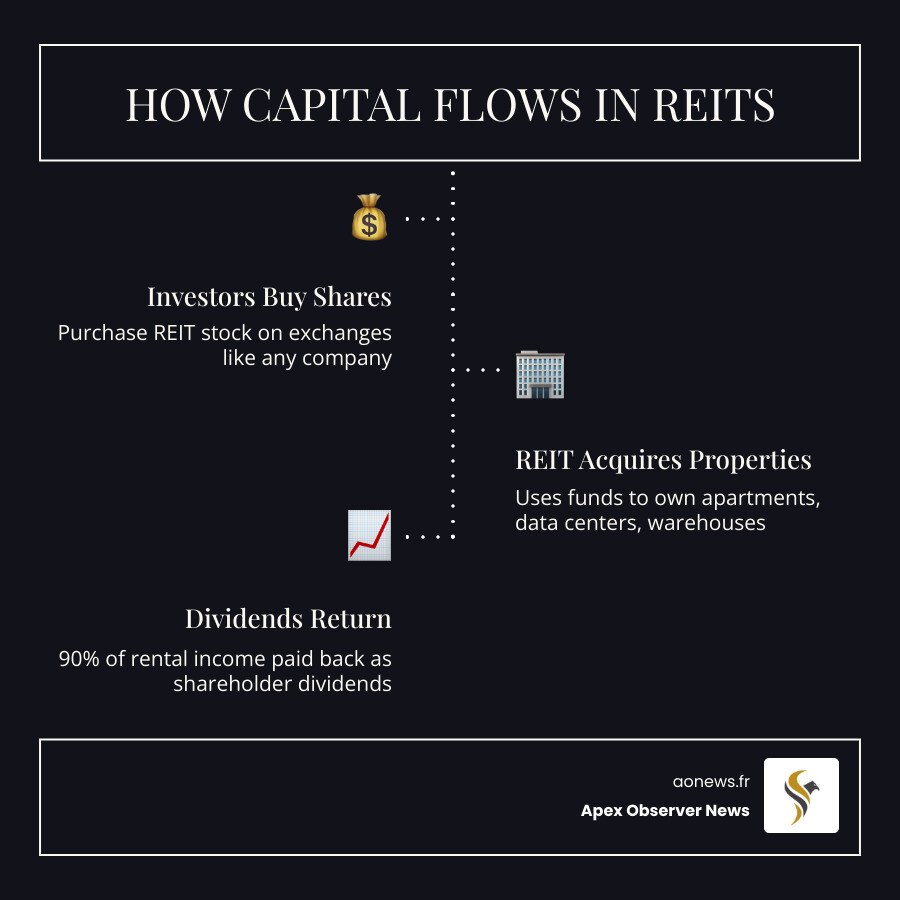
At their core, real estate investment trusts function as a bridge between the massive world of commercial real estate and the individual investor. To understand how they work, we have to look at the “REIT Pipeline.”
The Revenue Engine: Rent and Interest
Most REITs follow a straightforward business model: they lease space and collect rent. Whether it’s a tech giant paying for server space in a data center or a retailer paying for a storefront in a mall, that rental income is the lifeblood of the trust. This is the primary way “Equity REITs” make money.
On the flip side, “Mortgage REITs” (mREITs) don’t necessarily own the buildings. Instead, they provide financing for real estate by purchasing or originating mortgages and mortgage-backed securities. They earn income from the interest on these financial assets.
The 90% Rule
The most critical aspect of the REIT structure is the IRS requirement regarding distributions. To qualify as a REIT and avoid paying corporate-level income tax, a company must distribute at least 90% of its taxable income to shareholders annually in the form of dividends. In practice, many REITs pay out 100% to completely eliminate their tax liability at the corporate level.
This makes them a favorite for income-seeking investors, as it effectively passes the profits directly to us without the “double taxation” usually seen with standard corporate stocks. You can find more SEC guidelines on REIT functionality to see the legal nitty-gritty.
Key Performance Metrics: FFO and NAV
When we evaluate a typical stock, we look at Net Income. For REITs, that doesn’t work as well because real estate involves heavy depreciation, which artificially lowers “accounting” profit. Instead, we use:
- Funds From Operations (FFO): This adds back depreciation and amortization to earnings, providing a clearer picture of the cash being generated.
- Net Asset Value (NAV): This represents the market value of all the properties the REIT owns, minus its liabilities. It helps us determine if the stock is trading at a “discount” or “premium” to the actual real estate it holds.
For those interested in how these models apply to specific regional markets, checking out more info about real estate companies in Islamabad can provide context on how professional management firms operate on the ground.
The Different Types of Real Estate Investment Trusts
Not all REITs are created equal. Depending on what they own and how they are traded, the risk and reward profiles can vary wildly.
| REIT Type | Primary Asset | How They Make Money |
|---|---|---|
| Equity REITs | Physical Properties | Rental income from tenants |
| Mortgage REITs | Mortgages/Loans | Interest on real estate debt |
| Hybrid REITs | Both Properties & Debt | Rent + Interest income |
Publicly Traded vs. Private REITs
This is where many investors get tripped up.
- Publicly Traded REITs: These are listed on major stock exchanges (like the NYSE). They are highly liquid, meaning we can buy or sell them instantly during market hours. They are also subject to strict SEC oversight.
- Public Non-Traded REITs: These are registered with the SEC but don’t trade on an exchange. While they might offer higher yields, they are often illiquid. You might not be able to get your money out for several years, and they often come with high upfront fees (sometimes 9-10%).
- Private REITs: These are generally exempt from SEC registration and are only available to “accredited” (wealthy) investors. They have the least transparency and the highest liquidity risk.
Before diving into the less liquid options, it’s wise to read the FINRA alert on non-traded REIT risks. Understanding these differences is just as important as researching housing societies in Islamabad when looking at physical property — the “neighborhood” (or in this case, the structure) matters immensely.
Sector-Specific Real Estate Investment Trusts
One of the coolest things about real estate investment trusts is that we can bet on specific sectors of the economy through the buildings they use.
- Retail REITs: Think massive shopping malls and “big box” centers.
- Healthcare REITs: These own hospitals, medical office buildings, and senior living communities.
- Data Center REITs: These house the servers that keep the internet running. Companies like Equinix or Digital Realty are giants in this space.
- Cell Tower REITs: They own the infrastructure that powers our 5G networks.
- Industrial REITs: These own the warehouses and distribution centers used by e-commerce giants to ship your packages.
Global Real Estate Investment Trusts
The REIT model has gone global. The FTSE EPRA Nareit Global Real Estate Index tracks nearly 500 companies across 39 countries, representing a market cap of roughly $1.7 trillion.
- Mexico: Uses “FIBRAs” (Fideicomiso de Inversión en Bienes Raíces).
- India: Has “InvITs” for infrastructure.
- United Kingdom: Established its REIT regime in 2007, allowing for tax-efficient property investment.
You can explore the Nareit global REIT directory to see how diversified listed real estate has become.
Benefits and Risks of Investing in REITs
Why do we bother with real estate investment trusts instead of just buying more stocks or a rental house?
The Upside: Why We Like Them
- High Dividends: Because of that 90% payout rule, REITs often offer yields significantly higher than the average S&P 500 stock.
- Diversification: Real estate often moves in a different cycle than the broader stock market. While stocks might have a 6-7 year cycle, real estate cycles can last a decade or more.
- Liquidity: Unlike a physical house that takes months to sell, you can sell a public REIT in seconds.
- Inflation Hedge: Many REITs have “escalation clauses” in their leases. As inflation goes up, so does the rent they charge, which can lead to higher dividends for us.
The Downside: What to Watch Out For
- Interest Rate Sensitivity: This is the big one. When interest rates rise, REITs often take a hit. Why? Because they borrow a lot of money to buy buildings, and higher rates make that debt more expensive. Also, when bond yields rise, investors might ditch REITs for the “safety” of bonds.
- Market Volatility: Public REITs trade like stocks, which means they can be subject to the same emotional swings of the market, even if the underlying buildings are doing fine.
- Occupancy Risks: If a major tenant leaves (like a big department store in a mall), the REIT’s income can drop overnight.
We also have to keep an eye on the broader macro environment. For example, Warren Buffett’s housing market predictions often provide a “North Star” for where residential and commercial trends might be heading next.
How to Start Investing in REITs
Ready to jump in? We have three main paths:
1. Individual REIT Stocks
If you want to own a specific company — say, a giant like Realty Income (the “Monthly Dividend Company”) — you can buy shares through any standard brokerage account. This gives you the most control but requires the most research. You’ll want to check their debt levels, occupancy rates, and dividend history.
2. REIT ETFs and Mutual Funds
For most of us, this is the smartest move. An Exchange-Traded Fund (ETF) like the Vanguard Real Estate ETF (VNQ) lets you own a tiny piece of every major REIT in the U.S. with a single purchase. It’s instant diversification.
3. Tax-Advantaged Accounts
Because REIT dividends are usually taxed as “ordinary income” (which can be a high rate), it’s often best to hold them in a Roth IRA or 401(k). In these accounts, your dividends can grow and be reinvested tax-free.
When deciding how much to allocate, remember things to consider while investing in property. Even though REITs are liquid, the underlying asset is still real estate, which rewards patience.
Frequently Asked Questions about REITs
What are the tax implications of real estate investment trusts?
REIT dividends are generally taxed at your ordinary income tax rate, rather than the lower “qualified dividend” rate. However, under current U.S. tax law, many investors can claim a 20% pass-through deduction on REIT dividends, which helps lower the tax bill.
Sometimes, a portion of the dividend is classified as a “return of capital,” which isn’t taxed immediately but reduces your “cost basis” in the stock (meaning you’ll pay more in capital gains when you sell). Always check the IRS qualification requirements or talk to a pro.
How do REITs compare to direct property ownership?
Direct ownership (buying a rental house) gives you 100% control and potential tax benefits like depreciation. But it’s a job. You have to fix toilets and chase down rent. REITs are passive. You get a professional management team, instant diversification across hundreds of properties, and the ability to sell whenever you want.
Comparing a REIT to something like a Nova City Islamabad comparison highlights the difference between investing in a managed fund versus a specific development project. One is a broad market play; the other is a localized asset.
Can I lose money in a real estate investment trust?
Absolutely. Like any stock, the price can go down. If interest rates spike or if there’s a recession that leaves office buildings empty, REIT share prices will fall. We saw this during the 2008 financial crisis and the 2020 pandemic.
However, well-managed REITs with strong balance sheets usually recover. Looking at Bahria Town Karachi insights shows that even in volatile markets, high-quality infrastructure and management are the keys to long-term resilience.
Conclusion
Real estate investment trusts have revolutionized how we build wealth. They took an asset class that used to be reserved for the ultra-wealthy and opened the doors to everyone. Whether you’re looking for a steady monthly check or a way to protect your portfolio from inflation, REITs offer a unique blend of income and stability.
At Apex Observer News, we believe that staying informed is the first step to financial freedom. By understanding the “REIT or Wrong” of these vehicles, you can build a more resilient, diversified portfolio that stands the test of time.
For more updates on the economy, property trends, and latest business and real estate headlines, keep it locked here. We’ll keep aggregating the news you need to stay ahead of the curve.
