


Why AI in Business Is the Biggest Shift Since the Internet
AI in business is transforming how companies operate, compete, and grow — and it’s happening faster than most people realize.
Here’s a quick snapshot of what you need to know:
| What | Why It Matters |
|---|---|
| What it is | Technology that automates tasks, analyzes data, and supports smarter decisions |
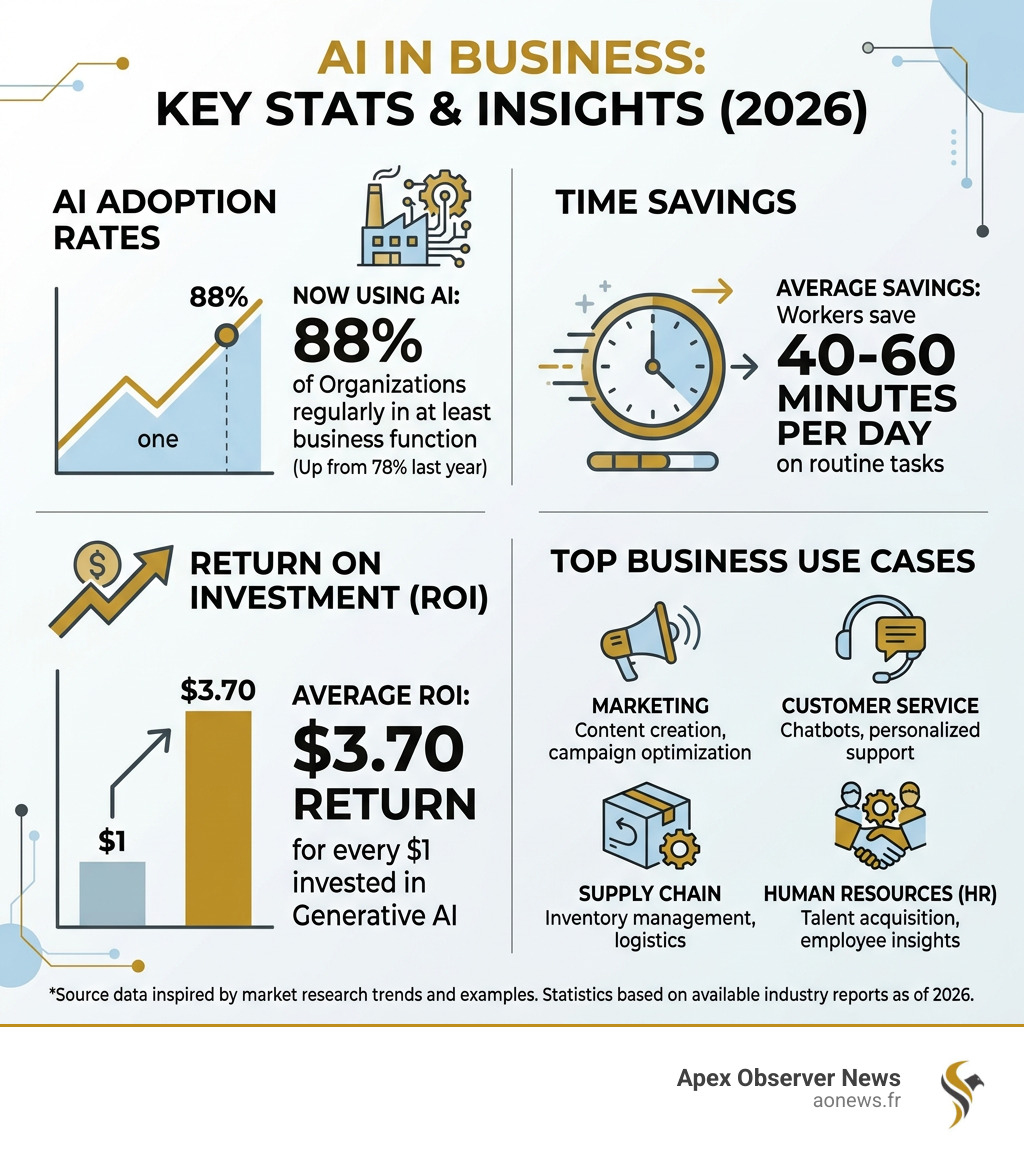
| Who’s using it | 88% of organizations now use AI in at least one business function |
| Key benefit | Workers save 40–60 minutes per day on average |
| Revenue impact | AI-driven recommendations account for up to 35% of Amazon’s revenue |
| ROI | Every $1 invested in generative AI returns an average of $3.70 |
| The risk | Only 22% of companies using AI are seeing transformational results |
Three years ago, AI was mostly a buzzword. Today, it’s a core business tool — used in customer service, marketing, supply chains, HR, and more. The companies pulling ahead aren’t just using AI. They’re redesigning their entire workflows around it.
According to McKinsey’s latest research, 88% of organizations now use AI regularly in at least one business function — up from 78% just a year ago. And 63% plan to increase their AI investment over the next three years.
The gap between early adopters and everyone else is growing fast.
I’m Faisal S. Chughtai, founder of ActiveX, where I’ve spent years helping businesses implement digital strategies — including AI in business — through branding, app and web development, and digital marketing. In this guide, I’ll walk you through everything you need to know to start using AI practically and profitably.
Ai in business further reading:
What is AI in Business and Why Does It Matter?
When we talk about ai in business, we aren’t just talking about robots taking over the office or your toaster suddenly developing a personality. We are talking about a suite of technologies designed to handle tasks that typically require human intelligence. This includes everything from spotting patterns in massive data sets to understanding the nuances of a customer’s email.
Why does it matter so much right now? Because we’ve reached a tipping point. Recent reports from industry giants like McKinsey and OpenAI show that AI has moved from the “experimental” phase into the “essential” phase. For us at Apex Observer News, we see this as the most significant technological leap since the dawn of the digital age.
Businesses that ignore this shift aren’t just missing out on a trend; they are risking their competitive edge. According to recent surveys, 82% of companies are either already using AI or actively exploring how to do so. The sheer scale of adoption is staggering, with the use of AI in business operations having doubled since 2017.
For a deeper dive into how these technologies are applied across different sectors, check out our guide on the application of artificial intelligence.
Defining AI in Business: From Automation to Strategy
In a business context, AI is often defined by its ability to move beyond simple automation. While a basic software script might follow a set of “if-then” rules, ai in business uses machine learning and predictive analytics to learn from data and improve over time.
- Machine Learning (ML): This allows systems to identify trends and make predictions without being explicitly programmed for every scenario. Think of it as a digital brain that gets smarter the more information it processes.
- Predictive Analytics: This is the “crystal ball” of business. It helps us forecast demand, identify potential equipment failures before they happen, and understand which customers are most likely to churn.
- Strategic Value: High-performing organizations don’t just use AI to do things faster; they use it to do things differently. They use AI to find new revenue streams and redesign workflows from the ground up.

If you’ve ever wondered if your office equipment is secretly plotting something while it processes all that data, you might enjoy our take on AI explained simply.
Current Trends in AI Adoption and Investment
The numbers tell a compelling story. Today, 88% of respondents in major surveys report regular AI use in at least one business function. This isn’t just a slight uptick; it’s a massive wave. Furthermore, 63% of leaders expect their investment in AI technologies to increase significantly over the next three years.
However, there is a growing divide. We often talk about “Frontier Firms”—the top 22% of companies that are achieving three times higher returns than slow adopters. These high performers aren’t just dabbling; they are achieving:
- 1.7x higher revenue growth
- 3.6x greater total shareholder return
- 1.6x better EBIT margins
The average ROI is equally impressive. For every $1 invested in generative AI, companies are seeing an average return of $3.70. This is why we see such a frantic rush to scale these technologies across entire enterprises.
Key Benefits and Real-World Use Cases
The benefits of ai in business are no longer theoretical. They are measurable, impactful, and, in many cases, essential for survival in a crowded market. Whether it’s saving time or boosting the bottom line, the impact is real.
| Feature | Traditional Workflow | AI-Enhanced Workflow |
|---|---|---|
| Data Analysis | Manual spreadsheets; takes days | Real-time insights; takes seconds |
| Customer Support | Human-only; 9-to-5 availability | 24/7 AI agents; instant resolution |
| Marketing | Broad segments; “spray and pray” | Hyper-personalized; 1-to-1 targeting |
| Supply Chain | Reactive; fixing things when they break | Predictive; fixing things before they break |
| HR Screening | Manual resume review; prone to bias | Automated screening; data-driven matching |
Enhancing Customer Service and Marketing
One of the most visible applications of ai in business is in how we interact with our customers. Have you ever noticed how Amazon seems to know exactly what you want to buy next? That isn’t luck. AI-powered cross-selling and upselling recommendations make up as much as 35% of Amazon’s total revenue.
In customer service, the “frustrating chatbot” is becoming a thing of the past. Modern AI agents, like Intercom’s Fin Voice, can resolve 53% of calls end-to-end. By using advanced models like OpenAI’s Realtime API, companies have seen latency decrease by 48%, making conversations feel natural and helpful.
Marketing has also been revolutionized. We can now use sentiment analysis to scan millions of social media messages and understand exactly how people feel about our brand in real-time. This allows for hyper-personalized marketing that resonates on a deeper level. To see how this works in digital sales, read more about artificial intelligence in e-commerce.
Optimizing Supply Chains and HR Operations
Behind the scenes, ai in business is the engine driving operational excellence.
- Supply Chain: Retailers use predictive models to optimize inventory, reducing the risk of “out of stock” messages while simultaneously cutting down on excess waste. Predictive maintenance sensors on machinery can flag a part that is about to fail, preventing costly downtime before it ever happens.
- HR and Recruitment: Hiring managers are using AI to handle the “mountain” of applications. AI can screen resumes and perform initial candidate assessments, allowing HR teams to focus on the human side of talent acquisition—interviews and culture fit.
In fact, 61% of respondents in supply chain functions report significant cost reductions after implementing generative AI. For a look at how this is scaling, see our article on generative AI in enterprise.
Essential Tools and Implementation Strategies for Small Businesses
You don’t need a billion-dollar budget to start using ai in business. In fact, some of the most powerful tools are affordable (or even free) for small business owners. The key is to start with a clear strategy rather than just buying every shiny new tool on the market.
Affordable AI Platforms for Growth
We recommend small businesses look at “plug-and-play” tools that integrate with their existing workflows. Here are some of the most effective platforms available today:
- Customer Service: Tidio offers a free plan for AI-powered chatbots that can engage customers 24/7.
- Marketing & CRM: HubSpot provides a free CRM with AI features for email scheduling and basic analytics.
- Analytics: Google Analytics uses AI to provide deep insights into website traffic and customer trends.
- Social Media: Tools like Buffer and Hootsuite use AI to help you schedule posts and analyze engagement.
- Accounting: Wave Accounting helps small businesses automate bookkeeping and invoice tracking.
- Content Creation: OpenAI’s ChatGPT and Microsoft Copilot are excellent for drafting emails, blog posts, and reports.
For those looking to build their own digital presence, AI is also making waves in the technical side of things. Learn more about 15 ways AI is contributing to web development.
The Impact of AI in Business on the Modern Workforce
There is a lot of talk about AI “taking jobs,” but the reality is more nuanced. AI is transforming jobs rather than simply eliminating them. Think of it like the transition from hand-drawn blueprints to digital CAD software; the job of an architect didn’t disappear, it just became more efficient.
- Productivity Gains: 75% of workers say AI has improved the speed or quality of their work, saving them nearly an hour every single day.
- Skill Requirements: The demand for “AI literacy” is skyrocketing. One study found that mastering AI technology could increase your salary by 25%.
- Transformation: Instead of spending hours on data entry, employees are being redeployed to higher-level strategic work that requires empathy, creativity, and complex problem-solving.
We’ve explored this topic in depth in our article: Will your job be next with AI taking over?
Navigating Risks, Ethics, and the Future of AI in Business
As much as we love the benefits, we have to be honest: ai in business comes with risks. From data privacy to ethical concerns, businesses must navigate this landscape with their eyes wide open.
Managing Ethical Concerns and Data Security
When you use AI, you are often feeding it data. If that data is sensitive or proprietary, you need to be extremely careful.
- Intellectual Property (IP): There are ongoing concerns about who owns AI-generated content and whether AI models were trained on copyrighted material.
- Security Risks: AI is being used to create more sophisticated phishing campaigns. We must be more “cybersmart” than ever.
- Bias: If the data used to train an AI is biased, the AI’s decisions will be biased too. This is why “human-in-the-loop” validation is critical.
We always recommend that businesses draft a public statement disclosing how they use AI. This builds trust with customers and ensures transparency. For more on this complex topic, visit our guide on AI and ethics.
The Rise of AI Agents and Custom GPTs
The next frontier of ai in business isn’t just a chatbot you talk to—it’s an “agent” that does work for you. We are seeing a shift toward “Agentic AI”—autonomous systems that can reason, plan, and execute multi-step workflows with minimal human oversight.
OpenAI reports that Custom GPTs (versions of ChatGPT tailored for specific tasks) have seen 19x growth in usage. These agents can handle everything from deep research to complex service-desk management. In the near future, we expect businesses to have “digital labor” forces—AI agents that act as autonomous collaborators rather than just tools.
To understand where this leads, you might want to read our complete guide to Artificial General Intelligence (AGI).
Frequently Asked Questions about AI in Business
How can a small business start using AI affordably?
Start small by identifying a single pain point—like answering repetitive customer questions or scheduling social media posts. Use free or low-cost tools like Tidio for chat or HubSpot for CRM. You don’t need a custom-built solution to see an immediate ROI.
What are the biggest risks of implementing AI in business?
The primary risks include data privacy (leaking sensitive info into public models), intellectual property disputes, and “hallucinations” where the AI provides incorrect information. Always have a human review AI-generated outputs before they go live.
Does AI replace human employees in the workforce?
In most cases, AI replaces tasks, not people. While some roles may change or decrease in size, new roles (like AI prompt engineers or data curators) are being created. The goal of ai in business should be augmentation—making your human team more powerful.
Conclusion
At Apex Observer News, we believe that ai in business is no longer a choice—it’s a necessity for those who want to thrive in the modern economy. Whether you are a small business owner looking for a bit of breathing room or a corporate leader aiming for “Frontier Firm” status, the path forward involves a strategic roadmap, a commitment to workflow redesign, and a culture of continuous learning.
The future belongs to those who can blend human creativity with machine efficiency. By starting today—identifying your needs, choosing the right tools, and ensuring robust governance—you can turn the “AI shift” into your greatest competitive advantage.
Stay updated with the latest AI news and trends right here at Apex Observer News.
