

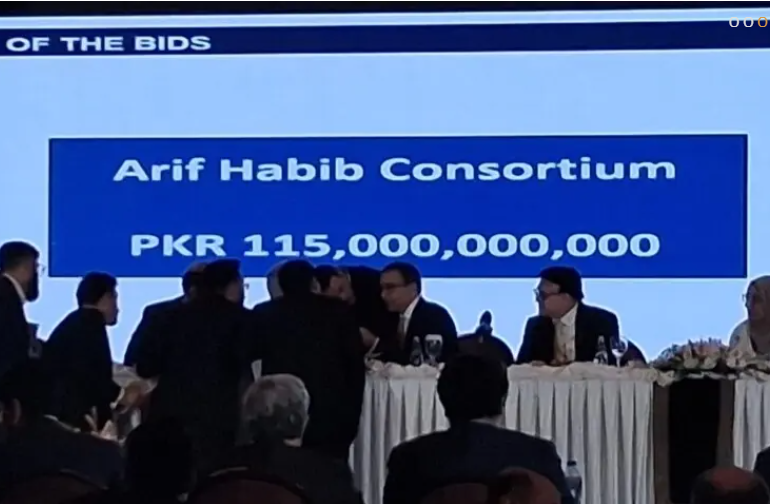
At a ceremony in Islamabad, the auction for Pakistan International Airlines Corporation Ltd. (PIAC) was moved to an open PIA auction round, and Arif Habib’s winning bid of Rs135 billion marked the country’s first major privatization in nearly two decades.
Initially, pre-qualified bids were submitted by Lucky Cement, private airline Airblue and investment firm Arif Habib in the morning. Following that, a 30-minute break was taken so that the two top bidders could hold consultations. A second round was then commenced.

It began with the base bid at Rs115bn, and the minimum increment was at Rs250 million. The base price was set on the basis of the highest bid made during the first round by Arif Habib.
Both bidders engaged in a brief competition to outbid each other during
the round. However, when Lucky Cement raised its bid to Rs134bn, Arif Habib countered with Rs135bn, forcing Lucky Cement to bow out and congratulate Arif Habib.
The entire procedure was broadcast live and streamed on all of the government’s social media accounts and television channels. Adviser to the prime minister on privatisation, Muhammad Ali, will also hold a press conference after the conclusion of the bidding proces.
At the bidding ceremony, Finance Minister Muhammad Aurangzeb thanked the PM’s aide and his team for their efforts and praised the bidding process for its transparency. “It takes a lot of time and effort to get to a good place where we are today,“ he said.

“All of the bidders today are from Pakistan. I used to say that Pakistan would win regardless of which team won. He said that investors and some of Pakistan’s most seasoned businesspeople would lead the flag carrier and praised Pakistan’s largest conglomerates for “vying for the best airline.” “The fact that they have stepped up is a doubtless sign that anyone who is the successful bidder will take it not only to where we were, but where we need to be in the comity of nations,” Aurangzeb added.
“We need to stop the bleeding and losses, but more importantly, our institutions need to be part of the comity of nations, and we will take them there,” he added.
Two of them demanded to take up to 75 per cent at least, and the other two demanded 100pc,“ he said.
“We wanted a multitude of bidders so the process of bidding would be transparent and competitive,” he continued.

He said that the government had “decided to sell at least 75pc of shares, and simultaneously, we also decided to offer the other 25pc”.
“Bidders will have the right to consider and let the government know if they also want to buy the other 25pc in the next 90 days,” he said.

“The transaction would be from 75 percent up to 100 percent; however, 75 percent of them will be made available for sale today,” he added. “The government wanted to structure this transaction so it would also get a fair share and investment to be made,” he said, adding that the government did not just want to sell PIA but “to bring the national airline back to the glory it enjoyed in the past”.
He stressed the need for bringing in “new investment, buy new carriers and repair the engine, cut the liabilities, pay the employees on time”.“If we want to expand the fleet from 18 planes to 30-40 or more, then investment is the only way,” he added.
Pre-qualified bids
In the morning, representatives of the bidding groups had walked in one by one to deposit sealed offers into a transparent box, briefly fumbling as they pushed envelopes through the slot in a separate public ceremony in Islamabad that was also broadcast on state television.
Meanwhile, Prime Minister Shehbaz Sharif, while addressing a meeting of the federal cabinet, thanked government officials and the Privatisation Commission for their role in the national carrier’s privatisation.
He stressed that the process has been made “transparent“, stating that it will be the “largest transaction” ever in Pakistan’s history.
“Today, as the bidding starts [..] the bids will come in sealed envelopes, there will be transparent boxes, there will be a live telecast. When the price is determined, the envelopes will be opened. They will compete, and whoever has the highest bid will [succeed],“ he said.
“Only God knows how high the bid will go, but the process must come back to the cabinet,” he said.
In recent remarks, he explained that losing bidders will have no right to join the winning bidder, and only those groups who were not party to the auction would be able to join the new management.
This means that while only one of the three consortiums currently in the running for the flag carrier will become part of its administration upon acquisition of a majority stake, Fauji Fertiliser Company Ltd retains the option to join with them subsequently, if it wishes to.
The company was previously in the race for PIA but then decided to quit the bidding process.
Ahead of Tuesday’s bidding, reports surfaced of a behind-the-scenes deal involving at least two of the parties involved — the Arif Habib and Lucky Cement groups — that reportedly fell through.
In a tweet, journalist Kamran Khan alluded to a meeting where it was proposed to split the controlling stake among three of the four interested parties. However, Khan claimed, this arrangement fell through as one of the parties — i.e. the Muhammad Ali Tabba-led Lucky Cement group — did not agree to it.
Both Tabba and a high-ranking government official privy to developments confirmed this, but clarified that this was not a government-brokered meeting, but rather an informal interaction.
Talking to AONEWS, Tabba expressed unwavering confidence in the privatisation process, and clarified that the proposal was floated to him after a meeting in Islamabad, which he did not pursue.
