


Who Is Avi Lewis? Canada’s New NDP Leader Explained
Avi Lewis is a Canadian politician, journalist, filmmaker, and activist who became leader of the New Democratic Party (NDP) on March 29, 2026.
Here are the fast facts:
| Detail | Info |
|---|---|
| Full Name | Avram David “Avi” Lewis |
| Born | May 1967 |
| Role | Leader, New Democratic Party of Canada |
| Elected Leader | March 29, 2026 |
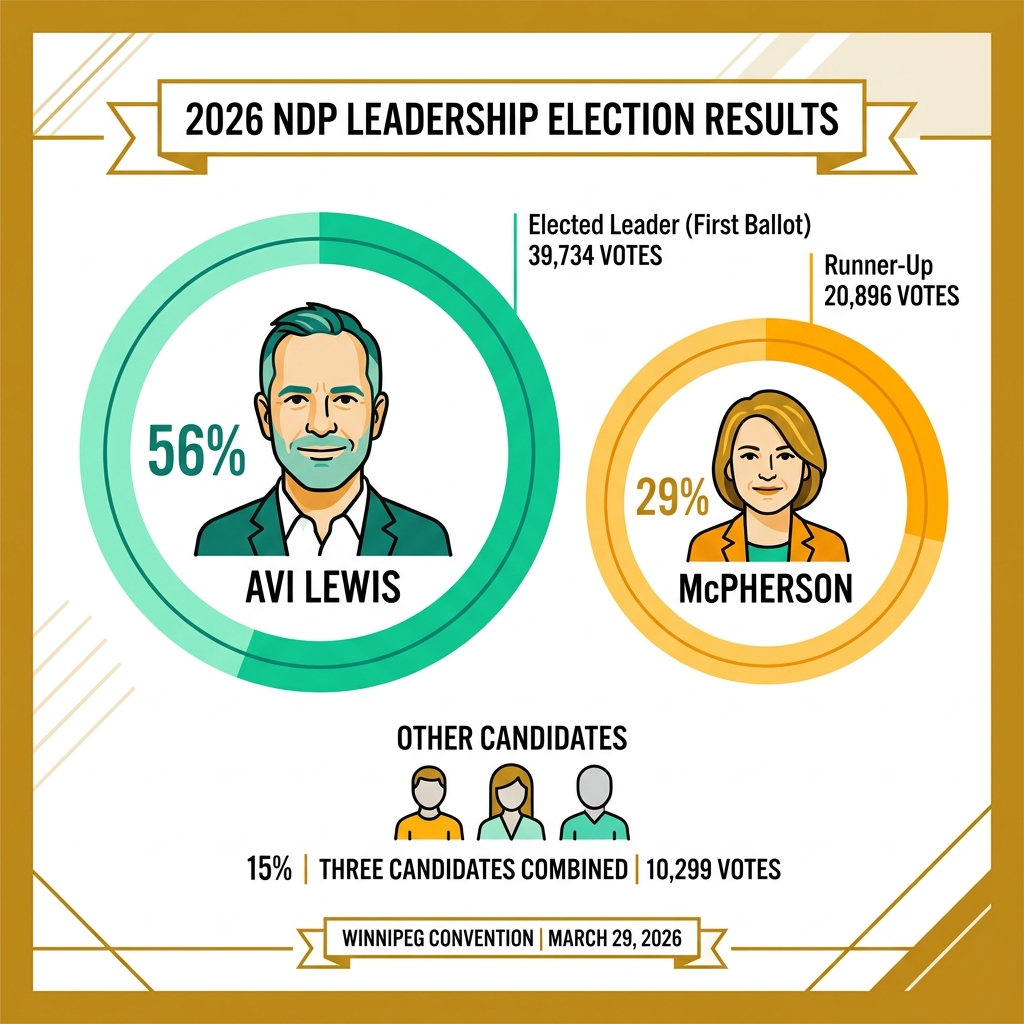
| Leadership Vote | 56.02% (first ballot) |
| Spouse | Naomi Klein (married 1998) |
| Family Legacy | Grandson of NDP founder David Lewis; son of Stephen Lewis |
| Career Background | Journalist, documentary filmmaker, UBC professor, activist |
| Key Policy Themes | Climate justice, wealth tax, public ownership, worker rights |
Lewis comes from one of Canada’s most prominent left-wing political dynasties. His grandfather David Lewis founded the NDP. His father Stephen Lewis led the Ontario NDP and later served as a UN ambassador. Now Avi steps into that legacy — but at a moment when the party holds just 6 seats in the House of Commons and polls at only 12% nationally.
He won the leadership race decisively, raising C$1.2 million and defeating four other candidates, including runner-up Heather McPherson, without a single runoff round needed.
His platform mixes bold ideas — public grocery stores, an AI moratorium, a Green New Deal worth 2% of GDP — with a clear message: “The system is rigged for the rich, and it’s time to fight back.”
I’m Faisal S. Chughtai, founder of ActiveX and a specialist in digital content and SEO strategy — I’ve tracked the rise of political figures like Avi Lewis across Canada’s shifting media and policy landscape. Read on for a full breakdown of his background, policies, and what his leadership means for Canadian politics.
The Rise of Avi Lewis: 2026 NDP Leadership Victory
The political landscape in Canada shifted significantly on March 29, 2026, when the New Democratic Party gathered in Winnipeg to choose a new path forward. After a disappointing federal election in 2025 that saw the party lose official status, the membership was looking for a “spark” to reignite their grassroots base. They found that spark in Avi Lewis.
The victory was not just a win; it was a landslide. Avi Lewis secured 56.02% of the vote on the very first ballot. In a ranked-ballot system where races often drag on through multiple rounds of counting, this was a clear mandate from the party faithful. He earned 39,734 votes out of 70,930 valid votes cast, a testament to his ability to mobilize the base. His closest rival, Heather McPherson, finished with 29.46%, while three other candidates trailed significantly behind.
One of the most telling signs of his momentum was his fundraising prowess. During the campaign, Avi Lewis raised a staggering C$1.2 million, completely dominating his rivals and proving that his “eco-socialist” message resonated with donors across the country. The convention itself was a high-energy affair, with supporters comparing the atmosphere to the era of Ed Broadbent. You can see the moment of his victory in this video: March 29, 2026 | NDP elect Avi Lewis as federal leader.
In his victory speech, Lewis called for a return to the party’s roots. He spoke about moving away from “incrementalism” and toward a bold, collectivist vision for Canada. For many in the room, it felt like the beginning of a party revival, though the road ahead remains steep.
Challenges Facing Avi Lewis as Leader
While the leadership victory was a triumph, the reality of the NDP’s current standing in Ottawa is sobering. We have to look at the numbers: the party currently holds only 6 seats in the House of Commons, down from 23 before the 2025 election. This means the NDP has lost its official party status, which impacts their funding, their ability to sit on committees, and their overall visibility in Parliament.
Furthermore, Avi Lewis faces a unique hurdle: he does not currently hold a parliamentary seat. Because he lost his own bid for a seat in Vancouver Centre during the 2025 election (placing third with 12.49% of the vote), he cannot participate in House of Commons debates or question the Prime Minister directly.
His strategy moving forward involves a careful byelection plan. There is talk of him running in an Ontario riding to establish a foothold in the East, similar to how previous leader Jagmeet Singh managed the party from outside the House before winning a byelection in Burnaby South. Until then, Lewis must rely on an interim House leader to carry the party’s message into the chamber while he focuses on rebuilding the party’s polling numbers, which currently sit at a historic low of 12%.
Political Roots and the Leap Manifesto
To understand Avi Lewis, we have to look at his DNA. He was born into a family that essentially built the modern Canadian left. His grandfather, David Lewis, was a key architect of the NDP and served as its federal leader in the 1970s. His father, Stephen Lewis, is a legendary figure in Ontario politics and a world-renowned diplomat.
Even before he officially entered the political ring as a candidate, Avi Lewis was shaping the conversation. In 2015, alongside his wife, the famous author and activist Naomi Klein, he co-authored the Leap Manifesto. This document was a radical call to action that proposed a rapid transition away from fossil fuels, an end to new pipeline projects, and a total restructuring of the Canadian economy to address climate change, inequality, and colonialism.
While the Manifesto was embraced by grassroots activists and celebrities like David Suzuki and Jane Fonda, it created significant friction within the party. It was particularly controversial in Alberta, where the provincial NDP under Rachel Notley felt the document’s stance on oil and gas was a threat to the province’s economy. This tension between Lewis’s “eco-socialist” vision and the more moderate provincial wings of the party remains one of his biggest internal challenges.
Before his leadership win, Lewis ran as a federal candidate twice. In 2021, he ran in West Vancouver–Sunshine Coast–Sea-to-Sky, where he achieved the NDP’s best-ever result in that riding with over 25% of the vote. In 2025, he ran in Vancouver Centre during a difficult cycle for the party, placing third. You can read more about his journey from activism to candidacy on his personal site: About Avi Lewis.
The Legacy of the Avi Lewis Family
The Lewis family history is a fascinating window into the history of social democracy. His great-grandfather, Moishe Lewis, was a Jewish labor activist who fled Poland after being interrogated for his involvement with the Jewish Bund. That spirit of resistance and community organization passed down through the generations.
Avi’s mother, Michele Landsberg, is also a powerhouse—a renowned journalist and feminist who influenced Avi’s own approach to storytelling and “uncoverage” of political issues. Growing up in this environment, Lewis was educated at the University of Toronto and spent his early years immersed in social justice and labor rights.
This family legacy isn’t just about names; it’s about a specific style of politics that combines intellectual rigor with passionate activism. It’s why Lewis describes himself as a “loud and proud democratic socialist.” He isn’t just running for office; he’s continuing a century-long family project to move Canada toward a more equitable society.
Key Policy Positions of Avi Lewis

When we look at the Avi Lewis platform, we see a shift toward what he calls a “care economy.” He argues that the current system is “rigged for the rich” and that the NDP must be the party that fights for the many, not the money. His policy positions are among the most radical the party has seen in decades.
One of his flagship proposals is a 2% GDP Green New Deal. This plan involves a massive public investment aimed at creating one million jobs in green energy, retrofitting buildings, and expanding public transit. He views climate justice not just as an environmental issue, but as an economic one that can revitalize the working class.
Other key policies include:
- Wealth Tax: Implementing a significant tax on the top 1% to fund social programs.
- Public Ownership: Advocating for state-owned options in essential sectors, including a national public grocery store chain to fight price gouging.
- AI Moratorium: Calling for a temporary halt on certain AI developments to ensure worker rights and jobs are protected in the digital age.
- Trade Justice: He has been a vocal critic of trade deals that he believes make Canada vulnerable. He has specifically called on Canadians to Let’s Fight Trump’s Tariff Attacks by building energy and economic independence.
Addressing the Cost-of-Living Crisis with Avi Lewis
The cost-of-living crisis is perhaps the most urgent issue for Canadian voters, and Lewis has a “collectivist” answer for it. Instead of relying on market forces, he proposes a return to public services and strict regulation.
For housing, he advocates for a national rent cap and a massive investment in non-market, social housing. He wants to see a “Tenants’ Bill of Rights” that protects people from renovictions and corporate landlords who treat homes as “profit machines.”
In the realm of energy, he proposes a “People’s Powerline”—an East-West electricity grid that would be publicly owned. This would help Canada achieve energy independence and lower costs for families. He also supports public options for telecommunications, arguing that high-speed internet and cell service are basic rights that shouldn’t be controlled by a handful of massive corporations.
Media Career and Filmmaking Influence
Before he was a politician, Avi Lewis was a familiar face on Canadian television. He spent 25 years in journalism, starting at CityTV and MuchMusic, where he pioneered “uncoverage” of politics for a younger audience. He later hosted CounterSpin on CBC Newsworld, where he presided over more than 500 televised debates, honing his ability to articulate complex ideas and challenge powerful figures.
His work with Al Jazeera English as a co-host of Fault Lines further established his reputation as a filmmaker who wasn’t afraid to go where the stories were hardest. His filmmaking career has always been an extension of his activism.
| Film / Project | Year | Social Impact / Focus |
|---|---|---|
| The Take | 2004 | Explored worker-occupied factories in Argentina; inspired cooperative movements globally. |
| This Changes Everything | 2015 | Directed this documentary (based on Naomi Klein’s book) linking climate change to capitalism. |
| Message from the Future | 2019 | Animated short with Alexandria Ocasio-Cortez envisioning a Green New Deal future. |
His experience as an Associate Professor at the University of British Columbia (UBC) in the Centre for Climate Justice also informs his leadership. He brings an educator’s touch to the campaign trail, often using his speeches to explain the systemic roots of economic inequality. This background in media and academia gives him a polished, persuasive style that helps him reach millions beyond the traditional political bubble.
Internal Tensions and Notable Endorsements
No leader wins without a few bruises, and Avi Lewis has some significant internal hurdles to clear. The “Leap Manifesto” remains a point of contention with provincial NDP wings. For instance, while Manitoba Premier Wab Kinew enjoys high approval ratings, his more pragmatic approach to governance sometimes clashes with Lewis’s radical federal vision.
In Alberta, the divide is even sharper. The Alberta NDP, historically led by Rachel Notley, has often distanced itself from the federal party’s aggressive stance on ending fossil fuel exports. Lewis’s proposal for a fossil fuel export tax is a “red flag” for many Western New Democrats who worry about regional jobs.
However, Lewis has an impressive roster of “outside-the-box” endorsers. His 2021 campaign saw support from:
- David Suzuki: The legendary environmentalist.
- Jane Fonda: The actress and activist.
- Billy Bragg: The folk singer and labor activist.
- Eve Ensler: The playwright and activist.
Within the party, he has seen both support and high-profile defections. For example, NDP MP Lori Idlout initially endorsed Lewis but later made headlines by moving toward the Liberals, highlighting the volatility within the party’s current ranks. Lewis will need to use all his diplomatic skills to keep the federal and provincial wings from drifting further apart.
Frequently Asked Questions about Avi Lewis
Does Avi Lewis have a seat in the House of Commons?
No, as of early 2026, Avi Lewis does not have a seat in the House of Commons. He lost his bid for Vancouver Centre in 2025. He is currently leading the party from the outside, a move that has been done before by leaders like Jagmeet Singh and Jack Layton. We expect him to seek a seat through a byelection, likely in an Ontario or British Columbia riding where the NDP has a strong grassroots presence. In the meantime, the party relies on an interim House leader to handle day-to-day parliamentary business.
What is Avi Lewis’s relationship to Naomi Klein?
Avi Lewis and Naomi Klein have been married since 1998. They are one of the world’s most famous “power couples” in the social justice movement. Klein is a best-selling author (No Logo, The Shock Doctrine) and a professor. Together, they have collaborated on numerous projects, including the documentary This Changes Everything and the Leap Manifesto. They live in Vancouver with their son, Toma. Their partnership is both personal and political, as they share a vision for a radical transformation of the global economy to combat climate change.
What was the result of the 2026 NDP leadership race?
The race was a decisive victory for the “eco-socialist” wing of the party. Avi Lewis won on the first ballot with 56.02% of the vote. The turnout was 70.55% of the 100,542 eligible voters. His victory was fueled by a dominant fundraising campaign that brought in over $1.2 million, allowing him to outspend his rivals and reach members across the country with his message of “returning the NDP to its roots.”
Conclusion
At Apex Observer News, we are watching the evolution of the NDP closely. The election of Avi Lewis marks a bold—and some would say risky—bet on a more radical, anti-capitalist future for the party. By choosing a leader with deep roots in activism and a world-renowned family legacy, the NDP membership has signaled that they are tired of “politics as usual.”
Whether Lewis can translate his grassroots mobilization into seats in Parliament remains to be seen. He faces a steep climb to regain official party status and unite a divided provincial-federal house. However, with his background in media and his ability to capture the public imagination, he is certainly a leader who cannot be ignored.
For more updates on how this leadership change affects the Canadian political landscape, stay tuned to our coverage of More trends in Canadian politics. We will continue to bring you the latest on the “care economy,” the Green New Deal, and the fight for the future of the Canadian left.
