


Why AI Is Suddenly Everywhere (And Why It Matters to You)
AI — short for artificial intelligence — is the ability of computer systems to do things we normally associate with human thinking, like learning, reasoning, solving problems, and understanding language.
Here is a quick answer to what AI is and why it matters:
| What | Why It Matters |
|---|---|
| Machines that learn and reason | Powers tools you use every day |
| Started as a concept in 1950 | Now embedded in search, apps, and more |
| Includes machine learning and deep learning | Enables smarter recommendations and voice assistants |
| Used in healthcare, finance, gaming, and beyond | Affects jobs, privacy, and daily decisions |
| Boom accelerated after 2012 and again in 2020s | Growing faster than most regulations can keep up |
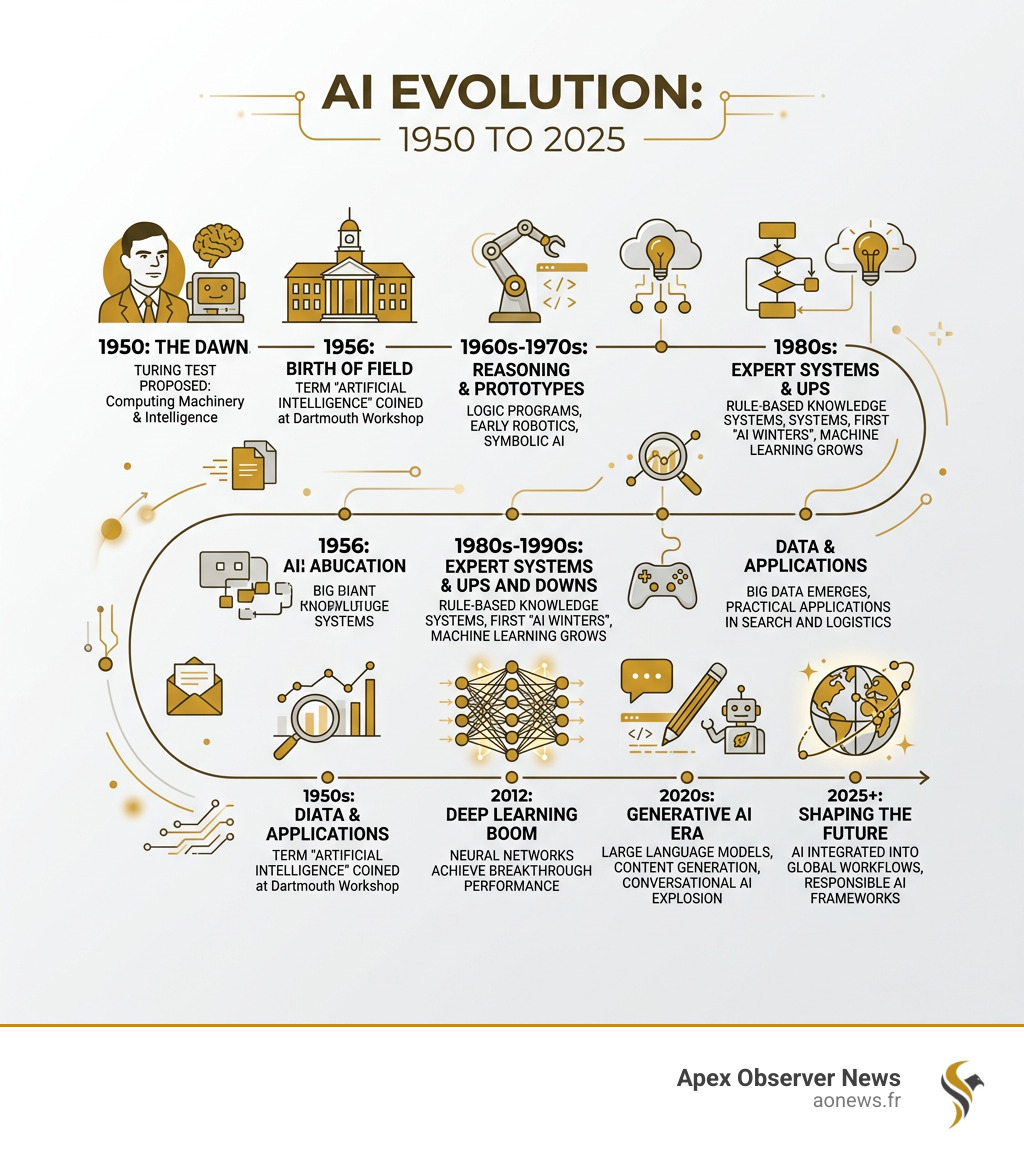
The idea of a machine that thinks is not new. It actually dates back to ancient Greece. But the moment it got a formal name was 1956, at a small academic workshop in Dartmouth, New Hampshire, where mathematician John McCarthy coined the term “artificial intelligence.”
Since then, AI has quietly slipped into almost everything — your Netflix queue, your Google search, your phone’s voice assistant. And in the 2020s, it exploded into public view with tools like ChatGPT that can hold a full conversation, write code, and pass a bar exam.
The wild part? Most of us are already using AI every single day without thinking twice about it.
I’m Faisal S. Chughtai, founder of ActiveX, where I’ve spent years working at the intersection of technology, digital strategy, and AI-driven tools to help businesses grow smarter and faster. My hands-on experience building and managing AI-integrated web and app solutions gives me a practical, ground-level view of how AI is reshaping industries in real time.
What is AI and How Does It Actually Work?
At its simplest, ai is the science of making machines smart. While a traditional computer program follows a rigid “if this, then that” recipe written by a human, an AI system is designed to figure out the recipe itself. We define it as the capability of computational systems to perform tasks typically associated with human intelligence. This includes everything from recognizing a face in a photo to deciding which move to make in a game of chess.
The magic happens through three main cognitive processes:
- Reasoning: This is the ability to use “rules” to reach approximate or definite conclusions. While early AI struggled with the “combinatorial explosion” (where the number of possibilities becomes too huge to calculate), modern systems are getting much better at narrowing down the right path.
- Perception: This involves interpreting sensory inputs. For a computer, this means “seeing” through a camera or “hearing” through a microphone and turning those signals into meaningful data.
- Problem-solving: This is the core of AI—taking a goal (like “get this car to the grocery store”) and navigating the obstacles to get there.
If you want to dive deeper into the nuts and bolts, check out this guide on how AI works and its various definitions.
The Main Goals of ai Research
Researchers aren’t just trying to build one “magic brain.” They are working on several specific goals that, when combined, look like human intelligence:
- Learning: Improving performance based on data. If the AI sees a thousand pictures of cats, it “learns” what a cat looks like without a human describing “pointy ears” or “whiskers.”
- Planning: Thinking ahead to achieve a goal. This is crucial for autonomous robots or software that manages complex logistics.
- Natural Language Processing (NLP): This is why you can talk to your phone. It’s the ability to understand, interpret, and generate human language.
- Knowledge Representation: Storing information about the world in a way that a computer can use to solve complex tasks. This is surprisingly hard because “common sense” is difficult to program!
- Social Intelligence: Teaching machines to recognize and respond to human emotions.
Core Techniques Powering ai Systems
Under the hood, several different “engines” drive these systems.
- Neural Networks: These are inspired by the human brain. They consist of layers of interconnected “nodes” that pass information along, getting stronger or weaker based on whether they get the answer right.
- Deep Learning: This is just a neural network with many, many layers. It’s what allowed AI to finally beat humans at recognizing images and translating languages.
- Search Algorithms: These help the AI look through millions of possibilities (like moves in a game) to find the best one.
- Probabilistic Methods: Since the world is messy, AI uses math to deal with uncertainty. It doesn’t just say “that is a dog”; it says “there is a 98% chance that is a dog.”
- Transformers: This is the breakthrough architecture from 2017 that made generative AI and the future of enterprise AI possible. It allows models to understand the context of words in a sentence all at once, rather than one by one.
For those interested in the math, you can read more about optimization algorithms in neural networks.
From AI Winters to the Modern Deep Learning Revolution
The road to modern ai wasn’t a straight line. It was more like a series of “booms” and “busts.”
In 1956, the Dartmouth workshop kicked off an era of extreme optimism. Researchers thought they would solve “human-level” intelligence in a single summer. When that didn’t happen, funding dried up, leading to the first “AI Winter.” This cycle repeated in the 1980s.
The real revolution started around 2012. Two things happened: we got massive amounts of data (thanks to the internet), and we started using GPUs (graphics cards) to run neural networks. Suddenly, deep learning began outperforming every other technique.
By 2017, the invention of the Transformer architecture poured rocket fuel on the fire. This led to the 2020s AI boom, characterized by Large Language Models (LLMs) like GPT. These models can generate text, images, and even video that look indistinguishable from human work. We’ve moved from “Symbolic AI” (logic-based) to “Connectionist AI” (data-based), and the results are everywhere.
High-Profile Applications Across Industries
AI isn’t just a lab experiment anymore; it’s a powerhouse in the real world.
- Web Search and Recommendations: Google Search uses AI to understand what you actually mean, even if you misspell your query. Companies like YouTube, Amazon, and Netflix use recommendation systems to keep you clicking.
- Virtual Assistants: Siri, Alexa, and Google Assistant are the most visible forms of AI for many people, helping with everything from setting timers to controlling smart homes.
- Healthcare: This is perhaps the most exciting area. AlphaFold 2 (2021) can predict the 3D structure of proteins in hours—a task that used to take months or years. This is accelerating drug discovery for diseases like Parkinson’s.
- Mathematics: AI is becoming a world-class mathematician. Qwen2-Math achieved 84% accuracy on competition-level math problems, and Google’s systems recently won a silver-medal standard at the International Math Olympiad.
- Military: AI is being used in high-stakes conflict. Systems like “Lavender” and “The Gospel” have been used for target selection, and autonomous drones are changing the nature of modern warfare.
- Sexuality and Relationships: This is a complex new frontier. Apps like Replika provide AI companions, but the technology also brings risks, such as the rise of deepfake porn, which has led to calls for better AI ethics and navigation.
- Art and Culture: AI is even intersecting with our physical travels. While cities like Florence, Kyoto, New Orleans, Prague, and Santa Fe are famous for their historical art, AI is being used to preserve these cultural sites and even create new digital art inspired by them.
Ethical Risks and the Environmental Cost of Innovation
As much as we love our smart assistants, ai comes with some heavy baggage.
Privacy and Bias are at the top of the list. Because AI learns from human data, it often learns human prejudices. We’ve seen this in “black box” systems like the COMPAS recidivism algorithm, which showed racial bias in US courts. There’s also the issue of hallucinations, where LLMs confidently state things that are completely false.
Misinformation and Deepfakes are another major concern. AI can now generate convincing videos of riots or fake election fraud, making it harder to know what is real. This is why many organizations are pushing for the NIST AI Risk Management Framework to be adopted globally.
Then there is the Environmental Cost. AI is a power-hungry beast.
- By 2026, the power demand for data centers and AI might double, equaling the electricity used by the entire nation of Japan.
- By 2030, US data centers alone will consume 8% of US power, up from 3% in 2022.
- AI’s carbon emissions are estimated to hit 180 million tons by 2025.
To combat this, tech giants are looking for “miracle” solutions, including reopening nuclear plants like Three Mile Island to keep the servers humming.
Future Prospects and Global Regulation
Where is this all heading? Many tech leaders are racing toward Artificial General Intelligence (AGI)—a hypothetical AI that can do any intellectual task a human can do. Some, like Geoffrey Hinton, give it a 50/50 chance of outsmarting humanity soon.
This has sparked a massive debate over Robot Rights and “personhood.” Should a conscious machine have legal protections? While we aren’t there yet, we are seeing the first steps in Global Regulation.
- The EU AI Act has officially entered into force, creating the world’s first comprehensive legal framework for AI. You can read more about how the AI Act enters into force here.
- The Bletchley Declaration, signed by multiple countries, aims to ensure that “frontier” AI is developed safely.
- Companies are even discussing “personhood credentials” to help distinguish humans from bots online.
Frequently Asked Questions about Artificial Intelligence
What is the difference between AI and Machine Learning?
Think of ai as the big umbrella. It’s the goal of making machines smart. Machine Learning (ML) is a specific way to achieve that goal by training the machine on data so it can learn for itself. All ML is AI, but not all AI is ML (some early AI was just a huge list of rules).
Can AI actually become conscious or self-aware?
Currently, no. AI like ChatGPT is essentially a very advanced “predictive text” engine. It doesn’t “feel” or “know” things; it calculates the most likely next word. However, philosophers and scientists are still debating whether a sufficiently complex computer could ever develop a mind.
How is AI impacting the current job market?
It’s a mixed bag. AI is already taking over some roles in data entry, basic coding, and even digital illustration. Some experts warn that half of white-collar jobs could be affected. However, AI is also creating new roles and helping humans work faster. The impact of AI on web development is a great example of how it’s changing a profession rather than just replacing it.
Conclusion
The ai revolution is here, and it’s moving faster than anyone predicted. From helping us find the best route home to discovering life-saving antibiotics, the potential is staggering. But as we move forward, we must prioritize human-centric development and responsible innovation.
At Apex Observer News, we believe that staying informed is the best way to navigate this new world. Whether AI is helping you write an email or managing a global finance network, understanding the fundamentals helps us ensure that technology remains a tool for our benefit—and that our toasters stay focused on making toast.
For the latest updates on how technology is driving our future, keep an eye on our artificial intelligence news category.
