

Breakthroughs in Advanced Nuclear and Solar Energy New Technology
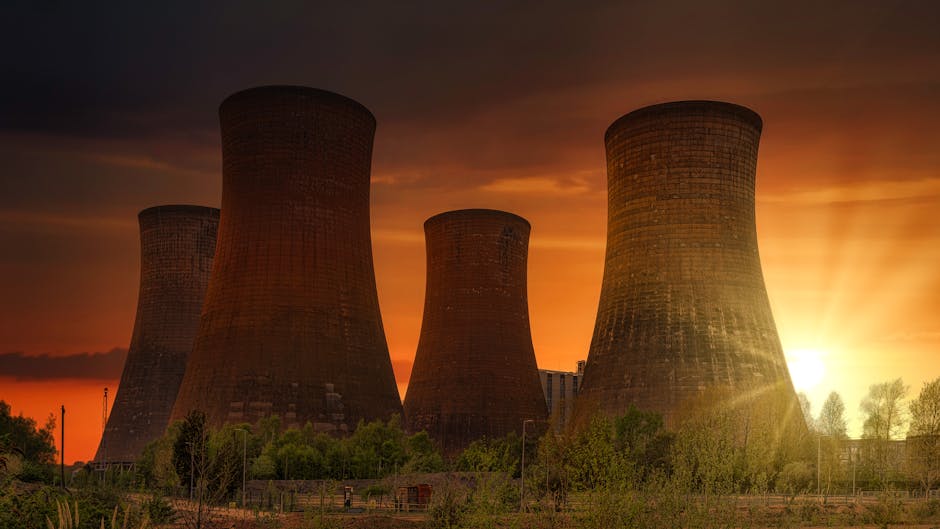
The landscape of energy new technology is witnessing a historic shift toward high-density, reliable power sources. At the forefront of this movement is advanced nuclear energy, specifically the Natrium reactor. Developed by TerraPower, this project recently achieved a massive milestone: the U.S. Nuclear Regulatory Commission (NRC) issued the first-ever construction permit for a commercial-scale, non-light-water nuclear plant.

The Natrium technology is a game-changer for grid stability. Unlike traditional reactors, it is a 345 MW sodium-cooled fast reactor integrated with a molten salt energy storage system. This allows the plant to boost its output to 500 MW for over five hours when the grid needs it most. This flexibility solves a major headache for utilities trying to balance intermittent renewables like wind and solar. According to the NRC Issues Construction Permit for TerraPower’s Natrium Advanced Reactor, the safety review was completed 11% under budget and ahead of schedule, signaling a new era of regulatory efficiency for nuclear power.
While nuclear provides the “baseload” backbone, solar is breaking efficiency records that were once thought impossible. We are seeing the rise of bifacial solar cells—panels that capture sunlight from both sides—combined with perovskite/TOPCon tandem technology. By stacking different materials that absorb different parts of the light spectrum, researchers have achieved a certified efficiency of 32.73%. To put that in perspective, most standard rooftop panels today hover around 20-22%. You can find more info about green tech and how these efficiencies are driving down costs for homeowners and businesses alike.
Efficiency isn’t just about making power; it’s about not wasting it. Buildings are currently the “energy hogs” of our infrastructure, using 74% of the nation’s electricity and racking up $370 billion in annual costs. New energy new technology in building envelopes, smart HVAC systems, and opaque insulation is being prioritized by the Department of Energy to turn these costs into savings.
Long-Duration Storage and Thermal Battery Innovations
One of the biggest jokes in the industry used to be that the sun doesn’t shine at night and the wind doesn’t always blow. But the punchline has changed thanks to Long-Duration Energy Storage (LDES). While lithium-ion batteries are great for your phone or a four-hour grid boost, we need something that can last for days.
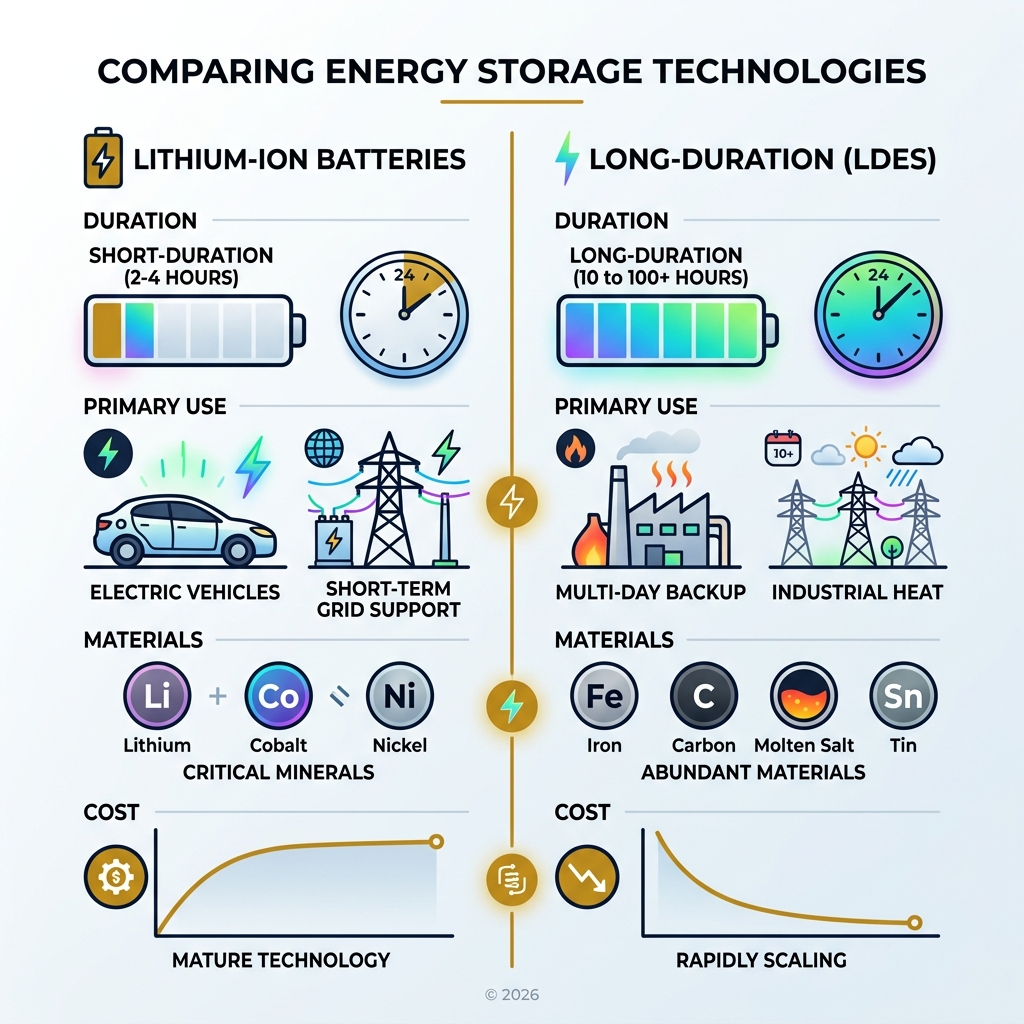
| Feature | Lithium-Ion Batteries | Long-Duration (LDES) |
|---|---|---|
| Duration | 2–4 Hours | 10 to 100+ Hours |
| Primary Use | EVs, Short-term grid peaks | Multi-day backup, Industrial heat |
| Material | Lithium, Cobalt, Nickel | Iron, Carbon, Molten Salt, Tin |
| Cost Trend | Mature, prices stabilizing | Dropping fast with scale |
A standout in this field is Fourth Power, an MIT spinout that has developed a “Sun in a Box.” Their thermal battery stores electricity as extreme heat in inexpensive carbon blocks at a staggering 4,350°F (2,400°C). When power is needed, the system uses thermophotovoltaics (TPV)—cells that convert light from the white-hot blocks back into electricity. This system can hold a charge for over 100 hours with only 1% heat loss per day. As reported in Thermal battery hits 4,350°F, stores electricity as heat for 100 hours, this is significantly cheaper and more reliable than lithium-ion for long-term needs.
We are also seeing the rise of iron-air batteries. Companies like Form Energy are deploying multi-day storage systems that use the literal “rusting” of iron to store and release energy. This technology is crucial for grid reliability and is a key part of the movement toward supply chain reshoring, as iron is far more abundant in the US than the rare minerals needed for traditional batteries. Stay updated with the latest on electric companies to see how these massive batteries are being integrated into our local grids.
Global Policy Shifts and the Energy Trilemma
The “Energy Trilemma” is the balancing act of making energy reliable, affordable, and clean. Historically, you could usually only pick two. However, global policy shifts are attempting to force all three into alignment.
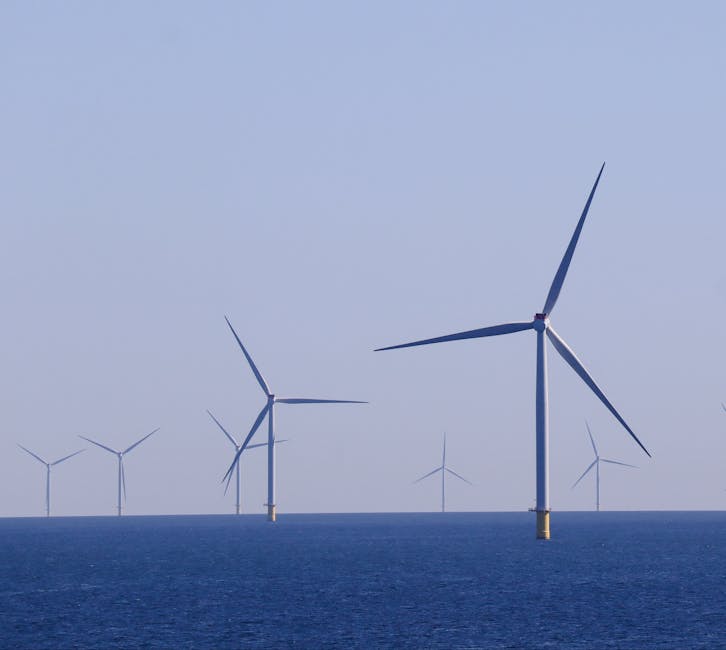
In the US, there has been a pragmatic shift toward energy dominance and security. While the landscape of the Inflation Reduction Act has seen changes, the underlying push for domestic manufacturing remains a priority. We are seeing a race to reshore supply chains for critical minerals to reduce reliance on China, which currently dominates the manufacturing of wind turbines, solar panels, and electrolyzers.
Meanwhile, India is emerging as a renewable powerhouse. The country surpassed its 2030 goal of achieving 40% renewable capacity a staggering nine years early. Projects like the Dhirubhai Ambani Giga Energy Complex are set to house gigawatt-scale manufacturing for solar, batteries, and hydrogen by 2026. This global competition is driving down prices for everyone. For those interested in how this affects the automotive world, check out these insights on EV strategy and how charging infrastructure is catching up to these power gains.
The World Energy Investment 2025 report highlights that despite geopolitical tensions, the momentum behind energy new technology is self-sustaining because it simply makes economic sense.
Scaling Energy New Technology for AI Data Centers
If you’ve used an AI chatbot lately, you’ve contributed to a massive surge in power demand. Data center electricity consumption is set to more than double to 945 TWh by 2030—roughly the total consumption of Japan today.
This “AI hunger” is the secret engine driving energy new technology commercialization. Because the traditional grid can’t keep up with the speed of AI growth, data center developers are turning to “behind-the-meter” solutions. Companies like Bloom Energy are providing onsite generation that allows data centers to run independently of the local utility.
The green tech revolution isn’t just about saving the planet anymore; it’s about making sure the servers don’t turn off. Power availability has now surpassed “proximity to fiber optic cables” as the #1 factor for choosing where to build a data center. This has created a massive business case for LDES, as tech giants are willing to pay a premium for 24/7 carbon-free energy.
Future Frontiers in Energy New Technology
Looking even further ahead, we are seeing “over-the-horizon” developments that sound like science fiction but are already in the prototype stage.
Australian scientists at CSIRO recently achieved a breakthrough with a proof-of-concept quantum battery. Unlike chemical batteries, quantum batteries use the weird laws of physics—superposition and entanglement—to charge. The most counterintuitive part? They actually charge faster the larger they get. While we aren’t at the point of putting them in phones yet, the Australian scientists achieve energy storage and quantum battery breakthrough shows they can operate at room temperature and could eventually allow for EVs that charge faster than you can fill a gas tank.
Beyond batteries, fusion energy is finally moving from “30 years away” to “maybe 10.” Recent demonstrations have achieved net energy gain, where the reaction produces more power than it takes to start. Combined with advanced TPV cells and high-efficiency geothermal (which involves injecting water into hot dry rock miles below the surface), the 2030-2050 roadmap looks incredibly bright.
Frequently Asked Questions about Energy New Technology
What is the most promising energy new technology for 2025?
The most immediate impact will come from Natrium reactors and iron-air batteries. These technologies are moving out of the lab and into the construction phase. Additionally, perovskite solar tandems are expected to begin appearing in high-end commercial applications, offering much more power from the same amount of roof space.
How does new technology solve the energy trilemma?
It solves the trilemma by decoupling clean energy from “luck.” We no longer have to hope the wind blows (reliability) because we have LDES. We don’t have to subsidize expensive fuels (affordability) because the cost of solar and iron-air storage is plummeting. And we reduce emissions (cleanliness) by replacing coal and gas with advanced nuclear and geothermal baseload power.
Why is AI driving energy innovation?
AI requires massive amounts of “firm” power—meaning power that is on 24/7. Since solar and wind are variable, AI companies are the primary funders for energy new technology like small modular reactors and thermal batteries. They are essentially acting as the “early adopters” that pay for the initial high costs of these technologies before they scale for the rest of us.
Conclusion
At Apex Observer News, we are committed to keeping you at the cutting edge of these developments. The world of energy new technology isn’t just a niche for scientists; it’s the foundation of our future economy, our job market, and our daily lives. From the quantum breakthroughs in Australia to the massive nuclear permits in Wyoming, the transition is happening in real-time.
For more deep dives into the tools shaping our world, explore our more info about emerging technologies section. Whether it’s the latest in AI power demand or the next record-breaking solar cell, we’ll be here to aggregate the news that matters most to you.
