

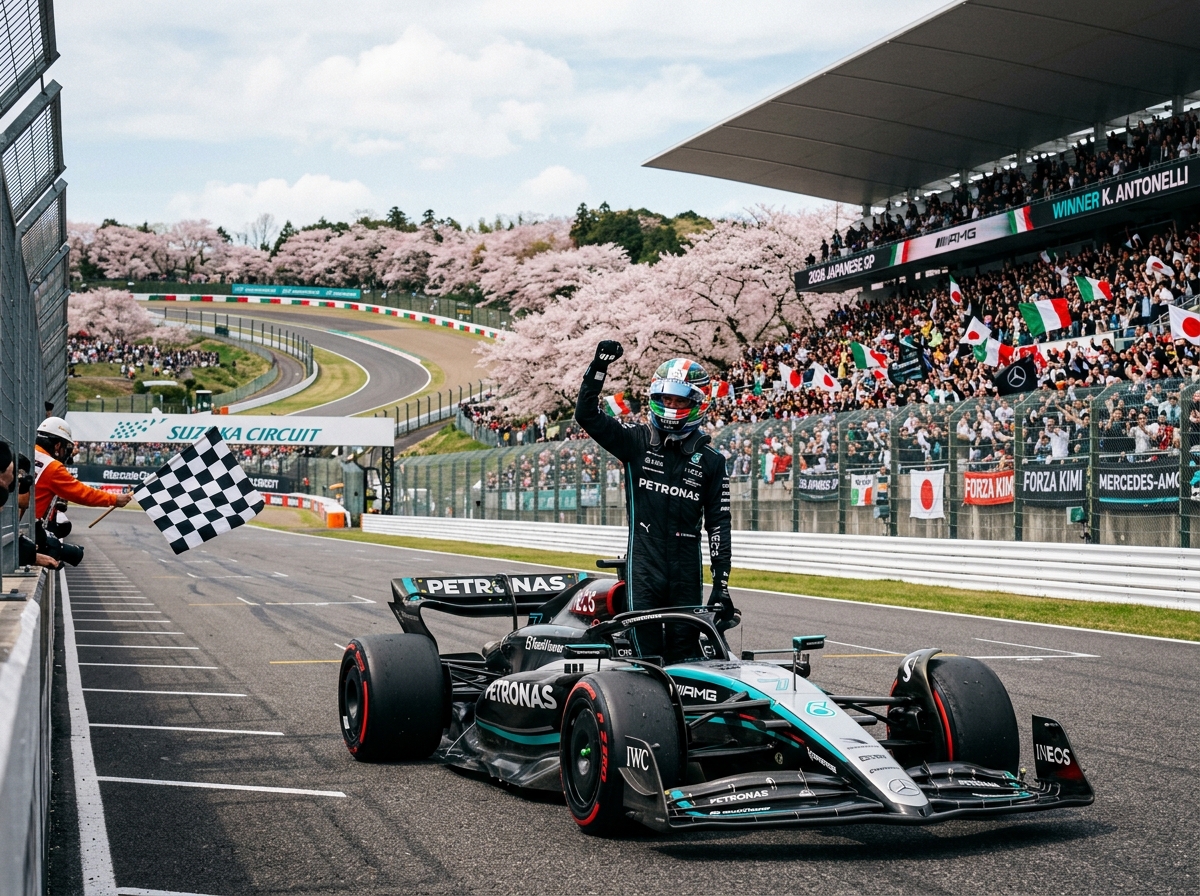
The F1 Japanese GP 2026: Kimi Antonelli Wins at Suzuka
The f1 japanese gp delivered one of the most dramatic races of the 2026 season, with Kimi Antonelli claiming victory at the legendary Suzuka Circuit on March 29, 2026.
Here’s what you need to know at a glance:
| Detail | Info |
|---|---|
| Race Date | Sunday, March 29, 2026 |
| Circuit | Suzuka Circuit, Japan (5.807 km) |
| Winner | Kimi Antonelli (Mercedes) |
| P2 | Oscar Piastri (+13.722s) |
| P3 | Charles Leclerc (+15.270s) |
| Race Distance | 53 laps / 307.471 km |
| Weekend Attendance | 266,000 fans |
| Championship Impact | Antonelli takes the lead — youngest-ever F1 championship leader |
Antonelli started poorly, dropped to sixth on lap one, then put together a controlled, commanding drive to win by nearly 14 seconds. A Safety Car caused by Oliver Bearman’s crash played a key role — and Antonelli made the most of it.
Beyond the race result, the 2026 Japanese GP exposed real pain points in F1’s new regulations. A 200kW power gap between cars caused dangerously high closing speeds. The weekend raised big questions about where Mercedes, McLaren, Ferrari, and Red Bull stand heading into the rest of the season.
Suzuka never fails to deliver — and 2026 was no exception.
I’m Faisal S. Chughtai, a digital strategist and sports tech analyst who has covered the f1 japanese gp across multiple seasons, tracking how regulation shifts and team strategies shape race outcomes at Suzuka. Read on for the full breakdown — from race results and regulation controversies to ticket tips and circuit history.
2026 Race Analysis: Results, Standings, and Major Incidents
The 2026 f1 japanese gp was a masterclass in resilience and tactical execution. While the headlines rightfully belong to Kimi Antonelli, the broader race results tell a story of a shifting hierarchy in Formula 1. Mercedes appears to have unlocked the secrets of the 2026 power unit regulations, while traditional powerhouses like Red Bull are finding the transition much more difficult.
The final classification saw a podium consisting of three different constructors, highlighting the competitive (if somewhat volatile) nature of the current era. Oscar Piastri secured a brilliant second place for McLaren, continuing their upward trajectory, while Charles Leclerc salvaged a third-place finish for a Ferrari team that is still searching for ultimate pace compared to the Silver Arrows.
Below is the breakdown of the top performers from the 53-lap sprint around Suzuka:
| Position | Driver | Team | Time/Gap | Points |
|---|---|---|---|---|
| 1 | Kimi Antonelli | Mercedes | 1:28:03.403 | 25 |
| 2 | Oscar Piastri | McLaren | +13.722s | 18 |
| 3 | Charles Leclerc | Ferrari | +15.270s | 15 |
| 4 | George Russell | Mercedes | +21.445s | 12 |
| 5 | Lando Norris | McLaren | +25.881s | 10 |
For a deeper look at the full classification, including the midfield battles and retirements, you can view the 2026 Japanese Grand Prix Results.
How Kimi Antonelli Dominated the f1 japanese gp
We witnessed history at Suzuka as Kimi Antonelli became the youngest-ever driver to lead the Formula 1 World Championship. However, the victory was far from guaranteed when the lights went out. Both Mercedes drivers suffered from poor getaways; Antonelli found himself bogged down and shuffled back to sixth position by the time the pack reached the first corner.
What followed was a display of maturity that belied his age. Antonelli didn’t panic. He systematically picked off his rivals, utilizing the superior straight-line speed of the Mercedes power unit. A pivotal moment occurred during the Safety Car period. While his teammate George Russell was disadvantaged by the timing of his pit stop, Antonelli managed to save crucial time under the neutralized conditions, allowing him to reclaim the lead.
Once in clean air, the young Italian was untouchable. He built a massive 13.722-second margin over Piastri, securing his second consecutive victory of the season. This win wasn’t just about speed; it was about managing the complex 2026 energy recovery systems better than anyone else on the grid.
Major Incidents and the Impact of 2026 Regulations
The race was not without its “heart-in-mouth” moments. The most significant incident involved Oliver Bearman, whose Haas suffered a terrifying 50G impact crash. This accident brought the Safety Car onto the track and highlighted a growing concern regarding the 2026 technical regulations.
Analysis following the crash revealed a staggering 200kW power difference between certain cars on the grid due to varying battery deployment strategies and engine efficiencies. This led to closing speeds of up to 45km/h between Bearman and Franco Colapinto, creating a dangerous speed differential that the FIA is now under pressure to address.
While Mercedes has clearly emerged as the dominant force with the best overall package, Red Bull’s struggles have become the talk of the paddock. Their chassis issues appear to be preventing them from making the traditional developmental leaps we’ve come to expect from the Milton Keynes squad.
Winners and Losers of the f1 japanese gp
Every race has its heroes and those who would rather forget the weekend ever happened. Here is our take on the winners and losers from Suzuka:
- Winner: Oscar Piastri (McLaren) – Piastri drove a flawless race, holding off a charging George Russell for a significant portion of the afternoon. McLaren has successfully resolved previous power unit integration issues, leapfrogging Ferrari in the process.
- Winner: Alpine – After a disastrous 2025, Alpine’s decision to “sacrifice” the previous season for 2026 development is paying off. Pierre Gasly secured a solid P7, and the team looks comfortably like the “best of the rest.”
- Loser: George Russell – Despite having the fastest car, Russell missed the podium for the first time in 2026. A combination of a poor start and unlucky Safety Car timing left him frustrated in P4.
- Loser: Red Bull & Max Verstappen – The reigning champion’s enthusiasm seems to be draining as Red Bull’s chassis limitations become more apparent. Finishing outside the top five at a track where he has historically dominated is a bitter pill to swallow.
- Loser: Williams – Treating a Grand Prix like a “test session” is rarely a good sign for a team’s competitiveness. Williams struggled for pace all weekend, remaining firmly in the lower midfield.
Planning Your Visit to the f1 japanese gp: Tickets and Logistics
If the 2026 race inspired you to see the action in person, planning for the next f1 japanese gp should start early. The event typically takes place in late March, coinciding with Japan’s world-famous Sakura (cherry blossom) season. This makes for a stunning backdrop, but it also means hotels and transport fill up months in advance.
Attendance in 2026 reached a staggering 266,000 fans over the weekend, a significant jump from previous years. To ensure you get the experience you want, we recommend looking into official ticket and hospitality packages. Options range from General Admission to the ultra-exclusive Paddock Club and Champions Club.
For those wanting the best views of the high-speed action, Grandstands D and E are legendary for their view of the “S” Curves, while Grandstand G offers an inside look at the terrifyingly fast 130R corner. If you prefer to see overtaking, Grandstand I at the Hairpin is your best bet.
You can find more information on the Official 2026 Event Guide to help plan your itinerary.
Essential Travel and Access Information
Getting to Suzuka requires some logistical foresight. The circuit is located in Mie Prefecture, and most fans stay in nearby Nagoya or Osaka.
- Public Transport: This is our strongest recommendation. The circuit is accessible via the Kintetsu Line (Shiroko Station) or the JR Ise Railway (Suzuka Circuit Ino Station). From Shiroko, shuttle buses run frequently to the track.
- Parking: Be warned—all 4-wheel parking tickets for the 2026 event sold out well in advance. There are no on-site sales, so do not attempt to drive to the circuit without a pre-purchased permit.
- Time Zone: Suzuka local time is UTC+9. Make sure to adjust your watches and streaming schedules accordingly!
- Support Races: The weekend isn’t just about F1. Fans in 2026 enjoyed the Ferrari Challenge Japan and the Porsche Carrera Cup Japan. FIA F2 and F3 do not currently travel to the Japanese round.
- Earplugs: While the 2026 engines have a distinct sound, they are still incredibly loud. Earplugs are highly recommended, especially for children, to protect against long-term hearing damage.
The Historical Legacy of Racing at Suzuka
Suzuka is unique. Built in 1962 by Soichiro Honda as a test track for his growing automotive empire, it remains the only figure-eight circuit on the F1 calendar. Its designer, Dutchman John Hugenholtz, originally envisioned a track that crossed over itself three times, though the final version settled for the iconic bridge and underpass we see today.
The f1 japanese gp made its Suzuka debut in 1987. That race famously decided the world championship before it even started, as Nigel Mansell crashed in qualifying, handing the title to Nelson Piquet. Since then, Suzuka has been the backdrop for 13 World Championship deciders.
We cannot talk about Suzuka without mentioning the legendary rivalry between Ayrton Senna and Alain Prost. Their collisions in 1989 and 1990 remain some of the most controversial and talked-about moments in sporting history. Over the years, Michael Schumacher established himself as the master of the track, holding the record for the most driver wins with six victories.
To explore the full timeline of winners and classic moments, check out the History of the Japanese Grand Prix.
Frequently Asked Questions about the Japanese Grand Prix
Who won the 2026 Japanese Grand Prix?
Kimi Antonelli won the 2026 f1 japanese gp for Mercedes. Despite a poor start that saw him drop to sixth, he recovered to win by over 13 seconds, taking the lead in the World Drivers’ Championship.
What is the best grandstand for viewing at Suzuka?
It depends on what you want to see! Grandstands D and E are best for the technical “S” Curves. Grandstand G provides a view of the high-speed 130R, and Grandstand I is the best spot for seeing overtaking maneuvers at the Hairpin.
Is on-site parking available for the 2026 race?
No, all 4-wheel parking tickets for the 2026 event sold out. Organizers strongly urged fans to use public transportation, as no parking spaces were available for purchase at the gate.
Conclusion
The 2026 f1 japanese gp was a turning point for the season. It solidified Kimi Antonelli’s status as a future superstar and confirmed that Mercedes is currently the team to beat under the new regulations. As we look forward to the next rounds of the championship, the technical challenges exposed at Suzuka—particularly the power unit disparities—will likely dominate the conversation in the paddock.
At Apex Observer News, we are committed to bringing you the most accurate and timely updates from motorsport. Whether it’s a deep dive into race strategy or the latest news on driver transfers, we’ve got you covered.
Stay ahead of the curve by checking out the Latest F1 Trends on our main site. The 2026 season is just heating up, and if Suzuka was any indication, we are in for a wild ride. We’ll see you at the next race!
