

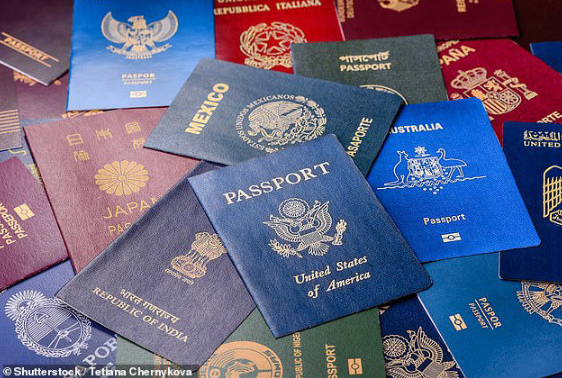
As the end of the year approaches, millions of Brits will be booking their long-awaited 2026 getaway.
In the first six months of 2025, more than 3.8million passports were issued in the United Kingdom.
But what often shocks people is that, despite thousands of potential colour options, more than 90 per cent of the world’s passports fall into just four tones: red, blue, green and black.
According to travel specialist Jamie Fraser from Wildpacks, the logic goes far deeper than people think. ‘People assume every country simply picks a colour they like, but passport colours carry meaning.’
Red often reflects EU identity or historic political ties, blue is widely used in the Americas, green is associated with Islamic nations, and black is chosen for practicality or tradition.
‘As global travel expanded in the 20th century, countries began standardising passports for faster recognition at borders.
‘That meant adopting colours that were visually consistent, dignified and easy for immigration officers to identify quickly.’
And according to printing experts Carrick Signs, there are other factors behind the limited colours.
They say: ‘Darker colours, like navy, black and deep burgundy, hide dirt, scuffs and wear much better than bright tones and that’s essential for a document handled constantly for five to 10 years.
‘But there’s also the manufacturing reality. Passport covers must use highly durable stock with no optical brighteners, have embedded security fibres, anti-tamper laminates, and inks that can’t degrade in UV light.
‘These materials perform better with deep, solid colours. Printers simply can’t guarantee longevity or security if a country chooses a pastel or neon shade.’
The two countries that break the four-colour pattern are Norway, where ordinary passports are salmon pink, and Fiji, where passports are a turquoise colour taken from the Fiji flag.
It comes as the world’s most desirable passport has been revealed, with the UK passport slumping into 35th place in a global ranking.
Nomad Capitalist’s ‘Passport Index’ reveals the top overseas destinations for entrepreneurs and investors.
The annual index ranks 199 countries on five different factors: visa-free travel, taxation of citizens, global perception, dual citizenship, and personal freedom.
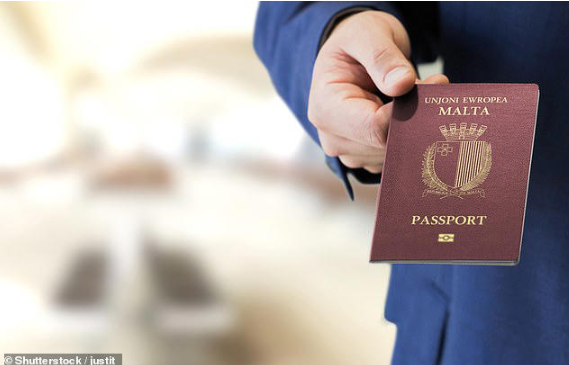
And while the UK dropped to 35th place, the number one spot went to Malta.
Greece, Ireland, and Romania share second place.
The three countries had strong scores in different areas. For example, Greece scored top marks for visa-free travel.
Meanwhile, Ireland ranked well for perception and freedom, and Romania for freedom.
All three received the highest ranking available for dual citizenship availability.
Cyprus rounds out the top five, praised also for its recognition of dual citizenship and its freedom.
