


Why Good Tips for Freelancing Can Change Your Career
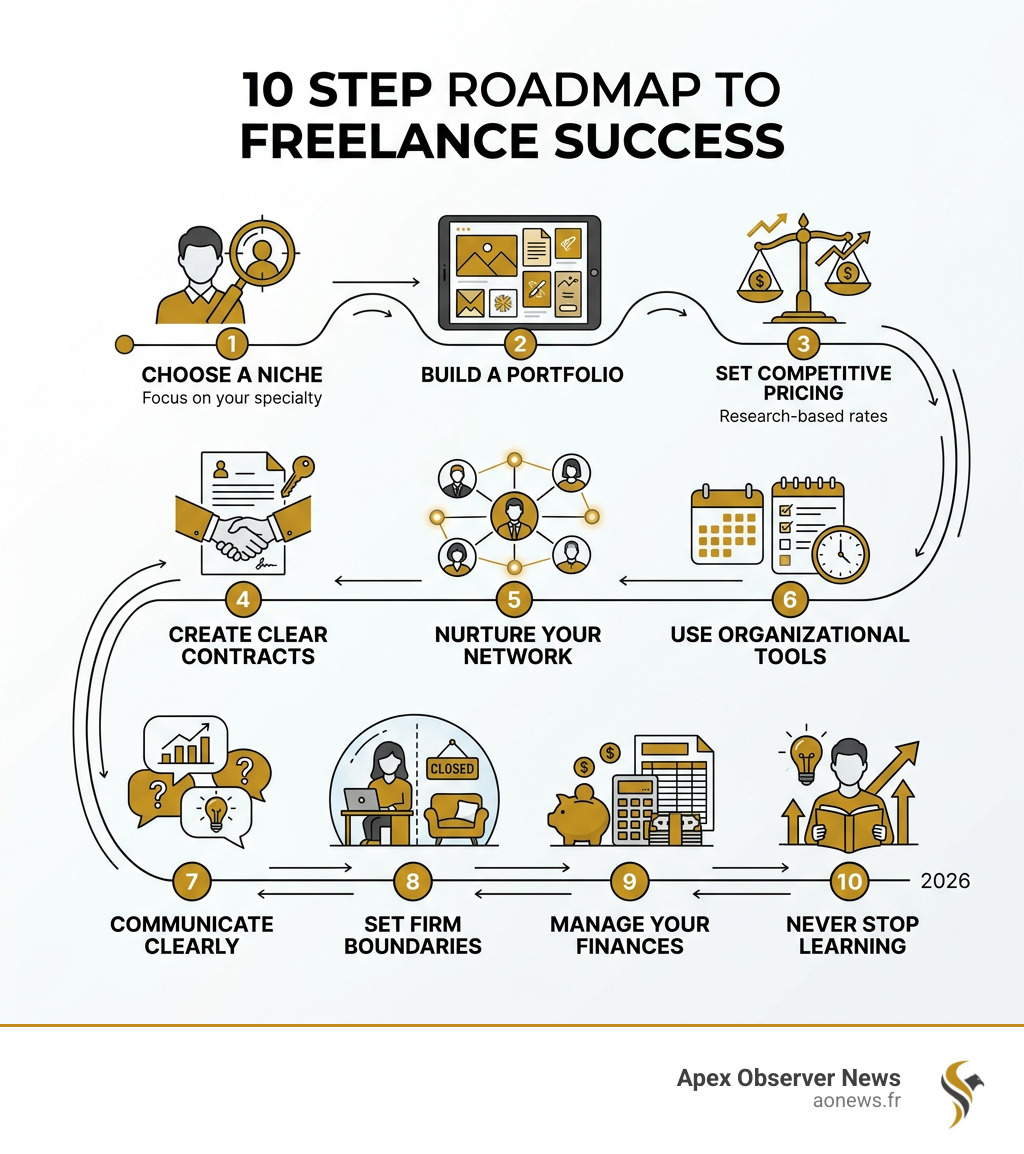
The best tips for freelancing come down to a handful of core habits that separate people who struggle from those who thrive:
- Pick a niche – Specialists get hired faster and paid more than generalists
- Build a portfolio – Even mock projects count when you’re starting out
- Set fair rates – Research the market and never undersell your time
- Use contracts – Always, on every project, no exceptions
- Nurture your network – Most freelance work comes from people you already know
- Stay organized – Use simple tools to track time, tasks, and money
- Communicate clearly – Over-explain your progress; clients reward transparency
- Set boundaries – Protect your time or clients will consume all of it
- Manage your finances – Save for taxes, build a buffer, track everything
- Keep learning – The freelancers who grow are the ones who never stop improving
Freelancing is one of the fastest-growing ways to earn a living. In 2023, freelancers contributed $1.27 trillion to the U.S. economy – up $50 billion from the year before. By 2027, freelancers are projected to make up over 50% of the U.S. workforce.
But the freedom comes with real challenges. There’s no HR department, no paid sick days, and no one chasing clients on your behalf. When things go wrong – a client ghosts you, a project balloons out of scope, or the work dries up – you have to figure it out.
That’s exactly why having a solid playbook matters from day one.
One thing experienced freelancers say over and over: it’s not just what you do, it’s how you do it. The technical skill gets your foot in the door. But communication, reliability, and relationships are what keep the work coming.
I’m Faisal S. Chughtai, founder of ActiveX, where I’ve spent years working across branding, web and app development, digital marketing, and SEO – giving me hands-on experience with the exact tips for freelancing that drive real results in competitive markets. In the sections below, I’ll walk you through the ten most practical steps to build a sustainable freelance career from the ground up.
1. Identify Your Profitable Niche and Skillset
One of the most common mistakes we see beginners make is trying to be a “jack-of-all-trades.” While it feels safer to say you can do everything, the market actually rewards specialists. If a company needs a high-converting sales page for a SaaS product, they aren’t looking for a “general writer”; they want a “B2B SaaS Copywriter.”
To find your niche, we recommend mapping your existing skills against current market demand. Look at platforms like Upwork or LinkedIn to see what clients are actually paying for. High-demand areas in 2025 include AI content editing, data visualization, and specialized technical writing.
If you feel your skills are a bit rusty, don’t worry. You can add certifications to your profile by taking courses on platforms like Coursera or LinkedIn Learning. These badges act as a “trust signal” to potential clients that you have the technical chops to solve their specific problems.
The goal of a niche is to reduce your competition. Instead of competing with millions of generalists, you are positioning yourself as the expert for a specific group of people. If you’re wondering about structured paths to entry, you might explore how to become a freelancer through official initiatives that provide training and mentorship.
2. Build a High-Impact Portfolio from Scratch
“How do I get work without a portfolio, and how do I get a portfolio without work?” It’s the classic freelance paradox. The secret is that your portfolio doesn’t have to consist of “paid” work to be effective. It just needs to demonstrate that you can deliver results.

Here are three ways we suggest building your social proof from zero:
- Mock Projects: Create a “spec” project. If you’re a graphic designer, redesign the logo of a local business or a famous brand. Explain the “why” behind your choices.
- Volunteer Work: Offer your services to a non-profit or a friend’s small business in exchange for a glowing testimonial and the right to use the work in your portfolio.
- Case Studies: Don’t just show a pretty picture. Explain the problem the client had, the solution you provided, and the measurable results (e.g., “This landing page increased signups by 40%”).
Your portfolio is your online handshake. Make sure it’s hosted somewhere professional. While a custom website is great, even a well-organized Notion page or a polished LinkedIn profile can serve as a powerful demonstration of your skills.
3. Master the Art of Pricing and Contracts
Underpricing is the fastest route to burnout. We’ve found that many beginners set their rates based on what they used to make at a 9-to-5 job. This is a mistake because, as a freelancer, you have to cover your own taxes, software, health insurance, and “non-billable” time (the hours you spend chasing clients).
A good rule of thumb is the 80% Rule: If you are winning more than 80% of the jobs you pitch for, your prices are likely too low.
Hourly vs. Project-Based Pricing
| Pricing Model | Best For | Pros | Cons |
|---|---|---|---|
| Hourly | Ongoing admin, consulting | You get paid for every minute | Rewards slow work; capped income |
| Project-Based | Websites, logos, articles | Rewards efficiency and expertise | Risk of “scope creep” if not defined |
To protect yourself, always use a written contract. It should clearly define the “Scope of Work” (what you will and won’t do), payment milestones, and a “kill fee” if the project is cancelled. We also highly recommend collecting a deposit (usually 25-50%) before you even open a Google Doc.
For those in the U.S., don’t forget to factor in the cost of finding health insurance for freelancers when calculating your “minimum acceptable rate.” You are a business owner now, and your rates must reflect that reality.
4. Essential Tips for Freelancing Success in Client Acquisition
Finding your first client is often the hardest part, but it gets easier once you have a system. Don’t just wait for people to find you; you need to be proactive.
Leveraging Your Network for Tips for Freelancing Growth
Believe it or not, most successful freelancers get the majority of their work through word-of-mouth. Start by telling everyone you know—friends, family, former colleagues—exactly what you are doing. Use a simple one-sentence offer: “I help [Target Audience] achieve [Result] through [Service].”
Warm leads are much easier to close than cold ones because there is already a foundation of trust. Keep a simple spreadsheet of your professional contacts and reach out to them every few months just to stay on their radar.
Using Platforms and Proposals as Tips for Freelancing Beginners
When you are using platforms like Upwork or Fiverr, your proposal is everything. Avoid “copy-paste” pitches. Instead, focus on the client’s problem.
- Acknowledge the need: “I see you’re looking to increase your email open rates…”
- Show expertise: “In a similar project, I used [Strategy] to boost engagement by 20%.”
- Call to action: “Are you free for a 5-minute chat to discuss your goals?”
If you’re using specific gig-based sites, learning how to promote Fiverr gigs to maximize orders can give you a significant edge in the search rankings.
5. Streamline Your Workflow with Professional Tools
As a freelancer, you are the CEO, the worker, and the accountant. Without the right systems, you’ll spend more time on admin than on the work that actually pays. We recommend building a “tech stack” that keeps you organized:
- Task Management: Todoist is excellent for keeping track of daily to-dos across different clients. For more complex projects, Trello or Asana are industry standards.
- Time Tracking: Even if you don’t bill hourly, use Harvest or Toggl to see how much time you’re actually spending on projects. This data is vital for pricing future jobs accurately.
- Finances: Tools like QuickBooks or FreshBooks make it easy to send professional invoices and track your expenses for tax season.
- Communication: Use Zoom for face-to-face meetings and Google Docs for real-time collaboration.
If working from home feels isolating or distracting, we’ve found that coworking spaces are a game changer for freelancers. They provide a professional environment that helps separate “work life” from “home life.”
6. Maintain Boundaries and Prevent Burnout
The biggest lie about freelancing is that you’ll work less. In reality, when your office is your living room, it’s easy to work all the time. According to Statista research on the growing freelance workforce, millions of people are entering this space, and the ones who survive long-term are the ones who set strict boundaries.
Set “office hours” and stick to them. If a client emails you at 9 PM on a Saturday, you don’t have to answer until Monday morning. If you respond immediately, you are training them that you are available 24/7.
Also, build a financial buffer. The “feast or famine” cycle is real. Having 3–6 months of expenses in a separate savings account will give you the “courage” to say no to “PITA” (Pain In The A**) clients who don’t respect your time or value.
Frequently Asked Questions about Freelancing
How do I start freelancing with no experience?
Focus on learning one high-demand skill first. Use free resources like YouTube or paid ones like LinkedIn Learning. Create “practice projects” to prove you can do the work, and start by pitching to smaller clients or non-profits to build your initial reputation.
How do I handle non-paying clients?
Prevention is the best cure. Always have a signed contract and always take a deposit upfront. If a client refuses to pay, send a formal, professional follow-up. Using the “passive voice” can sometimes help lower defensiveness (e.g., “It appears the invoice hasn’t been settled yet” rather than “You haven’t paid me”). If all else fails, milestone payments ensure you’ve at least been paid for the work you’ve already completed.
When should I raise my freelance rates?
We recommend evaluating your rates every six months or whenever you are consistently booked out. If you’ve gained a new certification, learned a new tool, or have a string of successful case studies, your value has increased. Most clients expect a small annual increase, just like a standard cost-of-living adjustment.
Conclusion
Freelancing is a marathon, not a sprint. It requires a shift in mindset: you are no longer just an employee; you are a business owner. By following these tips for freelancing, you can move past the initial “terrifying” phase and build a career that offers true freedom and stability.
At Apex Observer News, we are committed to helping you stay ahead of the curve in the ever-evolving gig economy. Whether you are looking for the latest tech tools or career strategies, we’ve got you covered. Success in this field comes down to consistency, quality, and a willingness to keep learning.
Ready to take the next step? Explore more freelancing resources on our site to keep your momentum going. The freelance revolution is here—it’s time to find your place in it.
Pakistan’s Freelance and Gig Economy on the Rise
